Showing posts with label Books. Show all posts

Wednesday, October 08, 2008

Zogby Poll Mechanics

If you are a politics buff like me, or get your news from the Drudge Report, you probably closely follow the Zogby tracking poll, along with other such polls (the Gallup is the one featured most often). But today I saw a sentence in your release that made me say Whoa!!

The telephone tracking poll shows neither candidate with a clear advantage in the national horserace


What are the magic words? Telephone tracking poll. News flash! Telephone tracking polls don't work! One, you only select voters with phones, bias the samples for people who stay at home during the day or answer the phone ... it's very poor science! And polling is a science!


In this season of statistics, I'd like to recommend one of the best books you can read. The 1954 classic, How to Lie with Statistics is a fantastic guide for the layperson on ways companies and politicians distort statistics to make their case. And no, you don't have to be math-savvy to understand the book! In fact, the telephone poll analysis was something I read in that book years ago.

Wednesday, January 09, 2008

The Indian Expert on the Hoods


Columbia university sociologist Sudhir Venkatesh's work formed a chapter in the book, Freakanomics. Now he's got his own book, Gang Leader for a Day. While I haven't read the book, this interview reminds me how interesting his work is. Think: if drug dealers are so successful, how is it that most live with their mother?

As I read the interview, it is sad to see how much we miss with a merely criminal view of gangs, ignoring the social causes.

An excerpt:
There is significant exposure to lead and asbestos and extremely poor nutrition. One of the most jaw-dropping experiences I continue to have is to walk into a grocery store in the inner city. There's a lack of fresh food, decent food.


And another:
It's depressing to see the cycle of failure and the reproduction of poverty. The typical story goes like this: Job is going well, then their kid gets sick. They start missing work, then they get fired. It just makes you want to scream. We're talking about the folks who are trying to help themselves, and they can't do it. That's another kind of sadness.

Monday, December 31, 2007

Book of the Day: The Third Wave

Alvin Toffler's classic, 'The Third Wave' presents a fascinating study of the forces that shape society today and will reshape the future. If you're wondering what the waves are, the first was agriculture, the second was industrialization and the third is the knowledge revolution. Even though it was written back in 1980, it offers a convincing argument for the shape of things to come. While Toffler's predictions aren't always spot on, the general principles are seen to be in play. Best of all, once you read this, you can read his later work, especially his latest book called 'Revolutionary Wealth'.

Footnote: The challenge if you plan to buy this book is finding a classic edition. The mass paperbacks available in B&N features much too small a print for my liking!

Tuesday, July 10, 2007

Book of the Day: All Over But the Shouting


The Pulitzer-prize winning journalist talks about his growth from Ricky of rural Applachia, born into poverty of an alcoholic father and a mother who did her damnest to do right by her kids, to become a famous (ok, he later became infamous, but that's another story) writer for the New York Times. This story will move you, make you laugh but also paint an incredible picture of what the rural South is. Ricky's honesty at times in unnerving, and sometimes finds a quest for your own true emotions that can at times be discomforting. A must-read!

Amazon link

Tuesday, June 26, 2007

A Potrait of Lee

Interesting article on how the Confederate general, Robert E. Lee wasn't quite what he's made out to be. He did believe in slavery and was quite harsh with his slaves. Hmm, add one to list of books to read.

Incidentally, a very good historical piece is Setting the World Ablaze, John Ferlig's bio of the real George Washington, Thomas Jefferson and John Adamns.

Saturday, February 03, 2007

Contemplating Death ... and Life

The last 24 hours have been filled with thoughts on the end of the road. No, I'm not suddenly missing my Prozac or any such event that may cause concern. Rather the current state of introspection has been triggered by the news of the passing away of a former fellow graduate student, who I'll refer to simply as L for privacy.

L was a charming young girl from Africa, greeting whom was part of my morning ritual when I got in to work. That someone in that position, a seemingly heathly woman no more than a few years ahead of me, could have her presence so suddenly terminated is enough to jolt you. And that got me thinking, if I could look back at my life, in some other world, if you will, what would I see? I remember reading somewhere that death is a funny event, because you know it will come, and yet you're never ready for it. But at least people of a certain advanced age spend time contemplating the issue. Here I am, in what might consider the prime of my life, and yet who knows what fate awaits me.

No, this isn't some depressed cry about not wanting to go. Rather it is a realization of the somewhat sober fact that my life hasn't amounted to that much. If I were to pass, how would the world be without me? Save my family, I dare say not by much. To be sure, friends will expend some tears remembering how life was, but as time goes by, I wouldn't expect too many people to notice much of a change.

And maybe that's how it's supposed to be. People die all the time, life is about moving on. I try to live my life trying to make sure that people never shed a tear on my account, so why should death be different? Ah, but I think that's where some of us have the same affliction as presidents, the need for a legacy!

Knowing death is coming has an interesting effect - it gets you to contemplate life. This idea is not new; in fact, it's one of the reasons I love the book 'Tuesdays with Morrie' (which you have not read is an absolute must-read!) But the death of someone so much like you tends to get your attention and make you focus. There's a Hindu prayer that seeks the Knowledge to transcend from death, not in a bodily sense but rather to transcend the body. So maybe in that spirit, it's only fitting that death of a body becomes a catalyst for renewal. What more fitting memorial than a pledge to reform your life?

"Reform your life" sounds like something an evangelical might say in a religious context. And yet the reality is that the vast majority of us, including yours truly, are living immensely mediocre lives. Now the vision of a reformed life might differ - reactions to the impending mortality of our existence triggers pronouncedly different responses. Some choose to embrace their passion, be it art of sport, choosing to leave their imprint for generations to come. Others opt instead to live every remaining moment seeking out the greatest joy that can be sought, in the form of food, spirit, adventure, or embracing the unaccepted.

The way forward for me, I believe is to try and improve my societal footprint. That word has been used in an environmental context, and certainly that is important, but the idea that mortality could come sooner helps me realize all those aspirations I once had, eventually consigned to the heap of impractical, as I embraced society's ideas on money and love, and the sensual paradigm (our contemporary emphasis on sense pleasures, rather than higher ideals). The character Justin Moreward Haig, in the not-truly-fictional novel 'The Initiate', advises a man who has left his wife of many years for her infidelity, that a fool is one who, because of his vanity, doesn't mind being considered a hero, while a hero is one who, because of his lack of that attribute, doesn't mind being considered a fool. What then do you call a man who throws his beliefs for the voice of "reason"?

Of course, the great challenge is memory. Moved by the death of a close friend or loved one, it's easy to pledge action, but as anyone who has ever made a New Year's resolution knows, a pledge isn't really that much...

Wednesday, January 31, 2007

Book of the Day

Just yesterday, I recommended Ruby Payne's A Framework for Understanding Poverty to a former student and now fellow grad student (hmm, when your students become your peers, maybe it's time to graduate already?) Payne's extraordinary book is aimed at middle-class teachers to understand that poverty is much more than a lack of money, but I think the book does an extraordinary job of understanding the choices people, and not just those in poverty, make based on the resources at their disposal. I'm a strong believer that people are shaped by environmental cues, and this book helps remind me that people's behavior isn't always an indication of a rational choice, but often a function of learned behaviors (in the book, Payne talks about the "rules of being poor", but you could extend this to just about any situation)

Saturday, January 20, 2007

Book of the Day

The Initiate by Cyril Scott. This has many things a prospective reader may not like - archaic language, New Agey references, an excessively reverential style quite alien to the average American reader ... and despite all that, this book, if you are open to it, will blow your mind at times. The "Initiate" Justin Moreward Haig lives in the belief that it is possible to fashion a better life by simply changing your perspective - something that over the years I've had to remind myself.

Wednesday, December 06, 2006

Quote of the Day

Jagdish Bhagwati, professor at Columbia University and author of the book 'In Defense of Globalization', on the fear of the deficits with China, and calls for tariffs on Chinese goods:

The Chinese surplus is cited as the cause of the U.S. deficit. This is a non sequitur. If they were to revalue, and our excess spending through the budget deficit were to continue, our deficit would continue but be directed to other nations than China. China, and also India, are such large countries and rapidly growing economies that they inculcate unjustified fear.

Friday, November 17, 2006

Fast Food Nation: The Movie

I'm looking forward to the release of the movie version of Eric Schlosser's 'Fast Food Nation '. I loved the book, about the various facets of our fast food chains, from their meat handling practices to their pursuit of a temporary workforce, to what the implications of this culture are on our landscape. I am especially curious about the movie because it's fiction rather than a documentary. The International Herald Tribune gave it a pretty positive review, and I think so did NPR. This movie is currently playing in a theater near you.

Friday, September 01, 2006

Interview with Warren

Wow, it has been over 3 weeks since I blogged! My life has been crazy busy recently, but I do hope to getting back to being somewhat frequent with this blog.

I read this article with Elizabeth Warren, author of the fascinating book The Two-Income Trap: Why Middle-Class Mothers and Fathers Are Going Broke.While I have read part of her book and now the central thesis, this fact still stunned me:
The data show that more than half of the families who file for bankruptcy do so in the aftermath of a serious medical problem. And three quarters of those people have health insurance at the onset of the illness or accident that ultimately landed them in bankruptcy. Sometimes it's hospital bills, but more often, it's about co-pay, deductibles, uncovered treatments, drugs, rehab, supplies, all the things that aren't covered by insurance. So part of the answer is that the financial impact of a serious medical problem goes beyond hospital bills. Lost jobs, drugs, physicians, rehab, health supplies. It's expensive to get sick in America today—too expensive for the average family.

Tuesday, July 04, 2006

History Repeats Itself?

You've been hearing it all the time recently - the rise of India and China, how the US is losing out to the competition, how the Asian Tigers are where all the action, and profits, are. Oh, and China is manipulating it's currency, and if we just impose anti-dumping tarrifs on Chinese imports, American manufacturing will be A-OK. Well, in line with my recent obsession to learn from history's lessons, I have been reading (ok, only a few pages at a time) Bill Emmott's historic book, 'The Sun Also Sets'. Why historic? Because writing at the height of the Japanese boom, he called for a collapse in the Japanese economy. OK, I haven't gotten to that part, but it amazes me how much alike the Japan story of those days is to India and China today - booming economies, increased consumer spending and the wealth effect, speculative asset bubbles in stocks and real estate ... Oh, and let's not forget Washington politicians accusing the Japanese of manipulating the yen rather than tackling America's self-made problem with trade deficits.

To be sure, there are several differences between the Japan of past and India and China today, not least of which are size and demographics. Nevertheless, the next time you come across a story suggesting you learn Chinese, you may just want to pass.

Wednesday, June 14, 2006

The Motorcycle Diaries

This last weekend, I saw the wonderful movie, The Motorcycle Diaries, a dramatization by Che Guevara of the roadtrip that changed his life. While I don't agree with all that Che did in his life, the movie is very moving, and gives pause even to a rabid capitalist like me. It helps to put in perspective the significance of electoral wins by Evo Morales, the indigenous cocoa-grower who won the presidency of Bolivia. Don't get me wrong - I think am a strong believer in free markets ... I have seen even modest reforms alleviate poverty in India, a poverty sustained by a bureaucracy for half a decase. In fact, governments in some cases can be far more ruthless than any corporation.

Anyway, this thoughtstream has just motivated me to add yet another book to my "wishlist" of books I intend to read in the next few weeks/months - Hernando De Soto's The Mystery of Capital. I had heard de Soto a long time back being interviewed by Bill Moyers, and found myself riveted.

Saturday, June 03, 2006

Book of the Day

My pick for Book of the Day is Suburban Nation: The Rise of Sprawl and the Decline of the America Dream - Andres Duany, Elizabeth Plater-Zyberk, Jeff Speck. The authors are architects who designed several sensible communities, and argue persuasively that the current design of suburbia is fundamentally flawed, and seek to take us back (and forward) to the days when communities were not zoned residential and commerical, where pedestrian-friendly designs meant you didn't drive to the store, where traffic jams are nonexistant because of the dispersion of the road network (where all traffic doesn't feed into a collector), accident rates are significantly lower, and most important, where residents can feel a sense of community, where rich and poor live in the same neighborhood. The book drives these points home with several photographs of communities good and bad, and had it not been the pangs of hunger, I may never have put the book down.

Monday, May 29, 2006

Radio Nuggets

I took a little road trip yesterday, and when you spend 5 hours on the road and listen to as much talk radio (no heavens, not Rush Limbaugh!) as I do, you learn a lot of interesting information. Here are some snippets of things I remember:

  • According to Dr Kathleen Hall, founder and President of the Stress Institute, studies have showed that stress levels are sometimes higher in people stuck in traffic than fighter pilots in combat!
  • I heard an interview with James Loewen, author of Lies Across America: What Our Historic Sites Get Wrong. The interview was by a local (northern VA) station, and focused mostly on the inaccuracies in several monuments in Virginia and DC, but was fascinating. I intend to add this book to my "wishlist" reading list of books I intend to read in the near future.
  • Good suggestions for interviewing and looking for jobs (which I'm not doing in the near future!) from Ford Myers of Career Potential, including trap questions to skip over and negotiating.

    Well, those were all I could remember for now. Hope the websites will provide you with good information.
  • Sunday, May 07, 2006

    Why So Silent?

    There are times in a man's (and yes, a woman's too) life when very public musings are abandoned for very private introspections, and this time is one such in my own life. I hope the adherent to this blog is not disappointed by the lack of activity on this brimming bazaar of cyberspace - rest assured, my rants will continue with ever more fervor when this phase passes.

    In the meanwhile, I thought I'd share a list of books I'm currently reading (some of which are listed on the panel on the right under 'Recent Book List', others which aren't), as well as list a 'wishlist' of books I intend to read. If you wonder how it is that a person could possibly read multiple books at the same time, it springs from my association of books with friends. Sometimes you desire a chirpy companion, at others your heart is warmed by a passionate friend, while there are moments when your mind is sent on an exploration by the philosophies of some.

    I invite you all to suggest books that you have found interesting or personally enriching, by using the comment feature of this blog.

    Current Reading List
  • American Vertigo: Traveling America in the Footsteps of Tocqueville - Bernard-Henri Levy
  • Setting the World Ablaze: Washington, Adams, Jefferson, and the American Revolution - John Ferling
  • Downsize This! Random Threats from an Unarmed American - Michael Moore
  • Empire of Debt: The Rise of an Epic Financial Crisis - William Bonner, Addison Wiggin

    Wish List
  • Democracy in America Alexis de Tocqueville
  • Hunger of Memory: The Education of Richard Rodriguez (want to read a second time!)
  • Me Talk Pretty One Day David Sedaris
  • Saturday, April 22, 2006

    Empire of Debt

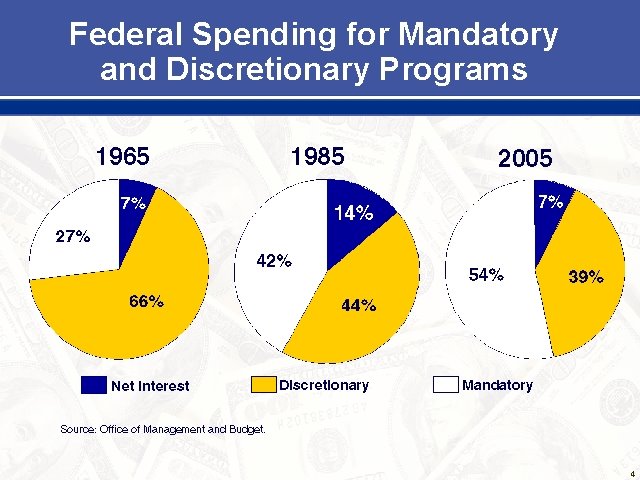
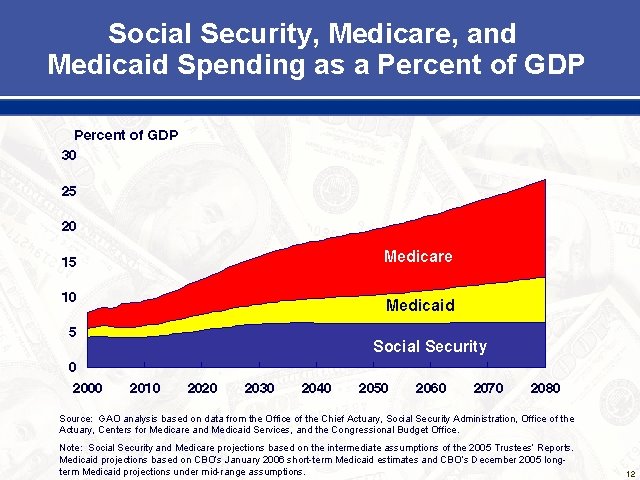
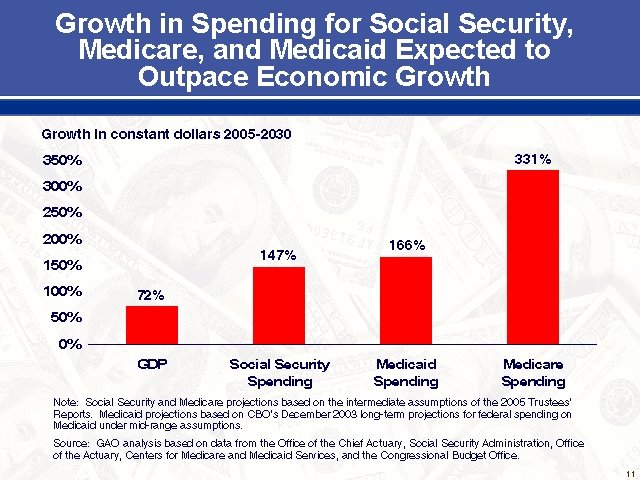
    Earlier this week, I was reading a very interesting book called 'Empire of Debt', where the authors fret over rising debt and arrogance in the US, drawing parallels to the decaying of the Roman empire. While I'm not sure I completely buy all their arguments or even their tone, it does make for a fascinating read and good perspective. But a quote from David Walker, the Comptroller General of the US, got my attention, so I tracked down a presentation he gave for some similar numbers. The images below are slides in a talk he gave to the National Conference of State Legislatures on April 8, 2006.


    I have heard about the Social Security and Medicare crises, but this really helps to bring home the fact that in fact our debt burden is largely one of entitlement spending. (OK, admittedly any model that goes out to 2080 isn't the most reliable, but still anything remotely close to a quarter of GDP's got to make you sit up and take notice)

    I was at a talk by Dr Peter Rodrigeuz of the Darden School of Business at the University of Viriginia earlier this week, where he explained why the changes in demographics in the US and Europe would require them to renegotiate social contracts. It appears that the Hon'ble David Walker's suggesting we may have to do the same.

    Saturday, March 04, 2006

    Nuclear vs Renewable

    Even as President Bush inked a historic nuclear deal with India, I received an e-mail from the Worldwatch Institute, an environmental think-tank, arguing that the deal was reckless on every score. In the past, I have read with some interest reports put out by the Worldwatch folks, but possibly because of self-interest, I read this e-mail a lot more critically and found it replete with flawed logic and lies. (As an aside, every person should read the 1954 classic book 'How to Lie With Statistics').

    Here is just one instance of this:

    Globally, the nuclear construction business has been in decline for more than two decades. Worldwide, nuclear power is growing at an average rate of less than 1 percent per year. By contrast, renewable energy--wind, solar, and biofuels--is on a growth surge, averaging annual expansion rates of 25-35 percent, as President Bush noted enthusiastically in speeches in Colorado and Michigan last week. Total investment in the world's renewable energy sector reached $30 billion in 2004, according to the 'Renewables 2005: Global Status Report'.

    Well yes, it helps to have a really small number to grow a lot. Nuclear power supplies an estimated 8% of the world's energy needs, 27 quadrillion BTU, according to the US Department of Energy. Geothermal, wind, biomass and solar and other sources supplied about 6 quadrillion BTU. In the US, nuclear power supplies about 8 quadrillion BTU per year, while biomass under 3 quadrillion BTU, and solar and wind about 0.1 quadrillion BTU or less. And let's not forget the pressures put upon the nuclear industry that have essentially killed the industry.

    Look, I'm a environmental engineer and a bit of a tree-hugger myself, but we cannot hope that biofuels and solar and wind sources are going to come close to tackling our energy needs in the near future. Nuclear is an option, one that produces low emissions and can be safe with adequate safeguards, and we need to embrace it, rather than have think-tanks scare people with snake oil science!

    Saturday, February 18, 2006

    Dell Theory and Oil Security

    Wow, the Master Thug Hugo Chavez has just threatened to stop exports to the US if the US keeps pissing him off. Big threat when Venuzuela is one of the big sources of American oil consumption! Is he serious? Can this be a threat?

    Thomas Friedman postulated in his book 'The World is Flat' what he called the Dell theory - essentially no two countries that make parts for a Dell computer will go to war. Essentially, it means economics beats rheotoric every time, so sleep easy because markets are at work. I'm a great believer in free markets, and think they are a better system than any bureaucrat-controlled one. But there are limitations, and one of them is that when markets are not truly free, we have some issues.

    What do I mean? When a country is ruled by a despot or a "democratically elected" leader who thrives on sentiment rather than performance, we have an issue. The argument is that no leader would take such an economically disastrous step for fear of losing the next election, but the reality is that leaders in many such countries either do not have to worry about elections, or can sway an uneducated public with false hope and rheotoric.

    We love to wax about the incredible promise of democracy, and it's one I truly believe in. But it requires people to make unemotional choices, and think of the consequences of their choices, as President Bush aluded to following the Hamas election. The reality is democracry after democracy elects leaders who will bring misery on them, all on the promise of justice or just sticking it to the US or the world (even as they take US aid!)

    So should we be worried about the Chavez threat? Absolutely. It underscores a point I made in a previous blog post - the major sources of oil are far fewer than we'd like and in countries who aren't necessarily full of warmth for us. I'd say let's pull out those plans for the nuclear power plants! There have been many safety concerns, but if we don't try to penny pinch, we can build safe reactors that make us safer (in energy terms at least).

    Sunday, January 15, 2006

    Stupid in America

    John Stossel is simply one of my favorite op-ed type journalists. His latest, aired this Friday on 20/20 on ABC, was a hour long piece called 'Stupid in America'. He rips up our failing public school systems which, despite spending a record-breaking $10,000 a student a year, still ranks 25th out of 40 countries that took an international standardized test. Ahead of us - South Korea (No. 2), Poland, Latvia - not exactly rich countries. Stossel blames public school monopoly and unions for the mediocre performance.

    He's clear to point out that there are great teachers, but our system does nothing to reward them. Teacher unions have consistently fought a merit-based system. In fact, shockingly, in New York, there are school districts with sex offenders who cannot be fired because of union-negotiated contracts, and desperate school districts have a seperate building to house them, paying them for no work because they are so dangerous to children.

    I agree wholeheartedly with Stossel's assertion that competition will help. I've seen it in my lifetime in my home country of India, where horrendous goverment-run loss-making businesses have thrived when privatized, or even when private competition has forced a change of the inertia that dominates their being.

    Opponents of vouchers will inevitably point to some study that suggests that charter and private schools are not much better. But that's not the point. If a charter school is no good, it will fail, it will have to shut down. The consumer will dictate if the school survives or not. The fact that 70% of charter schools have waiting lists at least as long as their enrollment suggests a great demand exists.

    Vouchers will benefit the poorest the most, but help the middle class too. In their eye-opening book, The Two Income Trap Elizabeth Warren and Amelia Tyagi argue that the biggest predictor of bankcruptcy was not wasteful spending using credit cards, but having children. Why, you ask? Parents desperate to put their kids in good schools are forced to try to buy a house in a good school district, overly leveraging themselves in the process. In fact, here's an excerpt from James Glassman in Reason magazine:
    Critics accuse charters of "skimming" the best students from public systems, which is often a coded way of claiming they have predominantly wealthy, white students. But the Advantage school's large minority student body is actually pretty typical for charters. A study released last May by the U.S. Department of Education found that 48 percent of charter school students are minorities, compared with 34 percent for all public schools nationwide. In Arizona, the study found that 45 percent of charter students come from families with incomes low enough to qualify for the free or reduced-price lunch program, compared with 40 percent for all public schools in the state. Nationally, 13 percent of charter school students are in special education programs, vs. 10 percent at regular public schools.

    It's time to end this silliness, and support school choice. If public schools are better, they will survive and become stronger. If they are failing, we can celebrate the transition of students to better schools.