So it now looks like all the minimum wage initiatives have or will pass - in Arizona, Colorado, Missouri, Montana, Nevada and Ohio. And voters in these states can pat themselves on their backs, deluding themselves that they have moved millions into a better life. Too bad it isn't true.
The whole argument in favor of raising the minimum wage has been something like this - an employee who earns $5.15 an hour and works full-time earns only $10,712 a year, which is too little. There is then this image that somehow huge swathes of people make do on $10,712 a year, often a guy supporting a wife and a few kids - truly a tragedy!
Unfortunately, it's a big hoax! According to the BLS (yes, I spend my spare time digging around in these places!), only 1.4% of all full-time workers make at or below the minimum wage. 71.9% of those workers are in the leisure and hospitality industry, where tip income, not wages, dominates take-home pay. That alone means that the targeted group is about 0.4% of employees. But wait, there's more:
6.3% of minimum wage earners are below the age of 25, a good number of whom are possibly high school or college students.
62% of minimum wage earners have never been married, while only 24% are currently married.
Ok, and save the best for last. You know all the hoopla of how the minimum wage adjusted for inflation is the lowest since 1955. I don't know if that's true, but here's what BLS data tells us ...
The percentage of hourly paid wage earners earning at or below the minimum wage has fallen from 13.4% in 1979 (and 15.1% in 1980) to a mere 2.7% in 2004!
Even more worrying than merely the increase in minimum wage is that the minimum wages are tied to inflation, with no upper cielings (except in Nevada, where the increase is capped at 3%). That means if, say oil prices surge, we could have a cost push inflation spiral that could result in stagflation!
Showing posts with label Minimum Wage. Show all posts
Showing posts with label Minimum Wage. Show all posts
Wednesday, November 08, 2006

Wednesday, October 18, 2006
Say No to a Minimum Wage
I have a new journo who I like - Tim Worstall of the Technology, Commerce and Society or TCS Daily. His latest offering, Spinimum Wage is a fascinating critique of the much-hyped letter from economists demanding an increase in the federal minimum-wage. He points to studies suggesting that the minimum wage is a relatively inefficient instrument to alleviate poverty, when compared with other federal programs. The reason: very few of those in poverty actually work full-time. Those few who do would move out of poverty with a minimum wage hike, but they would lose federal benefits such as Medicare. The net result: zilch! But no, actually negative, because the elevated costs would cause a reduction in the number of jobs available.
Liberals love to crone about how great Europe is, and how the US needs to be more like them, never mind the economic prosperity and low unemployment rates enjoyed by those of us on the right side of the ocean. In another piece here, Worstall points to data from the liberal Economic Policy Institute to show that for all the cries of how bad the poor in America are, the poor in America perform comparably to those in Europe. True, the disparity is greater, because the rich in America do so much better, but switching to a repressive regulatory regime like Germany would not improve the lot of the poor in the US, only serve to make the rest of the country see their standard of living to come down. Oh, and take this:
Liberals love to crone about how great Europe is, and how the US needs to be more like them, never mind the economic prosperity and low unemployment rates enjoyed by those of us on the right side of the ocean. In another piece here, Worstall points to data from the liberal Economic Policy Institute to show that for all the cries of how bad the poor in America are, the poor in America perform comparably to those in Europe. True, the disparity is greater, because the rich in America do so much better, but switching to a repressive regulatory regime like Germany would not improve the lot of the poor in the US, only serve to make the rest of the country see their standard of living to come down. Oh, and take this:
Wouldn't it be interesting if we were urged to adopt some other Swedish policies? Abolish inheritance tax (Sweden doesn't have one), have a pure voucher scheme to pay for the education system (as Sweden does), do not have a national minimum wage (as Sweden does not) and most certainly do not run the health system as a national monolith (as Sweden again does not). But then those policies don't accord with the liberal and progressive ideas in the USA so perhaps their being glossed over is understandable, eh?
Thursday, September 07, 2006
The Lie of Diminishing Wages
The other day, I was listening to the McLaughlin Group on PBS, and Eleanor Clift of Newsweek (not exactly my favorite journo!) made a claim that workers are getting screwed, and after adjusting for inflation, the average worker earns less than what he/she did in 1973. I immediately thought this was a stunning claim that, if true, would have me question the merits of the capitalist society we live in.
Time allows a more rational analysis. First, why 1973? It seems an arbitrary starting point. Any time anyone makes a claim relative to a murky baseline, be suspicious ... be very suspicious. So I used the Bureau of Labor Statistics web site to probe the data and produce the graphs used in this post. (All data is for the duration that earnings data is available)was dramatic
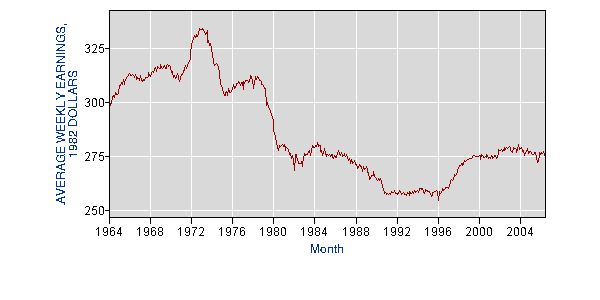
The first graph is a plot of the average weekly earnings in 1982$ (that is correcting for inflation). Now it becomes obvious why Clift uses 1973, it was the year of peak weekly earnings. Ok, but isn't her point true that the average worker makes less than he/she did in 1973? Well, yes it's true, but not because corporations have been screwing John and Jane Doe.
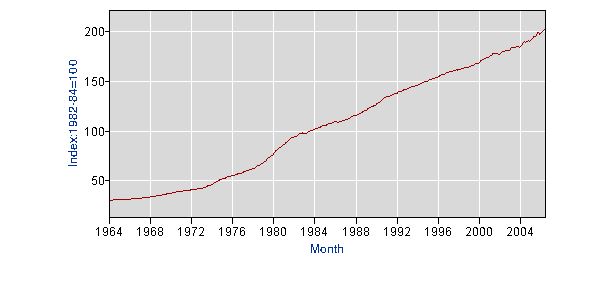
This second chart presents the Consumer Price Index for all urban consumers (CPI-U). As you can see, inflation (rate of change of the CPI-U) soared in the 1970s, thanks in large part due to oil prices and stagflation, until about 1983, after which the inflation rate has been relatively stable. The real wages of workers reflects that fact - tumbling in the years following 1973, and stabilizing after 1983 (yes, there have been ups and downs related to economic climate, but that's natural).
Critics of static wages use another subterfuge. They use a sleight-of-hand analogy to imply that the stagnant average weekly wages of a population imply stagnant wages for an individual worker. That is simply not true - people at the high end of the wage cycle retire, and are replaced by young men and women at the bottom of the cycle. The performance of average wages then is quite demographics of the population, and heaven knows Americans aren't having babies like there's no tomorrow. Then, in an ageing population, we should see real wages decline, and that we don't is a reflection of how the fruits of economic prosperity are translating into real wage improvements for the average worker!
Time allows a more rational analysis. First, why 1973? It seems an arbitrary starting point. Any time anyone makes a claim relative to a murky baseline, be suspicious ... be very suspicious. So I used the Bureau of Labor Statistics web site to probe the data and produce the graphs used in this post. (All data is for the duration that earnings data is available)was dramatic
The first graph is a plot of the average weekly earnings in 1982$ (that is correcting for inflation). Now it becomes obvious why Clift uses 1973, it was the year of peak weekly earnings. Ok, but isn't her point true that the average worker makes less than he/she did in 1973? Well, yes it's true, but not because corporations have been screwing John and Jane Doe.
This second chart presents the Consumer Price Index for all urban consumers (CPI-U). As you can see, inflation (rate of change of the CPI-U) soared in the 1970s, thanks in large part due to oil prices and stagflation, until about 1983, after which the inflation rate has been relatively stable. The real wages of workers reflects that fact - tumbling in the years following 1973, and stabilizing after 1983 (yes, there have been ups and downs related to economic climate, but that's natural).
Critics of static wages use another subterfuge. They use a sleight-of-hand analogy to imply that the stagnant average weekly wages of a population imply stagnant wages for an individual worker. That is simply not true - people at the high end of the wage cycle retire, and are replaced by young men and women at the bottom of the cycle. The performance of average wages then is quite demographics of the population, and heaven knows Americans aren't having babies like there's no tomorrow. Then, in an ageing population, we should see real wages decline, and that we don't is a reflection of how the fruits of economic prosperity are translating into real wage improvements for the average worker!
Subscribe to:
Posts (Atom)
