A compilation of some shocking numbers I've come across in the last few days:
Over a third of all home sales currently are foreclosed properties! Translation: Any increase in home sales ("we have a bottom") is because of the glut of cheap homes.
23% of all homeowners with a mortgage owe more on their mortgage than their house is worth. Translation: Holy Shit!!
A foreclosure near your home depresses the value of your home from somewhere between $5,000 to over $20,000, depending on who did the study! Translation: This foreclosure thing does affect you, at least in the short-term.
Showing posts with label Real Estate. Show all posts
Showing posts with label Real Estate. Show all posts
Sunday, October 26, 2008

Saturday, October 18, 2008
There are No Tax Benefits to Owning a House for Most People!!
I was having tea with this elderly British couple from Canada today, and in between a spirited political discussion, the topic of home ownership came up. I was fascinated to learn that home ownership in Canada was a very different beast! Buyers are typically required to put 25% down (compared with actually getting cash here in the US), and most families pay their loans off in 10-15 years. This couple in fact paid their Canadian house in 6 years!! That's a stunning difference from the US.
The big difference is that there is no tax deduction for mortgage interest in Canada. That of course, is much touted for being a reason to buy a house. Save on the taxes. But that is a totally bogus reason for many homeowners.
Let's run the numbers. Using this calculator, I estimate my tax savings on a mortgage of $200,000 is just a bit over $5,000. Wow! Except that the standard deduction for 2008 is $5,450 for singles, $10,900 for couples filing jointly. Which means, you'd still elect to use the standard deduction, unless you have substantial other deductions.
And mind you, those tax savings were only for the first year - they diminish every year as more of your mortgage goes towards principal. Oh, and don't forget property taxes which can take a bit out of your wallet.
There might be many reasons to buy a house, but saving on taxes isn't one of them ...
The big difference is that there is no tax deduction for mortgage interest in Canada. That of course, is much touted for being a reason to buy a house. Save on the taxes. But that is a totally bogus reason for many homeowners.
Let's run the numbers. Using this calculator, I estimate my tax savings on a mortgage of $200,000 is just a bit over $5,000. Wow! Except that the standard deduction for 2008 is $5,450 for singles, $10,900 for couples filing jointly. Which means, you'd still elect to use the standard deduction, unless you have substantial other deductions.
And mind you, those tax savings were only for the first year - they diminish every year as more of your mortgage goes towards principal. Oh, and don't forget property taxes which can take a bit out of your wallet.
There might be many reasons to buy a house, but saving on taxes isn't one of them ...
Saturday, September 13, 2008
Chart of the Day: Real Estate Predictions
Predictions by John Burns of John Burns Real Estate Consulting, reported by the always brilliant John Maudlin.

Wednesday, February 20, 2008
Scary Chart of the Day: Phoenix Real Estate
Courtesy of a very nifty graphing tool at National City, here's an example of the craziness of the speculative real estate boom that occurred in so many places. As someone who loved his time in Phoenix partly because of reasonable real estate prices, all I can do is shake my head ...


Tuesday, February 19, 2008
Housing Meltdown?
Businessweek recently carried a very negative story on the housing meltdown. A meltdown? If that seems extreme, the authors don't think so. Even for a housing bear like me, some of the predictions and information in the story were surprising and deeply troubling.
Even more troubling was this excerpt:
Ouch! Not looking good for real estate outlook! True, in recent years, the easy availability of credit would support greater leveraging of household budgets (in contrast, in the 20s and 30s, most houses put something like 50% down!), but if the credit crisis is more than short-term, then we just may see this Mankiw prediction come good after all!
Brace yourself: Home prices could sink an additional 25% over the next two or three years, returning values to their 2000 levels in inflation-adjusted terms... Shocking though it might seem, a decline of 25% from here would merely reverse the market's spectacular appreciation during the boom. It would put the national price level right back on its long-term growth trend line, a surprisingly modest 0.4% a year after inflation. There's a recent model for this kind of return to normalcy after the bursting of a financial bubble. The stock market decline that began in 2000 erased most of the gains of the boom of the second half of the 1990s, leaving investors with ordinary-sized returns.
Even more troubling was this excerpt:
For another bearish view, there's what economists refer to as the Mankiw paper. In 1989, long before working in the White House as chief economic adviser or writing his best-selling textbook, Principles of Economics, Harvard University economist N. Gregory Mankiw co-wrote a paper that was startlingly negative on housing. He and David N. Weil predicted that home prices would decline by 47% after inflation over the next 20 years, based on a shrinking pool of potential first-time buyers and an expectation that baby boomers as a group would spend less on housing as they grew older. It could be that Mankiw and Weil were not so much wrong as premature.
Ouch! Not looking good for real estate outlook! True, in recent years, the easy availability of credit would support greater leveraging of household budgets (in contrast, in the 20s and 30s, most houses put something like 50% down!), but if the credit crisis is more than short-term, then we just may see this Mankiw prediction come good after all!
Saturday, January 26, 2008
Real Estate Stinks!
I woke up way too early on a Sunday morning, and since all the buzz in India and back stateside has been on the real estate market, I was curious what the historical returns on residential real estate have been. While no data exists in India, I found a study for the US, from which I reproduce this graphic on nominal and real (i.e. inflation-adjusted) returns. Nothing to write home about.

Source
To be fair, this study does not appear to factor in rent savings, which could be substantial. My own experience with online calculators is that there is a huge disparity based on assumptions, so do your homework. Nevertheless, it is useful to consider that home price inflation has only barely beat inflation in much of the US, a far cry from the 10-20% annual returns we have seen recently.
Source
To be fair, this study does not appear to factor in rent savings, which could be substantial. My own experience with online calculators is that there is a huge disparity based on assumptions, so do your homework. Nevertheless, it is useful to consider that home price inflation has only barely beat inflation in much of the US, a far cry from the 10-20% annual returns we have seen recently.
Tuesday, December 11, 2007
Chart of the Day: Median Home Price to Median Income
Courtesy of GMO, the ratio of median home price to median income. Anyone who thinks this real estate slump is over (like the snake-oil charmers at the National Association of Realtors) are going to be sadly mistaken!


Sunday, August 12, 2007
Let the Foreclosures Begin!
Many politicians are complaining about the rising wave of foreclosures, and insisting that government needs to step in and stem the crisis. Thankfully, President Bush has decided to do so such thing. Why not, you ask? Well, it simply isn't the government's place in a free-market system to insulate individuals from risk; such a practice simply encourages greater risk-taking and creates ever-greater bubbles until the protector is no longer able to be a hero.
Housing prices must correct! I hope to be financially in a position to benefit from a substantial correction down the road, but this isn't simply about the value investor in me who's hoping in asset price corrections to give me goods at bargain prices. We have frequently heard complaints that housing in most big cities is unaffordable. The Housing Affordability Index put out by the National Association of Realtors declined from a high of 133.2 in 1998 to 113.9 in March 2007, thanks to the housing boom. But even that understates the problem because it considers home prices across the US - the median price, for example, is $215,300 - good luck finding a home for that price in almost any decent-sized American city.
A real estate correction then is appropriate, and may be desirable in the long-term. Despite all the huey, one could argue that indeed price appreciation in excess of wages is rather undesirable, and if anything, government should consider tweaking tax policy to dissuade rampant speculation, including measures such as limiting the number of times you can flip a house before you lose capital tax gains.
This is hardly a popular position. We tend to get really excited when stocks or houses skyrocket in price, even if it means that the early buyers are being rewarded, while younger entrants are forced to pony up. But unlike stocks, housing affects livability, and government support of speculative efforts would be rather undesirable.
A side note You may have read that the Fed Reserve has been using something called repo agreements to purchase mortgage securities. Lest you think of it as a bail-out, here's a clarification I needed, from John Hussman of Hussman Funds:
Housing prices must correct! I hope to be financially in a position to benefit from a substantial correction down the road, but this isn't simply about the value investor in me who's hoping in asset price corrections to give me goods at bargain prices. We have frequently heard complaints that housing in most big cities is unaffordable. The Housing Affordability Index put out by the National Association of Realtors declined from a high of 133.2 in 1998 to 113.9 in March 2007, thanks to the housing boom. But even that understates the problem because it considers home prices across the US - the median price, for example, is $215,300 - good luck finding a home for that price in almost any decent-sized American city.
A real estate correction then is appropriate, and may be desirable in the long-term. Despite all the huey, one could argue that indeed price appreciation in excess of wages is rather undesirable, and if anything, government should consider tweaking tax policy to dissuade rampant speculation, including measures such as limiting the number of times you can flip a house before you lose capital tax gains.
This is hardly a popular position. We tend to get really excited when stocks or houses skyrocket in price, even if it means that the early buyers are being rewarded, while younger entrants are forced to pony up. But unlike stocks, housing affects livability, and government support of speculative efforts would be rather undesirable.
A side note You may have read that the Fed Reserve has been using something called repo agreements to purchase mortgage securities. Lest you think of it as a bail-out, here's a clarification I needed, from John Hussman of Hussman Funds:
Contrary to the apparent belief of investors, the Fed did not shift its policy, nor did it “bail out” the mortgage-backed securities market by “buying” them from banks. What actually happened is that the Federal Funds rate shot to about 6% on Friday morning, and the FOMC brought it down to its target rate by entering into 3-day repurchase agreements . The banks sold securities to the Fed on Friday, and are obligated to buy them back from the Fed on Monday at the sale price, plus interest. Such open market operations are designed to ease the immediate demand for liquidity, and to give the banks and dealers more time to find buyers in the open market for the securities they are trying to liquidate.
Wednesday, July 25, 2007
Real Estate Bloodbath
From American Public Media's program, Marketplace:
Countrywide Financial CEO Mozila seemed to be overstating things when he talked about the worst housing slump since the Great Depression, but stats like this make you sit up. And keep in mind Ohio is supposed to have one of the more "affordable" housing markets.
Incidentally, one of my friends in Arizona has been texting me about great deals she's been finding in the overheated (in more ways than one!) desert, including a 5 bed, 3 bath house for 189k! If there is a good news in this bloodbath, it might be that those of us who don't work on Wall Street may finally be able to find a place to live and own.
This year alone, [Cayahoga country treasurer] Rokokis expects 17,000 foreclosures in his county. He blames careless, even abusive mortgage lending. According to Cayahoga county statistics, just one lender, Argent Mortgage, has seen about 25 percent of its loans in Cleveland go under.
Countrywide Financial CEO Mozila seemed to be overstating things when he talked about the worst housing slump since the Great Depression, but stats like this make you sit up. And keep in mind Ohio is supposed to have one of the more "affordable" housing markets.
Incidentally, one of my friends in Arizona has been texting me about great deals she's been finding in the overheated (in more ways than one!) desert, including a 5 bed, 3 bath house for 189k! If there is a good news in this bloodbath, it might be that those of us who don't work on Wall Street may finally be able to find a place to live and own.
Tuesday, April 03, 2007
They Have Their Models!
I was watching a very interesting interview with Mr James Grant, editor of the Grant's Interest Rate Observer and a truly brilliant forecaster, and was stunned by some of what I heard. For all we have heard on the subprime mortgage market risks, most articles have focussed on the revenues of individual subprime mortgage providers. We have never really heard just how significant the subprime market is, and many articles have alluded to the subprime being a small fraction of the overall mortgage market.
What is a CDO? CDO is a collaterized debt obligation - basically a package of mortgage loans that has been studied by credit rating agencies and assigned a certain risk. So basically agencies have used mathematical models to study recent correlations between the securities in that portfolio to classify the collection of junk as equivalent grade to a US Treasury. The problem, as Mr Grant points out, is that these models are based on what can be considered an anomalous recent period of lax lending, and the model predictions will turn out to be wrong. Indeed, a caption during the story pointed out that about 10% of subprime mortgages are delinquent by 90 days as of December 2006.
Mr Barry Ritzhold takes the focus to the effects on the economy, and the effect of the reset of interest rates on $2 trillion dollars worth of mortgage debt, that will result in monthly payments rising 10-50%. He cites a study by a title insurer, First American Corp., that projects that one in eight ARMs (adjustable rate mortgage) will end up in default. That's a stunning number, and in an economy that's already a little overstretched, may well cause a recession, in his opinion.
The risks associated with computer modeling though stretch further than the mortgage market. A bevy of hedge funds and "quant" investors have increasingly been relying on mathematics for investing. As one of my professors who teaches a water quality modeling course keeps reiterating, creating a model without the right data to support it is an exercise in academic gymnastics ... and foolhardiness.
Sub-prime and Alt-A [better than subprime, but below prime] represent 40% of the $8 trillion mortgage market. Hundreds of billions of dollars of CDOs were sold... You take 70% of a pile of BBB- (marginal)... 70% of this junk, is AAA. [How do they do that?] They have their models!
What is a CDO? CDO is a collaterized debt obligation - basically a package of mortgage loans that has been studied by credit rating agencies and assigned a certain risk. So basically agencies have used mathematical models to study recent correlations between the securities in that portfolio to classify the collection of junk as equivalent grade to a US Treasury. The problem, as Mr Grant points out, is that these models are based on what can be considered an anomalous recent period of lax lending, and the model predictions will turn out to be wrong. Indeed, a caption during the story pointed out that about 10% of subprime mortgages are delinquent by 90 days as of December 2006.
Mr Barry Ritzhold takes the focus to the effects on the economy, and the effect of the reset of interest rates on $2 trillion dollars worth of mortgage debt, that will result in monthly payments rising 10-50%. He cites a study by a title insurer, First American Corp., that projects that one in eight ARMs (adjustable rate mortgage) will end up in default. That's a stunning number, and in an economy that's already a little overstretched, may well cause a recession, in his opinion.
The risks associated with computer modeling though stretch further than the mortgage market. A bevy of hedge funds and "quant" investors have increasingly been relying on mathematics for investing. As one of my professors who teaches a water quality modeling course keeps reiterating, creating a model without the right data to support it is an exercise in academic gymnastics ... and foolhardiness.
Wednesday, May 24, 2006
Negotiation Delays
Several newspapers published stories today about the "resilience" in real estate markets, with the number of new homes sold hitting a new high. These stories did note that the median price of the homes sold did drop, but failed to connect it with the sale volumes. Well, I'm no economist, but here's the way I see it (hmm, I keep pointing out I'm no economist, but then propose my theory on economic issues ... oh well, that's why I have a blog!)
Price in free markets is fixed by a negotiation process. If sales of say new cars aren't doing very well, offer a discount and sales should improve - simple enough. I like to call this 'negotiation delay', although I'm sure there's a technical term for it. In stock markets, information is transmitted quickly, and hence a reluctance to pay higher prices for equity assets quickly results in sellers reducing prices until there are buyers at the new price. Negotiation delays can be longer in real estate markets, especially when individuals are reluctant to sell for a loss (or even for less than what a neighbor got for theirs). After a few months of seeing prices decline, sellers (especially speculators) recognize new information (the bubble may be bursting) and are keen to get out at existing prices, even if it represents a loss.
It is then rational that we should see increased sales at lower prices. It isn't a sign of resilience, just a sign that speculators and some non-speculative sellers recognize the sound of a bubble popping!
Price in free markets is fixed by a negotiation process. If sales of say new cars aren't doing very well, offer a discount and sales should improve - simple enough. I like to call this 'negotiation delay', although I'm sure there's a technical term for it. In stock markets, information is transmitted quickly, and hence a reluctance to pay higher prices for equity assets quickly results in sellers reducing prices until there are buyers at the new price. Negotiation delays can be longer in real estate markets, especially when individuals are reluctant to sell for a loss (or even for less than what a neighbor got for theirs). After a few months of seeing prices decline, sellers (especially speculators) recognize new information (the bubble may be bursting) and are keen to get out at existing prices, even if it represents a loss.
It is then rational that we should see increased sales at lower prices. It isn't a sign of resilience, just a sign that speculators and some non-speculative sellers recognize the sound of a bubble popping!
Thursday, May 18, 2006
Understanding Risk
Even if you are not mathematically inclined, bare with the geektalk on this post for what I hope will be a useful revelation
My monthly newsletter from T Rowe Price included a note from one of their bond fund managers who noted that a 50-50 stock and bond allocation has been shown to produce 85% of the returns of stock-only portfolios while substantially reducing volatility. I flipped the page - I'm not the kind of guy who sells when the market crashes, and hence don't worry about volatility.
But maybe I should. A new day brings new insight, and I wondered what volatility does to "terminal values", which really is what you and I care about. A terminal value is the value of an investment after some lengthy period of time. So, for example, how does volatility affect the value of a $1,000 investment after 20 years? Intuitively, we all seem to think it doesn't matter - as long as the timeframe is "sufficiently long", the returns will approximate the mean returns, things will average out. But is that true?
So as I chomped on my lunch, I wrote a little program to simulate terminal values (yes, sad is the life of a geek!) And the results were revealing. I simulated two artificial portfolios - fund A has a mean return of 8% and standard deviation of 8%, while fund B has a mean return of 16% and a standard deviation of 24%. The simulated mean returns after 20 years, not surprisingly showed that fund B was a lot better than fund A - your $1,000 investment was now worth $20,540 in the former, as opposed to $4,690 in the latter. Ah, the joys of compounding!
But what about the ranges? Your terminal values in fund A could have ranged from $1,700 to $11,600, while in fund B, you could have been left with $630 to $178,440. That is, even after what you consider a long time, the volatily in fund B could have caused you to lose money, although it just might have made you phenomenally rich!
This is the part left out of the literature for the common investor. Risk matters ... in fact, risk is pivotal. I understand that many publications are trying to get excessively conservative investors to embrace risk (the ones who refuse anything riskier than a bank deposit), but the average Joe and Jane do have to worry about risk. This is especially true when they read stories of people who invested in a speculative issue or hot real estate market and ended richer than you could ever dream - yes, it can happen to you, but you could lose your shirt and a lot more.
It strikes me that a statistically appropriate measure while planning for retirement would then be to study this dispersion, and have a certain degree of confidence in achieving some basic milestone. (So you may want to be 90% confident of retiring with a $1 million)
Postscript Since the time of this post, I have noticed several articles and mutual fund companies refer to similar probabilities, even though they are closer to a 75-80% chance of adequate savings (a higher probability causes a dramatic rise in the required savings, as one can determine from the shape of a Bell curve). Nevertheless, I still think this aspect is underplayed in articles and most personal investors do not have an appreciation for risk.
My monthly newsletter from T Rowe Price included a note from one of their bond fund managers who noted that a 50-50 stock and bond allocation has been shown to produce 85% of the returns of stock-only portfolios while substantially reducing volatility. I flipped the page - I'm not the kind of guy who sells when the market crashes, and hence don't worry about volatility.
But maybe I should. A new day brings new insight, and I wondered what volatility does to "terminal values", which really is what you and I care about. A terminal value is the value of an investment after some lengthy period of time. So, for example, how does volatility affect the value of a $1,000 investment after 20 years? Intuitively, we all seem to think it doesn't matter - as long as the timeframe is "sufficiently long", the returns will approximate the mean returns, things will average out. But is that true?
So as I chomped on my lunch, I wrote a little program to simulate terminal values (yes, sad is the life of a geek!) And the results were revealing. I simulated two artificial portfolios - fund A has a mean return of 8% and standard deviation of 8%, while fund B has a mean return of 16% and a standard deviation of 24%. The simulated mean returns after 20 years, not surprisingly showed that fund B was a lot better than fund A - your $1,000 investment was now worth $20,540 in the former, as opposed to $4,690 in the latter. Ah, the joys of compounding!
But what about the ranges? Your terminal values in fund A could have ranged from $1,700 to $11,600, while in fund B, you could have been left with $630 to $178,440. That is, even after what you consider a long time, the volatily in fund B could have caused you to lose money, although it just might have made you phenomenally rich!
This is the part left out of the literature for the common investor. Risk matters ... in fact, risk is pivotal. I understand that many publications are trying to get excessively conservative investors to embrace risk (the ones who refuse anything riskier than a bank deposit), but the average Joe and Jane do have to worry about risk. This is especially true when they read stories of people who invested in a speculative issue or hot real estate market and ended richer than you could ever dream - yes, it can happen to you, but you could lose your shirt and a lot more.
It strikes me that a statistically appropriate measure while planning for retirement would then be to study this dispersion, and have a certain degree of confidence in achieving some basic milestone. (So you may want to be 90% confident of retiring with a $1 million)
Postscript Since the time of this post, I have noticed several articles and mutual fund companies refer to similar probabilities, even though they are closer to a 75-80% chance of adequate savings (a higher probability causes a dramatic rise in the required savings, as one can determine from the shape of a Bell curve). Nevertheless, I still think this aspect is underplayed in articles and most personal investors do not have an appreciation for risk.
Friday, March 24, 2006
The Sound of Popping
Well, the latest piece of evidence in the popping of the real estate bubble is the 10.5% drop in seasonally-adjusted new home sales, and the fourth month of decline in median sale price. All the bullish arguments for why home prices would not fall have been shown to be bullsh*t instead! We should see prices continue to drop in the months to come, especially if the US hits a recession at some point in the near term(you know the GDP can't just keep growing!)
I forecast that even places without local real estate bubbles will see a downturn. Why? Simply because of how prices are set. Price is determined by emotion as much as reality, and if and when stories flood the newspaper of individuals losing their shirts (rather than some abstract economic headline number), sellers will be more pressured to compromise on price, while buyers will be encouraged to bargain harder. That's why a recession or even economic slowdown could be significant - a seller who has either lost his/her job or fears doing so is more likely to try to reduce his/her mortgage liabilities for what he/she can.
I forecast that even places without local real estate bubbles will see a downturn. Why? Simply because of how prices are set. Price is determined by emotion as much as reality, and if and when stories flood the newspaper of individuals losing their shirts (rather than some abstract economic headline number), sellers will be more pressured to compromise on price, while buyers will be encouraged to bargain harder. That's why a recession or even economic slowdown could be significant - a seller who has either lost his/her job or fears doing so is more likely to try to reduce his/her mortgage liabilities for what he/she can.
Tuesday, March 14, 2006
Yes Virginia, You Are Overvalued!
I have not talked about real estate in a while, in part because it's been all over the mainstream media, more so than it really deserves (most stories have no new content, and rehash the same old crap!) But National City Corp. reported estimates of fair value for real estate in several cities yesterday and found several cities to be vastly overvalued. My own state of Virginia as well as my former state of Arizona are positively bloated - I live in Charlottesville, where houses are 30% overvalued! The most overvalued? Naples, FL - 96% overvalued. The most undervalued? College Station, TX - almost 23% undervalued. Texas accounted for 8 of the 10 most undervalued cities, while California and Florida for 18 of the 20 most overvalued.
Monday, December 19, 2005
Pricking the Bubble
With all the talk of wiretapping, there was little attention paid to a couple of important news items about real estate that should have gotten people's attention. One was the Housing Market Index, a measure of US homebuilder sentiment, which fell to its lowest level since April 2003! Yikes!!
The other was a news piece that indicated that the value of unsold homes amounted to $500 billion, up 33% since last year!
In fact, I was listening to a local station while driving through Louden County, one of the high-priced areas of northern Virginia, and heard a caller complain of their inability to sell their house in the last 5 months, despite cutting costs twice already. The host (or one of his guests?) chimed in that the median home price in Louden County had falled in the last few months had dropped from $506,000 to $480,000.
These are just early signs of trouble. It is sad that people fail to recognize irrational exuberance, especially so soon after a decade of similar exuberance about stocks. If and when there is a collapse, it gives none of us much joy, because families are going to be crushed, our monetary system affected, the economy may take a knock ... so obviously I hope that all the gloomies and I are wrong, those optimists are right, and things go on. But history tells us that the track record of "soft landings" is rather suspect, and a correction is imminent.
The other was a news piece that indicated that the value of unsold homes amounted to $500 billion, up 33% since last year!
In fact, I was listening to a local station while driving through Louden County, one of the high-priced areas of northern Virginia, and heard a caller complain of their inability to sell their house in the last 5 months, despite cutting costs twice already. The host (or one of his guests?) chimed in that the median home price in Louden County had falled in the last few months had dropped from $506,000 to $480,000.
These are just early signs of trouble. It is sad that people fail to recognize irrational exuberance, especially so soon after a decade of similar exuberance about stocks. If and when there is a collapse, it gives none of us much joy, because families are going to be crushed, our monetary system affected, the economy may take a knock ... so obviously I hope that all the gloomies and I are wrong, those optimists are right, and things go on. But history tells us that the track record of "soft landings" is rather suspect, and a correction is imminent.
Friday, October 14, 2005
Prices Can Go Down
In recent times the popular press has been obsessed with the real estate bubble, which is why I have stopped writing that much about the issue. But this story (and accompanying table) reinforce what I have said in the past - real estate prices can go down!
Tuesday, September 06, 2005
Ouch!
OK, I confess as an engineer, I'm obsessed with numbers. I just have to crunch them. I'm a numeroholic!! So as my MRI machine warms up, I crunched some numbers in Excel using publically available (and reliable) information, and produced the following graphs.
The first one is what you are likely to see any time someone convinces you that the road to wealth is by buying their newsletter, investing in the stock market or whatever. In this case, it's to show how rich you'd have been if you had invested in real estate.
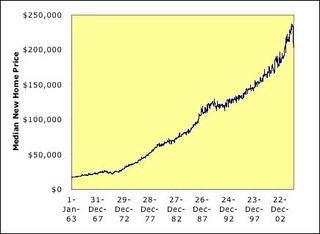
Wow, how can you argue with that, right? Well, turns out that little thing we rarely think about these days, inflation makes a big difference. Here are the same numbers in 2004 dollars.
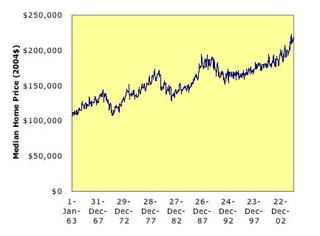
Still good, but certainly doesn't look like the pathway to Mackena's gold! Well, then there is that little thing called risk. You only have to read the works of Benjamin Graham and William Bernstein to realize that the path to higher returns is often associated with higher risk (see, those newsletters promising to make you money never tell you how much you lost. The master investor Warren Buffer always said rule 1 of investing was - never lose money! Rule 2? Always pay attention to rule 1!!)
Looking at changes in new home prices over 5 years reveals something quite interesting - it bursts the myth that home prices can never go down. BTW, this is based on new home prices - you will have to include a discount for the house being 5-yrs old, and that discount actually increases when the market crashes.
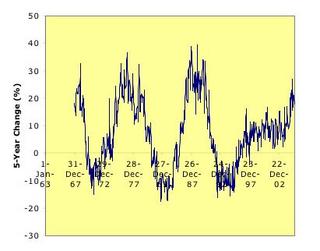
Add in the fact that a house is highly leveraged and you could really lose your shirts. Planning on holding on to your home for a longer period does mitigate these risks somewhat. The figure below is the percentage change in value over 10 years.
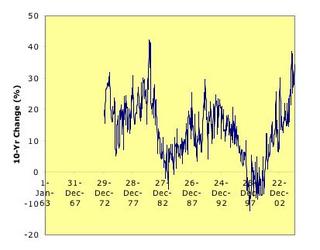
My point is not to bash the act of buying a house. Heck, I sure hope I can do it someday. My mission is rather to educate, because I've encountered a shocking number of people who invest substantial sums of money without asking some rather basic questions about the risk or returns of their investment! I have heard people say that real estate is an investment, and yet not apply the same critical analysis to real estate markets as they would to the stock market.
The first one is what you are likely to see any time someone convinces you that the road to wealth is by buying their newsletter, investing in the stock market or whatever. In this case, it's to show how rich you'd have been if you had invested in real estate.
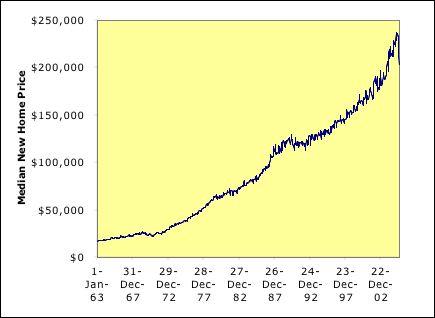
Wow, how can you argue with that, right? Well, turns out that little thing we rarely think about these days, inflation makes a big difference. Here are the same numbers in 2004 dollars.

Still good, but certainly doesn't look like the pathway to Mackena's gold! Well, then there is that little thing called risk. You only have to read the works of Benjamin Graham and William Bernstein to realize that the path to higher returns is often associated with higher risk (see, those newsletters promising to make you money never tell you how much you lost. The master investor Warren Buffer always said rule 1 of investing was - never lose money! Rule 2? Always pay attention to rule 1!!)
Looking at changes in new home prices over 5 years reveals something quite interesting - it bursts the myth that home prices can never go down. BTW, this is based on new home prices - you will have to include a discount for the house being 5-yrs old, and that discount actually increases when the market crashes.
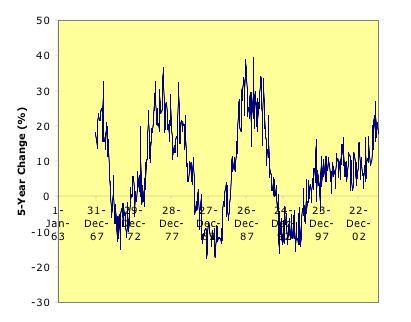
Add in the fact that a house is highly leveraged and you could really lose your shirts. Planning on holding on to your home for a longer period does mitigate these risks somewhat. The figure below is the percentage change in value over 10 years.
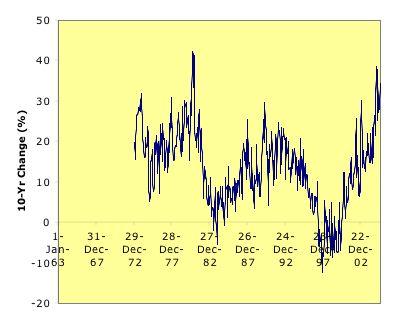
My point is not to bash the act of buying a house. Heck, I sure hope I can do it someday. My mission is rather to educate, because I've encountered a shocking number of people who invest substantial sums of money without asking some rather basic questions about the risk or returns of their investment! I have heard people say that real estate is an investment, and yet not apply the same critical analysis to real estate markets as they would to the stock market.
Monday, September 05, 2005
Median Price Falls
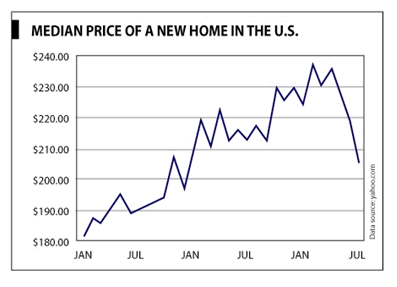
This story points to the fact that the first prick of the real estate bubble might have already occurred. I have reproduced a graph from one of the links in the story - one of median new home price. This is consistent with what I had been expecting - in fact, compare the chart here with the one on my posting on July 29. Sure looks like a correction is in progress. Folks, if you own a home, aggressively pay down your loan ahead of schedule. The gains of real estate are because of leverage, but leverage works both ways, so don't be caught owing a lot more than your house is worth! (This is especially true for people who work in jobs that may require them to relocate, or who are in the early years of their career where they would be better off being flexible about relocating)
Friday, July 29, 2005
More Indications on the Real Estate Bubble
This story in USNews further supports the general indication that there is a real estate bubble about to pop. The data is pretty conclusive. I've been amazed in talking to people about how much blind optimism there is in the market!
Add those numbers to the chart shown here, which I got from this article at the InvestmentU.com, and you will see a correction in progress.
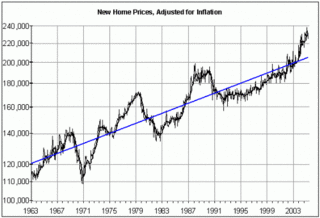
For full disclosure, I do own shares of real estate companies - Toll Brothers and MDC Holdings, despite my confidence in an impending crash. I am still trying to determine what an appropriate metric might be to determine when to sell them, but for now they are profitable and successful companies that seem undervalued.
Add those numbers to the chart shown here, which I got from this article at the InvestmentU.com, and you will see a correction in progress.

For full disclosure, I do own shares of real estate companies - Toll Brothers and MDC Holdings, despite my confidence in an impending crash. I am still trying to determine what an appropriate metric might be to determine when to sell them, but for now they are profitable and successful companies that seem undervalued.
Thursday, July 28, 2005
Why A Real Estate Crash Is Imminent!
I am currently reading about the bursting of the tech bubble, and the one think that strikes me, something I have thought about for the last few months, is how similar the present real estate market is to the tech bubble. I didn't believe a crash was imminent a few months ago, when many naysayers were forecasting it. But as crash failed to materialize, many bears became bulls, arguing now that things had changed, that traditional ideas about bubbles were no longer valid. This is the same as what happened in the tech bubble - the early bears missed tremendous profit opportunities, thought to themselves, jeez we must be wrong, and bought into the myth of structural change.
The tough part is predicting when the bubble will pop, and how will we guard ourselves? I don't own any real estate, but when housing markets crash, it will ripple through not only our stock market, but those around the world.
The tough part is predicting when the bubble will pop, and how will we guard ourselves? I don't own any real estate, but when housing markets crash, it will ripple through not only our stock market, but those around the world.
Subscribe to:
Posts (Atom)
