'Home Sweet Home' is a special series on my visit back home to India after 3 years, hoping to document not just macroscopic changes in the world's populous democracy, but my own emotions on being back. While originally intended to be posted as events occurred, I was too busy to go online while in India, and I'm now posting these after my return to the US.
There are changes in India that become evident only when you take a road trip. For one, the choices of quality cars available is phenomenal, and several with good gas mileage to boot. Our choice was my brother's Tata Indica V2 , a homegrown 70 hp compact. While 70 horses seems a bit too few on American roads, Indians seem to do well on Indian roads with lower power. The Indica under real conditions gives about 10 kmpl (23 mpg) under real city conditions, even though under test conditions, it is rated at 14 kmpl (32mpg).
The National Highways are far improved from my days in India, thanks to the phenomenal Golden Quadrilateral project and other big infrastructure investments under the previous government. The GQ is a system of interstates linking the four largest cities in India by top-notch freeways. As we discovered on our drive to Bangalore, much of the freeway is now a toll road, but the Rs 150 ($3.20) spent on using the tolled highway saved us plenty of travel time.
Maybe it's a fiction of my imagination, but it does seem villages along the GQ are less impoverished than I remember. With rural centers now better connected to commercial hubs, I guess it's logical to expect the rural economy close to the distribution system is booming.
We stop at Natrampalli, a village that was my dad's first posting back in 1969, and now a town of just under 10,000 people. Let that number not fool you - in India, where populations are measured in rather large units, a town of just under 10,000 people is still a town in the middle of nowhere. So we were indeed surprised to walk into the bank and see an air-conditioned office, filled with computers. We learn that they will be inaugrating the ATM later that week .... imagine that, an ATM in the middle of nowhere! The branch manager also tells us they are part of the centralized computer banking system, that allows these villagers to access an account located anywhere in India. What change!
But lest we get too euphoric, a touch of reality. We go over to the Ramakrishna Mission premises. The Mission is an order of monks attempting to change the world, but unlike the wealthy religious groups of today, they still maintain an austerity, and still believe in a mission to improve spirituality, to make the Hindu a better Hindu, the Muslim a better Muslim, the Christian a better Christian. Our purpose though is not a religious one. We talk to the gentleman in charge of the Mission office, and he tells us of their efforts in education, with the percentage of children passing up from 8% to 30%. However, getting them to a level where they can go to college is a difficult task. The challenge is finding teachers willing to come for low pay to a remote village like Natrampalli.
After much discussion, the gentleman, in a reference to the previous government's electoral slogan 'India Shining', says, 'India is Shining, but only in the cities and highways'. He points out that when you get away from the highway, there are still myriad problems requiring solution. I still am an optimist, and I leave hopeful that the new successes in the economy will allow tutors from cities to come down for 1-2 weekends a month to help these children.
Tuesday, August 08, 2006

Thursday, July 27, 2006
Jet Airways
My brother insists my experience on Jet Airways was atypical, and the crowds that swell India's airports mean that even a labor-ready country like India has started to incentivize electronic check-in with free frequent-flyer miles and the like. Just how much has travel increased? In 1996, there was one flight a day between Chennai and Bangalore (two cities about a half-hour flight apart) and one train line, both operated at some loss by the federal government. Today, there are no less than 31 flights, 4-5 train lines, countless sleeper and nonsleeper buses, almost all by private operators, and yet it's virtually impossible to get a ticket on any of these modes of transport on short-notice.
Even the flight attendants on my Jet Airways flight reflected a change from the India of past. They were attractive women dressed in skirts rather than the traditional garb of a sari, although at least one of them seemed not to appreciate her natural aesthetics, donning enough makeup to serve as an endorsement for a budding rouge maker.
The meal ... yes, Indian air operators still offer more than peanuts ... was delicious, leaving me tempted to ask if I could buy another serving, and was served on china and with silverware - a welcome fact for a food-loving tree-hugger like myself.
Even the flight attendants on my Jet Airways flight reflected a change from the India of past. They were attractive women dressed in skirts rather than the traditional garb of a sari, although at least one of them seemed not to appreciate her natural aesthetics, donning enough makeup to serve as an endorsement for a budding rouge maker.
The meal ... yes, Indian air operators still offer more than peanuts ... was delicious, leaving me tempted to ask if I could buy another serving, and was served on china and with silverware - a welcome fact for a food-loving tree-hugger like myself.
The Nation's Capitol
'Home Sweet Home' is a special series on my visit back home to India after 3 years, hoping to document not just macroscopic changes in the world's populous democracy, but my own emotions on being back.
There were claps all around. As the acceleration kicked in our solar plexus, we were all glad to be off the ground. It had been a long 4.5 hours, sitting on the tarmac at Newark International, as rains had prevented us from taking off. Especially rough when you are at the start of a 14-hour flight to Delhi. Some time earlier, we were told that if we didn't make it by 53 minutes past midnight, we would have to call the whole venture off. As the deadline loomed, many of us were praying hard ... a cancellation would have been disastrous for me, with another local flight to catch in India. The takeoff was hence all the more exhilarating! Later, I managed to have a great chat with the head steward of the flight, talking about procedures and donut holes - no, not the food, but the fact that pilots are required by federal law to retire at 60, but can't claim pension benefits till 65! Turns out if we had returned to the gate under inclement weather, federal law would have required a new crew, which could have delayed departure even further. Hmm, a reminder that sometimes things aren't as simple as they seem ... I wish one of those serial complainers ("why can't they just return to the gate and reboard when they are ready to leave") could have heard!
I got into Delhi well past midnight, and was rather excited to catch up with an aunt of mine. She works for a large publishing company and represents an interesting generation of worker caught between a traditional and a new aggressive paradigm. The new model, inspired by the new breed of MBAs, seek short-term explosive growth, often at the expense of a core business of some heritage value, and a lot of social values. What is the purpose of a business, and what are its social commitments? This is an interesting question even in mature economies like the US, but especially in a nascent economy like India where you cannot depend on governments alone to address the problems that plague the country.
The next morning, I headed to Delhi's domestic airport, only to be shocked by the plethora of airlines operating. When I left India for the US, a private competitor had just come on to take on the federally run monolith, Indian Airlines. Now several private players controlled the market, and the effect was obvious. I waited for checking-in less than 10 min (something even operators in the US can't manage) and boarding was a breeze. I waited to board in a hall more reminiscent of a Greyhound bus stop than a plush airport (although a lot cleaner and with none of the seedy characters that dominate the landscape of the bus terminus in the US). The waiting room of the airport is an interesting place to watch people, and I think I got some perspective on Indian life, but none more interesting than that from a kid!
This kid was playing on the ground and periodically engaging strangers including yours truly. If this had been in the US, the mother would have freaked out and held on to the child tight, but here the mother actually seemed to be encouraging the child to interact more ("what's that uncle's name?" and other such nudges). As it turned out, the family sat next to me on my Jet Airways flight, and I pointed out my observation to them. The lady was surprised that any parent would not allow their child interaction with the public phase. We love it when he plays with strangers, she said, it means he's learning important social skills.
The family themselves represented an interesting demographic. He ran an Eicher dealership selling tractors, trucks and buses. Business had been very good recently, thanks to a booming economy, and they said there was no place better to see it than Faridabad, a sprawling industrial town outside of Delhi. I had noted the flood of new cars in Delhi, but they tell me it's peanuts compared to what's happening in the small towns, where industrial small businesses (as opposed to service workers) are truly reaping the benefits, and more importantly, spending money like never before. The change in spending patterns is new, and while at least partly represents a desire for present comforts over defered gratification, in some degree represents a confidence that the present boom isn't a cyclical uptick.
This has become a long post, what with the lack of time to write, and I have a speech to prepare, to give at a local school on environmental issues, so the blogging will have to wait till I'm a little more in control of that.
There were claps all around. As the acceleration kicked in our solar plexus, we were all glad to be off the ground. It had been a long 4.5 hours, sitting on the tarmac at Newark International, as rains had prevented us from taking off. Especially rough when you are at the start of a 14-hour flight to Delhi. Some time earlier, we were told that if we didn't make it by 53 minutes past midnight, we would have to call the whole venture off. As the deadline loomed, many of us were praying hard ... a cancellation would have been disastrous for me, with another local flight to catch in India. The takeoff was hence all the more exhilarating! Later, I managed to have a great chat with the head steward of the flight, talking about procedures and donut holes - no, not the food, but the fact that pilots are required by federal law to retire at 60, but can't claim pension benefits till 65! Turns out if we had returned to the gate under inclement weather, federal law would have required a new crew, which could have delayed departure even further. Hmm, a reminder that sometimes things aren't as simple as they seem ... I wish one of those serial complainers ("why can't they just return to the gate and reboard when they are ready to leave") could have heard!
I got into Delhi well past midnight, and was rather excited to catch up with an aunt of mine. She works for a large publishing company and represents an interesting generation of worker caught between a traditional and a new aggressive paradigm. The new model, inspired by the new breed of MBAs, seek short-term explosive growth, often at the expense of a core business of some heritage value, and a lot of social values. What is the purpose of a business, and what are its social commitments? This is an interesting question even in mature economies like the US, but especially in a nascent economy like India where you cannot depend on governments alone to address the problems that plague the country.
The next morning, I headed to Delhi's domestic airport, only to be shocked by the plethora of airlines operating. When I left India for the US, a private competitor had just come on to take on the federally run monolith, Indian Airlines. Now several private players controlled the market, and the effect was obvious. I waited for checking-in less than 10 min (something even operators in the US can't manage) and boarding was a breeze. I waited to board in a hall more reminiscent of a Greyhound bus stop than a plush airport (although a lot cleaner and with none of the seedy characters that dominate the landscape of the bus terminus in the US). The waiting room of the airport is an interesting place to watch people, and I think I got some perspective on Indian life, but none more interesting than that from a kid!
This kid was playing on the ground and periodically engaging strangers including yours truly. If this had been in the US, the mother would have freaked out and held on to the child tight, but here the mother actually seemed to be encouraging the child to interact more ("what's that uncle's name?" and other such nudges). As it turned out, the family sat next to me on my Jet Airways flight, and I pointed out my observation to them. The lady was surprised that any parent would not allow their child interaction with the public phase. We love it when he plays with strangers, she said, it means he's learning important social skills.
The family themselves represented an interesting demographic. He ran an Eicher dealership selling tractors, trucks and buses. Business had been very good recently, thanks to a booming economy, and they said there was no place better to see it than Faridabad, a sprawling industrial town outside of Delhi. I had noted the flood of new cars in Delhi, but they tell me it's peanuts compared to what's happening in the small towns, where industrial small businesses (as opposed to service workers) are truly reaping the benefits, and more importantly, spending money like never before. The change in spending patterns is new, and while at least partly represents a desire for present comforts over defered gratification, in some degree represents a confidence that the present boom isn't a cyclical uptick.
This has become a long post, what with the lack of time to write, and I have a speech to prepare, to give at a local school on environmental issues, so the blogging will have to wait till I'm a little more in control of that.
Thursday, July 20, 2006
Home Sweet Home
I will be blogging a special series titled 'Home Sweet Home', about my current visit to my homeland, India after 3 years. While much of it is couched in nostalgia and may be trivial information unworthy of anyone's attention but my own, my intent is to log my own experiences as sentiments to be able to revisit to get a sense for the nature of change and staticism in this dynamic land.
Sunday, July 16, 2006
The Deficit Does Matter
Mike Norman wrote an article for the Motley Fool website arguing that the trade deficit is not a bad thing. His reasoning was something like this: ordinary people run trade deficits, with your grocer, your barber and what have you, buying goods and services from them, and selling nothing to them, and that's a good thing. Ditto for the country!
Ah, but Mike forgot one little detail: true, we do run deficits with most of our vendors, trading services for IOUs (and cash really is a tradeable IOU). But there is at least one vendor we run a large surplus with, your employer - you export services to your employer, and in return, your employer gives you a large IOU called a paycheck, which you then use to import from your vendors. As long as you export more than you import, you have an excess of IOUs that can be invested and you are increasing your net wealth. However, when you have more imports, you are living on credit (like millions of Americans do).
Now, indebtedness is by itself not awful if two conditions are met: the cost of borrowing is cheap, and the credit is used for additional revenue-generating assets. The Chinese have made sure the first is true, but what about the second? Most of their investments have been in government securities, and it is questionable if our governments are investing them in revenue-enhancing activities. (Think of the difference between investing in a rental property versus a car)
And as an individual, you do have to worry about the spigot turning off. That's why you pay your way out of even a mortgage. In the case of the US, the trade deficit keeps increasing. What happens when foreign borrowers are now longer satisfied with their risk-reward profile? After all, a credit card gives you money because that's how it makes money, but at some point, the returns on a risk-adjusted basis are no longer appealing, and the spigot of easy money is turned off. How will the US cope in this event?
Ah, but Mike forgot one little detail: true, we do run deficits with most of our vendors, trading services for IOUs (and cash really is a tradeable IOU). But there is at least one vendor we run a large surplus with, your employer - you export services to your employer, and in return, your employer gives you a large IOU called a paycheck, which you then use to import from your vendors. As long as you export more than you import, you have an excess of IOUs that can be invested and you are increasing your net wealth. However, when you have more imports, you are living on credit (like millions of Americans do).
Now, indebtedness is by itself not awful if two conditions are met: the cost of borrowing is cheap, and the credit is used for additional revenue-generating assets. The Chinese have made sure the first is true, but what about the second? Most of their investments have been in government securities, and it is questionable if our governments are investing them in revenue-enhancing activities. (Think of the difference between investing in a rental property versus a car)
And as an individual, you do have to worry about the spigot turning off. That's why you pay your way out of even a mortgage. In the case of the US, the trade deficit keeps increasing. What happens when foreign borrowers are now longer satisfied with their risk-reward profile? After all, a credit card gives you money because that's how it makes money, but at some point, the returns on a risk-adjusted basis are no longer appealing, and the spigot of easy money is turned off. How will the US cope in this event?
Wednesday, July 12, 2006
Perspectives on Terror
The world has seen two very different responses to acts of terror in recent days. While Israel sought to attack Lebanon to recover its kidnapped soldiers, India has thus far maintained a much less aggressive tack after the Mumbai blasts that killed 200, at last count. Till earlier this evening, I wished India would adopt Israel's aggression, striking militant camps in Pakistan rather than waiting for its neighbor to seek them out. Over dinner, watching the Newshour gave me another perspective.
I would encourage you to listen to or read the comments of Hisham Melhem, the Washington bureau chief for the Lebanese newspaper An-Nahar, and host of a weekly program on the Arab satellite channel Al-Arabiya on the Newshour. He made a lot of sense about how retaliation pushes the moderates out of the political space. For example, in the Lebanon case, he argued that the Lebanese government is not in a position to do anything about Hezbollah, not because they don't want to, but because Hezbollah is militarily more powerful than the government itself. The Lebanese government then has to try to coax the militant group to lay down its arms, something the recent offensive makes a lot more difficult.
Postscript Soon after I posted this, I read this column by Saisuresh Sivaswamy arguing for a aggressive response, just as the US had done in the days after 9/11.
I would encourage you to listen to or read the comments of Hisham Melhem, the Washington bureau chief for the Lebanese newspaper An-Nahar, and host of a weekly program on the Arab satellite channel Al-Arabiya on the Newshour. He made a lot of sense about how retaliation pushes the moderates out of the political space. For example, in the Lebanon case, he argued that the Lebanese government is not in a position to do anything about Hezbollah, not because they don't want to, but because Hezbollah is militarily more powerful than the government itself. The Lebanese government then has to try to coax the militant group to lay down its arms, something the recent offensive makes a lot more difficult.
Postscript Soon after I posted this, I read this column by Saisuresh Sivaswamy arguing for a aggressive response, just as the US had done in the days after 9/11.
The US Aint No Unhappy Place!
I love how some crazy organization will periodically perform a study on happiness, and eventually tell us how unhappy people in the US and other rich countries are. And news organizations will report it as the holy word, so that you and I can sit and either feel miserable about our affluence, or pleased with our lack of it. Well, hooey! MSNBC reported that Vanuatu was rated as the happiest place in the world while the US, Russia and the UK came in at 150, 172 and 108 off the 178 places in the world. The conclusion - happiness is not correlated with economic success.
Now, I live the US, and I know it certainly couldn't be the happiest place in the world, but come on ... 150! Something fishy ... Turns out the (Un)Happy Planet Index is an "innovative measure" (quotes from website) of true happiness. Except that they rigged the index to make industrial nations do poorly. The HPI is defined as:
HPI = Life satisfaction x Life expectancy/Ecological Footprint
Look at that for a moment. Assume life satisfaction surveys indicate that about the twice the percentage of people in the US are satisfied with their lives, as compared to oh say Malawi (a random African nation), but the US consumes 10 times as much. To achieve the same HPI, the US would have to have life expectancies 5 times as high as the Malawians, which means the average Malawian would have to live to less than 20 years of age.
Listen, I don't believe affluence alone brings happiness. I think there are far more important factors, including social structures and a rich faith tradition. But to create "innovative measures" to justify poverty the world over makes me sick (which is what most leftist groups try to do)! The reality is that the average farmer in each of those purportedly happier countries would gladly accept higher incomes, better healthcare, and not having to commit suicide because the monsoon failed!
Now, I live the US, and I know it certainly couldn't be the happiest place in the world, but come on ... 150! Something fishy ... Turns out the (Un)Happy Planet Index is an "innovative measure" (quotes from website) of true happiness. Except that they rigged the index to make industrial nations do poorly. The HPI is defined as:
HPI = Life satisfaction x Life expectancy/Ecological Footprint
Look at that for a moment. Assume life satisfaction surveys indicate that about the twice the percentage of people in the US are satisfied with their lives, as compared to oh say Malawi (a random African nation), but the US consumes 10 times as much. To achieve the same HPI, the US would have to have life expectancies 5 times as high as the Malawians, which means the average Malawian would have to live to less than 20 years of age.
Listen, I don't believe affluence alone brings happiness. I think there are far more important factors, including social structures and a rich faith tradition. But to create "innovative measures" to justify poverty the world over makes me sick (which is what most leftist groups try to do)! The reality is that the average farmer in each of those purportedly happier countries would gladly accept higher incomes, better healthcare, and not having to commit suicide because the monsoon failed!
Tuesday, July 11, 2006
Time for Action
The recent blasts in Mumbai, India are a grim reminder that the barbarian threat of terror still looms large. In the days to come, there will be much print dedicted to individual horror stories, and much condemnation of the gruesome acts. None of this is new. And yet, if every country condemning the acts were sincere, we have to ask if groups such as LeT and JeM would exist. And what of that most-wanted Dawood Ibrahim, terrorist financier, sought by India for well over a decade and a half now? And it is time the Indian political class go beyond photo-ops after rushing to the scene of the terror, and put the weight of the nation's largest democracy and second-most populous nation to exert pressure on the countries that allow these thugs to exist (read Pakistan, Saudi Arabia, and a handful of Gulf nations).
The retarded Home minister, Shivraj Patil was on record as stating that an attack was expected, but no specifics were available as to location and timing. Why then were public places not put on high alert? Could it be that the pols were more busy with populism, be it quotas or bureaucratic battles, to bother about the issues that truly affect people?
The retarded Home minister, Shivraj Patil was on record as stating that an attack was expected, but no specifics were available as to location and timing. Why then were public places not put on high alert? Could it be that the pols were more busy with populism, be it quotas or bureaucratic battles, to bother about the issues that truly affect people?
Customer Nonservice
That's it - I'm officially sick and tired about the nincompoops who work at customer nonservice centers. My latest run-in was with a nitwit at Capital One. I applied for a credit card that promised me 0% APR on purchases and balance transfers, but when I activated, I was told I was getting 0% on purchases only. I tried to explain to the genius that that's not my offer stated, that I had my offer right in front of me, and yet he kept parroted like a broken record that the APR was for purchases only, and that I must be looking at the wrong offer (even after I pointed out that I had notated the offer for my records). After a tiring exchange that had me feel like I was talking to a wall, I asked for his supervisor, only to be put on hold for 15 minutes before I gave up and hung up!
What the hell is wrong with companies these days? Why do they think they can treat us like worthless pieces of crap, and that we will put up with it. I for one would never use Capital One, unless my letter to the complaints department yields an apology and more. Shame on you, Capital One, for forgetting that old adage in business - customer is king!
What the hell is wrong with companies these days? Why do they think they can treat us like worthless pieces of crap, and that we will put up with it. I for one would never use Capital One, unless my letter to the complaints department yields an apology and more. Shame on you, Capital One, for forgetting that old adage in business - customer is king!
Thursday, July 06, 2006
Quote of the Day
Former House Speaker and architect of the GOP's Contract with America, Newt Gingrich on Democrats and their bloggers:
This is a core problem [the Democrats] have. ... I don't think you can write a Contract with Vermont and San Francisco. ... Al Gore has refused to endorse his vice presidential running mate [Lieberman]. A party which is so driven by its left that—I don't know if you saw the blogger meeting in Las Vegas? From the standpoint of an average American, some of that stuff was weird. Candidates out there run a risk of resembling the people they're trying to appeal to. Normal people I think become distanced by that stuff. I think the Republican Party has few allies more effective than the Daily Kos. It puts them into an echo chamber of listening to each other. There was a reason [2004 Democratic presidential nominee John] Kerry looked normal—because Howard Dean looked so strange. So you have Dean as national chair, you have Gore coming back as a true left winger to Hillary's left, you have Lieberman unacceptably pro-national security, you have Nancy Pelosi from San Francisco... Let's drop Nancy Pelosi into a typical exurban swing district and see how she does. You listen to her talk and it's all about the counterculture, unilateral disarmament type of babble.
Tuesday, July 04, 2006
History Repeats Itself?
You've been hearing it all the time recently - the rise of India and China, how the US is losing out to the competition, how the Asian Tigers are where all the action, and profits, are. Oh, and China is manipulating it's currency, and if we just impose anti-dumping tarrifs on Chinese imports, American manufacturing will be A-OK. Well, in line with my recent obsession to learn from history's lessons, I have been reading (ok, only a few pages at a time) Bill Emmott's historic book, 'The Sun Also Sets'. Why historic? Because writing at the height of the Japanese boom, he called for a collapse in the Japanese economy. OK, I haven't gotten to that part, but it amazes me how much alike the Japan story of those days is to India and China today - booming economies, increased consumer spending and the wealth effect, speculative asset bubbles in stocks and real estate ... Oh, and let's not forget Washington politicians accusing the Japanese of manipulating the yen rather than tackling America's self-made problem with trade deficits.
To be sure, there are several differences between the Japan of past and India and China today, not least of which are size and demographics. Nevertheless, the next time you come across a story suggesting you learn Chinese, you may just want to pass.
To be sure, there are several differences between the Japan of past and India and China today, not least of which are size and demographics. Nevertheless, the next time you come across a story suggesting you learn Chinese, you may just want to pass.
Sunday, July 02, 2006
Alter on Flag Burning
My brother sent me this wonderful piece by Jonathan Alter on the recent efforts by the Senate to pass a flag-burning amendment. I thought John Glenn put it best, as quoted by Alter:
Those 10 amendments we call the Bill of Rights have never been changed or altered by one iota, not by one word, not a single time in all of American history. There was not a single change during any of our foreign wars, and not during recessions or depressions or panics. Not a single change when we were going through times of great emotion and anger like the Vietnam era, when flag after flag was burned or desecrated. There is only one way to weaken our nation. The way to weaken our nation would be to erode the freedom that we all share.”
The Lankan Destroyers
Wow, this is only my third-ever sports post. And this time it's on a sport only a small subset of my blog readers understand, let alone follow. But the Lankan destroyers merit attention ... a lot of it! If you haven't been following cricket recently, the Sri Lankan visitors (ranked #6) just massacred England (ranked #2) 5-0 in the recent one-day (ODI) series. The Lankans were far superior in all aspects, but what really caught my eye was the top 3 batsman for Lanka. Here's how they did:
Game 1 2 3 4 5
Tharanga 120 17 41 60 109
Jayasuriya 11 122 23 14 152
Jayawardane 24 66 126 100 12
Between them, they had six 100's and two 50s - I don't think I've ever seen a similar domination by the top 3 of any side! Just for a contrast, compare the figures of England's top 3:
Game 1 2 3 4 5
Trescothick 67 9 36 44 121
Strauss 12 18 32 39 41
Bell 7 40 77 30 18
That's one 100 and one 50 for you. Incredible! Beating England at home isn't easy ... making them look like a second-rate team no mean achievement.
Game 1 2 3 4 5
Tharanga 120 17 41 60 109
Jayasuriya 11 122 23 14 152
Jayawardane 24 66 126 100 12
Between them, they had six 100's and two 50s - I don't think I've ever seen a similar domination by the top 3 of any side! Just for a contrast, compare the figures of England's top 3:
Game 1 2 3 4 5
Trescothick 67 9 36 44 121
Strauss 12 18 32 39 41
Bell 7 40 77 30 18
That's one 100 and one 50 for you. Incredible! Beating England at home isn't easy ... making them look like a second-rate team no mean achievement.
Free and Clear
Money magazine has some great specials about individuals who paid off debt or saved and invested their way to wealth. One such story is that of Doug and Tina Koch who paid off $30,000 of debt acquired by the marriage ceremony within 11 months! It truly is revealing, and as Tina points out, if we could save even a fraction of that every month, we'll all be in good shape!
Saturday, July 01, 2006
Quote of the Day
Syndicated columnist Mark Shields duscussing his reaction to the flag burning amendment, which failed in the US Senate, on the Newshour with Jim Lehrer:
It made me angry, because I listened to those speeches. I listened to the people advocating it, and they talked about our fighting men and women. If they really were remotely authentic or sincere about our fighting men and women and honoring them, how about body armor? How about armoring Humvees? How about not cutting veterans' benefits? How about not putting our troops in a position where they're ordered to perform torturous acts? How about sending enough troops into battle? I mean, I just -- I mean, this was hypocrisy at its worst.
Thursday, June 29, 2006
Is This Guy for Real?
Every now and then, I like to light up. Not often, but about once in a while or so, sometimes when I am super-stressed and haven't been able to make it to the gym, a cigarette really calms me down. A cigarette a month aint that bad, right? But the new Surgeon General begs to differ. I was shocked by just how toxic he suggested cigarette smoke, even second hand smoke, was, pointing to research that suggested cellular and arterial changes within seconds of exposure! You can watch his interview with Jim Lehrer here. I confess I find it a little hard to believe that exposure to such minor amounts of smoke can affect you if it's not on a consistent basis (I know I'm not a doctor, just a biased consumer!)
Wednesday, June 28, 2006
Protect Our Cyberspace
I was very disappointed to read of that the director of the National Cyber Security Division of the Homeland Security Department just quit, because (according to the pervasive anonymous sources) of his frustrations with the lack of attention and money allotted to the issue. Looks like another case of poor functioning by Homeland Security. While no one is equating a physical terrorist attack with an electronic one, we should realize we live in a time where the latter could cripple our economy. Viruses written by high-school hackers manage to inflict millions of dollars of damage; the day may not be far when highly-sophisticated terrorist groups do just the same. But in Washington, the philosophy is to wait till it actually happens, so I don't expect any movement until the first major attack. Call it the Windows syndrome - don't fix security flaws until after they have been exploited by hackers!
Talking of which, who is in charge of information security? Who takes care of the fact that everything from our social security numbers to our banking details and cell phone records are routinely stolen and sold on a thriving market. The fact that a news-aware person doesn't know this is a sign Washington hasn't made it a big issue. But to be fair, they had more pressing issues ... like casting symbolic votes on gay marriage, flag burning, troop withdrawal, even if they knew none of these measures would ever pass!
Talking of which, who is in charge of information security? Who takes care of the fact that everything from our social security numbers to our banking details and cell phone records are routinely stolen and sold on a thriving market. The fact that a news-aware person doesn't know this is a sign Washington hasn't made it a big issue. But to be fair, they had more pressing issues ... like casting symbolic votes on gay marriage, flag burning, troop withdrawal, even if they knew none of these measures would ever pass!
Tuesday, June 27, 2006
No Raise For You!
The Democrats' move to block pay raises for Congress was a brilliant one politically. How can Congress argue that wage increases at the low end of the scale would affect business climate, and yet fatten their hourly allowances by $15, on average? And for what? To sit in Washington and debate stupid non-issues like flag burning? Tell me one solid bill that has actually passed recently from Washington? Zilch! Nada! If our democracy is about being hostage to electoral concerns every two years, then God save us all!
About the hourly wage, I confess I don't like a fixed wage number. It will lead to retrenchment of low-skilled work, as automation and reallocation will ensure the total cost to business is unchanged. Some Republicans did propose an alternative, linked to tax initiatives, but they never showed any leadership on the issue. This is like Kyoto, where the Bush administration pulled out unilaterally (it did have some valid reasons) but failed to show leadership towards an alternative. But that is a topic for another day!
About the hourly wage, I confess I don't like a fixed wage number. It will lead to retrenchment of low-skilled work, as automation and reallocation will ensure the total cost to business is unchanged. Some Republicans did propose an alternative, linked to tax initiatives, but they never showed any leadership on the issue. This is like Kyoto, where the Bush administration pulled out unilaterally (it did have some valid reasons) but failed to show leadership towards an alternative. But that is a topic for another day!
Sunday, June 25, 2006
Give It Away!
The world of philanthropy just have a second tremor - days after the world's richest man, Bill Gates announced that he would be taking up philanthropy full-time, the second-richest man, Warren Buffet announced he would be giving away his share of Berkshire stock to charities (especially the Bill & Melinda Gates Foundation) starting now. In doing so, he has reversed a long-standing disagreement with his now-late wife Susan, arguing that it was best for him to allow his money to compound at a high rate before giving to charity posthumously. I hope this is a start of more private giving to eliminate the ills that plague our world.
Interestingly both Gates and Buffet talk about how giving money is not only for others, it's actually also for the benefit of their kids. Here's Buffet in the Fortune article:
May this be a phenomenon restricted to the super-wealthy, or will their example stir more of us to give to the needy around the world, rather than focusing on a consumption-driven lifestyle?
Interestingly both Gates and Buffet talk about how giving money is not only for others, it's actually also for the benefit of their kids. Here's Buffet in the Fortune article:
I still believe in the philosophy ... that a very rich person should leave his kids enough to do anything but not enough to do nothing.
May this be a phenomenon restricted to the super-wealthy, or will their example stir more of us to give to the needy around the world, rather than focusing on a consumption-driven lifestyle?
Monday, June 19, 2006
New AHA Guidelines
The American Heart Association issued new guidelines on trans fat, as well as many other recommendations. They recommend trans fats constitute less than 1% of the total calories consumed. The story has more of their recommendations, but I have reproduced some of them below with additional information from other sources:
Limiting trans fat: these are formed by combining liquid vegetable oil with hydrogen (hence partially hydrogenated oils) to form a solid. The problem? The solid oils clog up your arteries. (source)
Limiting saturated fats to no more than 7 percent of daily calories, down from the 10 percent formerly recommended and the 11 percent most Americans consume. The body in a strategy evolved from centuries of food scarcity stores saturated fat in your belly when the need should arise. Problem is, unless you plan to participate in some twisted new reality show, that need will probably arise, and instead the excess ab fat can kill you! (source) For more information on how fat works in the body, read this".
A half-hour of exercise a day. I can evangelize about this, having been a frequent victim to illness, until a daily exercize program has added a spring in my step. The founder of my university and a co-founder to the idea of America, Thomas Jefferson exhorted his students to spend two hours a day on the body to exercise the mind.
Adding little or no salt to food. Blood pressure causes an estimated two-thirds of all strokes in America, and about half of all heart attacks around the world. About 60 million Americans suffer from high BP. Most agencies studying the issue have recommended a maximum consumption of between 1100-2300 mg of sodium - the average American consumes 4,000 mg! (source)
Saturday, June 17, 2006
Does the Convention Hold?
Ok, I'm officially sick of hearing people criticize the Bush administration for not upholding the Geneva conventions. Let's pause from partisan rheoteric for a second and ask what the basis of the Geneva conventions is. Nearly 200 countries around the world agreed to abide by certain norms for treating prisoners beonging to other signatories. If you missed that, the key phrase is "other signatories". No terrorist group has ever signed the Geneva convention, and most of their activities involve targeting of innocent civilians and torture that goes against the spirit and letter of the convention. Finding fault with the US for not abiding by the Geneva convention is like criticizing a state for failing to keep up a ceasefire agreement the enemy didn't sign!
Thursday, June 15, 2006
Who's Fixing the Price Of Oil?
Nowadays, it's hard for a day to go by without someone commenting on who's behind the high gas prices - price gouging by the gas stations (never mind they actually make less money when prices are high), the Saudis and OPEC, Big Oil, George Bush (who evidently is behind everything bad in the world for some people!), China and India consuming too much ... the list is endless. Well, blogger Dimitris Hatzopoulos in Greece argues that in reality, prices are set in a derivatives market that has nothing to do with the physical reality of oil production. He cites numerous examples to support his thesis that trade in "paper barrels", i.e. oil futures, determines the price of "wet barrels", real oil, while still being disconnected from true supply-demand considerations. Do read the link titled 'Oil Markets and Prices' for a better understanding of the subject.
Wednesday, June 14, 2006
The Bubble Will Pop ...
It's now common consensus that the housing markets will correct, although still no consensus on if it will be gentle (stagnation in prices) or harsh (you see horror stories in the newspaper) I tend to be a believer that the scenario will be closer to the latter than the former. I wrote way back in September 2005 that the historical record suggests housing markets do correct harshly, with three giant nation-wide bear markets since 1967. Now, an article by Paul Lim in USNews argues along similar lines, and once again points to the historical record.
And remember, your losses are exaggerated by the leverage you used (using Other People's Money works both ways!), so true losses are probably several times that percentage.
As I pointed out in my piece back in September, time is your friend, so if you intend to stay put for 5-10 years, the odds are in your favor, but if you're a 20-something year-old flipper, God be with you, 'cos you're gonna need Him.
The bottom line: Real estate prices eventually correct themselves. And unfortunately for homeowners, it often takes years before home prices start to rise again, especially after a big run up. National City recently studied 66 major metro regions over the past 21 years that suffered through a 10 percent or greater decline in prices for at least a two-year period of time. It found that home prices, once they begin to correct, tend to decline 17 percent on average before markets heal themselves. "And the average duration of these adjustments is 3.5 years," says DeKaser [chief economist at National City].
And remember, your losses are exaggerated by the leverage you used (using Other People's Money works both ways!), so true losses are probably several times that percentage.
As I pointed out in my piece back in September, time is your friend, so if you intend to stay put for 5-10 years, the odds are in your favor, but if you're a 20-something year-old flipper, God be with you, 'cos you're gonna need Him.
The Motorcycle Diaries
This last weekend, I saw the wonderful movie, The Motorcycle Diaries, a dramatization by Che Guevara of the roadtrip that changed his life. While I don't agree with all that Che did in his life, the movie is very moving, and gives pause even to a rabid capitalist like me. It helps to put in perspective the significance of electoral wins by Evo Morales, the indigenous cocoa-grower who won the presidency of Bolivia. Don't get me wrong - I think am a strong believer in free markets ... I have seen even modest reforms alleviate poverty in India, a poverty sustained by a bureaucracy for half a decase. In fact, governments in some cases can be far more ruthless than any corporation.
Anyway, this thoughtstream has just motivated me to add yet another book to my "wishlist" of books I intend to read in the next few weeks/months - Hernando De Soto's The Mystery of Capital. I had heard de Soto a long time back being interviewed by Bill Moyers, and found myself riveted.
Anyway, this thoughtstream has just motivated me to add yet another book to my "wishlist" of books I intend to read in the next few weeks/months - Hernando De Soto's The Mystery of Capital. I had heard de Soto a long time back being interviewed by Bill Moyers, and found myself riveted.
Saturday, June 10, 2006
Quote of the Day
I read this in a column on investing, dealing with panic of the lay investor due to losses in the stock markets, but this quote by the Frenchman Joseph Joubert ring true for so many aspects of life:
When you go in search of honey you must expect to be stung by bees.
Vote Hyundai for Quality?
This is huge ... the latest survey by J.D.Power & Associates rated Hyundai as #3 in initial quality, ahead of Toyota, Honda, Nissan, Mitsubishi and all those other brands you may think are better. Only a Porsche and Lexus ranked better. The Hyundai Tucson got the top rating for compact SUV or crossover. As someone who recently suggested a friend avoid a Hyundai, I was left feeling very stupid. A sign that conventional wisdom isn't so wise after all ...
AfterthoughtLooking at the 2005 Vehicle Dependibility Study, the Hyundai performed very poorly, while (surprise surprise!) Honda and Toyota ruled the non-luxury segment! Maybe conventional wisdom aint so bad after all ...
AfterthoughtLooking at the 2005 Vehicle Dependibility Study, the Hyundai performed very poorly, while (surprise surprise!) Honda and Toyota ruled the non-luxury segment! Maybe conventional wisdom aint so bad after all ...
Thursday, June 08, 2006
Killers Be Damned
It is indeed a joyous occasion when a mass murder becomes the victim of his own game. Today, when US forces ended the life of Abu Musab al-Zarqawi, the murders of thousands of innocent Iraqi citizens was avenged. Just how significant is this?
Over the last several years, no single person on this planet has had the blood of more innocent men, women and children on his hands than Zarqawi. He personified the dark, sadistic and medieval vision of the future, of beheadings, suicide bombings, and indiscriminate killings, a behavior pattern that has been rejected by the overwhelming majority of the Iraqi people, whether Sunni, Shias or Kurds, and certainly by the overwhelming majority of Muslims worldwide.
- Defense Secretary Donald Rumsfeld
Monday, June 05, 2006
Garbage on Groceries
I am a regular reader of Forbes magazine, but of their stock opinions. I don't expect to embrace healthy living or societal choices from reading this magazine. So when MSNBC reproduced this piece of junk, titled Healthier eating would raise grocery bills, I threw a fit! Gosh, did they get someone from the National Council of Chain Restaurants to write this crap? The article argues that healthier choices would spike up grocery bills, and disses Eric Schlosser's (author of Fast Food Nation) call to migrate to less processed foods. The author of this piece grudgingly acknowledges Schlosser's observation that the premium is small compared to the medical savings from avoiding Big Macs.
But how can someone writing about a financial magazine be so blind to economies of scale. Here's one observation about organic food:
Yes, but as more people embrace organic food, costs come down. Whole Foods Market sells the cheapest organic tofu in town, cheaper than the non-organic tofu at Kroger or other giant retail stores. How? As a WFM sales assistant told me, once they have enough scale, prices come tumbling down. Most of the prices aren't production-related, they are distribution costs.
That's not to say organic food's gonna be cheaper anytime soon. It's to say I look forward to the day a tightwad like me can buy organic food. And with WalMart getting into the business, that day may not be too far away!
But how can someone writing about a financial magazine be so blind to economies of scale. Here's one observation about organic food:
Unfortunately, organic food is typically more expensive than industrialized food, usually costing 25 percent to 100 percent as much. That may explain why Whole Foods Market, which has capitalized on the public's interest in more natural foods, has been nicknamed "Whole Paycheck" for its high prices. An example: Last week in downtown Chicago, a dozen large regular eggs cost $1.79, while a dozen large organic, cage-free eggs sold for $3.39.
Yes, but as more people embrace organic food, costs come down. Whole Foods Market sells the cheapest organic tofu in town, cheaper than the non-organic tofu at Kroger or other giant retail stores. How? As a WFM sales assistant told me, once they have enough scale, prices come tumbling down. Most of the prices aren't production-related, they are distribution costs.
That's not to say organic food's gonna be cheaper anytime soon. It's to say I look forward to the day a tightwad like me can buy organic food. And with WalMart getting into the business, that day may not be too far away!
Saturday, June 03, 2006
Book of the Day
My pick for Book of the Day is Suburban Nation: The Rise of Sprawl and the Decline of the America Dream - Andres Duany, Elizabeth Plater-Zyberk, Jeff Speck. The authors are architects who designed several sensible communities, and argue persuasively that the current design of suburbia is fundamentally flawed, and seek to take us back (and forward) to the days when communities were not zoned residential and commerical, where pedestrian-friendly designs meant you didn't drive to the store, where traffic jams are nonexistant because of the dispersion of the road network (where all traffic doesn't feed into a collector), accident rates are significantly lower, and most important, where residents can feel a sense of community, where rich and poor live in the same neighborhood. The book drives these points home with several photographs of communities good and bad, and had it not been the pangs of hunger, I may never have put the book down.
Thursday, June 01, 2006
Lip Service
There are days when I feel excited about the prospect of the world's only superpower supporting free regimes all over the world. And then there are days when reality bites me in the ass. This is one of the latter days. Recently, that saint of democracy, Aung San Suu Kyi had her detention extended by the military junta in Myanmar. Suu Kyi has been under house arrest since 1990, after winning by a landslide a general election. And yet, the military has had no trouble detaining her for the last 16 years, ruling Myanmar with an iron fist.
Are we truly serious about freedom? Yes, the US and Europe, as also many other countries, protest every extension, and have a representative to "conduct talks with" with the junta. And yet, precious little has come up. Surely the powers of the world can do better if they cared!
Shame Shame Shame!
Are we truly serious about freedom? Yes, the US and Europe, as also many other countries, protest every extension, and have a representative to "conduct talks with" with the junta. And yet, precious little has come up. Surely the powers of the world can do better if they cared!
Shame Shame Shame!
Monday, May 29, 2006
Radio Nuggets
I took a little road trip yesterday, and when you spend 5 hours on the road and listen to as much talk radio (no heavens, not Rush Limbaugh!) as I do, you learn a lot of interesting information. Here are some snippets of things I remember:
According to Dr Kathleen Hall, founder and President of the Stress Institute, studies have showed that stress levels are sometimes higher in people stuck in traffic than fighter pilots in combat!
I heard an interview with James Loewen, author of Lies Across America: What Our Historic Sites Get Wrong. The interview was by a local (northern VA) station, and focused mostly on the inaccuracies in several monuments in Virginia and DC, but was fascinating. I intend to add this book to my "wishlist" reading list of books I intend to read in the near future.
Good suggestions for interviewing and looking for jobs (which I'm not doing in the near future!) from Ford Myers of Career Potential, including trap questions to skip over and negotiating.
Well, those were all I could remember for now. Hope the websites will provide you with good information.
Well, those were all I could remember for now. Hope the websites will provide you with good information.
Saturday, May 27, 2006
Nutritional Biohazards
One of the websites I visit every day is Men's Health. Yes, it's filled with advice I would never follow, often of a morally questionable nature or that requires you to spend such an incredible amount of time grooming yourself that you might as well be gay! But it's fitness and nutritional information is top-notch, and a daily visit gives me several new ideas to live my life.
Here's one y'all (men and otherwise) could use - four nutritional biohazards. They are:
High Fructose Corn Syrup
Trans Fats
Saturated Fats
Refined Carbs
Do be aware of some caveats, of course. For example, peanut butter is rich in saturated fats, but the good kind (rich in omega-3). But even in peanut butter, there is considerable nutritional variety between brands, and the generic brands are sometimes better. My preferred brand is Kroger, which does not have the crappy partially hydrogenated oils that Jif and some other brands have.
So live healthy and enjoy your life!
Here's one y'all (men and otherwise) could use - four nutritional biohazards. They are:
Do be aware of some caveats, of course. For example, peanut butter is rich in saturated fats, but the good kind (rich in omega-3). But even in peanut butter, there is considerable nutritional variety between brands, and the generic brands are sometimes better. My preferred brand is Kroger, which does not have the crappy partially hydrogenated oils that Jif and some other brands have.
So live healthy and enjoy your life!
Thursday, May 25, 2006
Indian Bees
I was just reading about the results of the 2006 Geography Bee contest and I was amazed that the top three finishers were Indian American. Three of the last four winners of the Spelling Bee were Indian American too. Tell me immigration hasn't caused a lot of smart new American kids!
Wednesday, May 24, 2006
Negotiation Delays
Several newspapers published stories today about the "resilience" in real estate markets, with the number of new homes sold hitting a new high. These stories did note that the median price of the homes sold did drop, but failed to connect it with the sale volumes. Well, I'm no economist, but here's the way I see it (hmm, I keep pointing out I'm no economist, but then propose my theory on economic issues ... oh well, that's why I have a blog!)
Price in free markets is fixed by a negotiation process. If sales of say new cars aren't doing very well, offer a discount and sales should improve - simple enough. I like to call this 'negotiation delay', although I'm sure there's a technical term for it. In stock markets, information is transmitted quickly, and hence a reluctance to pay higher prices for equity assets quickly results in sellers reducing prices until there are buyers at the new price. Negotiation delays can be longer in real estate markets, especially when individuals are reluctant to sell for a loss (or even for less than what a neighbor got for theirs). After a few months of seeing prices decline, sellers (especially speculators) recognize new information (the bubble may be bursting) and are keen to get out at existing prices, even if it represents a loss.
It is then rational that we should see increased sales at lower prices. It isn't a sign of resilience, just a sign that speculators and some non-speculative sellers recognize the sound of a bubble popping!
Price in free markets is fixed by a negotiation process. If sales of say new cars aren't doing very well, offer a discount and sales should improve - simple enough. I like to call this 'negotiation delay', although I'm sure there's a technical term for it. In stock markets, information is transmitted quickly, and hence a reluctance to pay higher prices for equity assets quickly results in sellers reducing prices until there are buyers at the new price. Negotiation delays can be longer in real estate markets, especially when individuals are reluctant to sell for a loss (or even for less than what a neighbor got for theirs). After a few months of seeing prices decline, sellers (especially speculators) recognize new information (the bubble may be bursting) and are keen to get out at existing prices, even if it represents a loss.
It is then rational that we should see increased sales at lower prices. It isn't a sign of resilience, just a sign that speculators and some non-speculative sellers recognize the sound of a bubble popping!
Monday, May 22, 2006
Bribe the People
As I fret about the pervasiveness of populism, be it in the capitalist model-state of the United States, or in the still-ambivalent New World, including my own India, I came across this quotation from Alexis de Tocqueville that struck a chord:
Bribe the people indeed! In my home state of Tamil Nadu in India, the DMK party won the recent state elections by promising subsidized rice, a free television for every family and a variety of such pork that would make a conservative shudder. No one ever asked why the party was unwilling instead to commit to provide a robust economy that would alleviate the need for subsidized rice or free TVs.
Here in the US, as our governments rack up record deficits from being unable to cut out our spending sprees, we would do well to remember those words.
The American Republic will endure, until politicians realize they can bribe the people with their own money.
Bribe the people indeed! In my home state of Tamil Nadu in India, the DMK party won the recent state elections by promising subsidized rice, a free television for every family and a variety of such pork that would make a conservative shudder. No one ever asked why the party was unwilling instead to commit to provide a robust economy that would alleviate the need for subsidized rice or free TVs.
Here in the US, as our governments rack up record deficits from being unable to cut out our spending sprees, we would do well to remember those words.
Saturday, May 20, 2006
Leave Americans to Baseball
Sambit Bal, writing for the online magazine Cricinfo, questions the merit of seeking to expand the game of cricket beyond its present sphere of influence, and in doing so, touches a chord this this:
(For my American friends, as Bal puts it, a game of Test cricket lasts 5 days and quite regularly ends with neither team winning the game!)
Cricket is not an easy game to start liking. It is a complex and baffling game. It demands utter devotion, infinite patience, certain intellectual engagement, and that utterly scarce commodity: time, lots of it. Also, the cricket lover, particularly those attracted to the alluring charms of Test cricket, must be prepared to enjoy the journey for the sake of it, without obsessing about the destination. Try convincing your American friend that a drawn Test is not a waste of five days.
(For my American friends, as Bal puts it, a game of Test cricket lasts 5 days and quite regularly ends with neither team winning the game!)
Thursday, May 18, 2006
Understanding Risk
Even if you are not mathematically inclined, bare with the geektalk on this post for what I hope will be a useful revelation
My monthly newsletter from T Rowe Price included a note from one of their bond fund managers who noted that a 50-50 stock and bond allocation has been shown to produce 85% of the returns of stock-only portfolios while substantially reducing volatility. I flipped the page - I'm not the kind of guy who sells when the market crashes, and hence don't worry about volatility.
But maybe I should. A new day brings new insight, and I wondered what volatility does to "terminal values", which really is what you and I care about. A terminal value is the value of an investment after some lengthy period of time. So, for example, how does volatility affect the value of a $1,000 investment after 20 years? Intuitively, we all seem to think it doesn't matter - as long as the timeframe is "sufficiently long", the returns will approximate the mean returns, things will average out. But is that true?
So as I chomped on my lunch, I wrote a little program to simulate terminal values (yes, sad is the life of a geek!) And the results were revealing. I simulated two artificial portfolios - fund A has a mean return of 8% and standard deviation of 8%, while fund B has a mean return of 16% and a standard deviation of 24%. The simulated mean returns after 20 years, not surprisingly showed that fund B was a lot better than fund A - your $1,000 investment was now worth $20,540 in the former, as opposed to $4,690 in the latter. Ah, the joys of compounding!
But what about the ranges? Your terminal values in fund A could have ranged from $1,700 to $11,600, while in fund B, you could have been left with $630 to $178,440. That is, even after what you consider a long time, the volatily in fund B could have caused you to lose money, although it just might have made you phenomenally rich!
This is the part left out of the literature for the common investor. Risk matters ... in fact, risk is pivotal. I understand that many publications are trying to get excessively conservative investors to embrace risk (the ones who refuse anything riskier than a bank deposit), but the average Joe and Jane do have to worry about risk. This is especially true when they read stories of people who invested in a speculative issue or hot real estate market and ended richer than you could ever dream - yes, it can happen to you, but you could lose your shirt and a lot more.
It strikes me that a statistically appropriate measure while planning for retirement would then be to study this dispersion, and have a certain degree of confidence in achieving some basic milestone. (So you may want to be 90% confident of retiring with a $1 million)
Postscript Since the time of this post, I have noticed several articles and mutual fund companies refer to similar probabilities, even though they are closer to a 75-80% chance of adequate savings (a higher probability causes a dramatic rise in the required savings, as one can determine from the shape of a Bell curve). Nevertheless, I still think this aspect is underplayed in articles and most personal investors do not have an appreciation for risk.
My monthly newsletter from T Rowe Price included a note from one of their bond fund managers who noted that a 50-50 stock and bond allocation has been shown to produce 85% of the returns of stock-only portfolios while substantially reducing volatility. I flipped the page - I'm not the kind of guy who sells when the market crashes, and hence don't worry about volatility.
But maybe I should. A new day brings new insight, and I wondered what volatility does to "terminal values", which really is what you and I care about. A terminal value is the value of an investment after some lengthy period of time. So, for example, how does volatility affect the value of a $1,000 investment after 20 years? Intuitively, we all seem to think it doesn't matter - as long as the timeframe is "sufficiently long", the returns will approximate the mean returns, things will average out. But is that true?
So as I chomped on my lunch, I wrote a little program to simulate terminal values (yes, sad is the life of a geek!) And the results were revealing. I simulated two artificial portfolios - fund A has a mean return of 8% and standard deviation of 8%, while fund B has a mean return of 16% and a standard deviation of 24%. The simulated mean returns after 20 years, not surprisingly showed that fund B was a lot better than fund A - your $1,000 investment was now worth $20,540 in the former, as opposed to $4,690 in the latter. Ah, the joys of compounding!
But what about the ranges? Your terminal values in fund A could have ranged from $1,700 to $11,600, while in fund B, you could have been left with $630 to $178,440. That is, even after what you consider a long time, the volatily in fund B could have caused you to lose money, although it just might have made you phenomenally rich!
This is the part left out of the literature for the common investor. Risk matters ... in fact, risk is pivotal. I understand that many publications are trying to get excessively conservative investors to embrace risk (the ones who refuse anything riskier than a bank deposit), but the average Joe and Jane do have to worry about risk. This is especially true when they read stories of people who invested in a speculative issue or hot real estate market and ended richer than you could ever dream - yes, it can happen to you, but you could lose your shirt and a lot more.
It strikes me that a statistically appropriate measure while planning for retirement would then be to study this dispersion, and have a certain degree of confidence in achieving some basic milestone. (So you may want to be 90% confident of retiring with a $1 million)
Postscript Since the time of this post, I have noticed several articles and mutual fund companies refer to similar probabilities, even though they are closer to a 75-80% chance of adequate savings (a higher probability causes a dramatic rise in the required savings, as one can determine from the shape of a Bell curve). Nevertheless, I still think this aspect is underplayed in articles and most personal investors do not have an appreciation for risk.
Wednesday, May 17, 2006
The Retirement Apocalypse
PBS' Frontline did a special called 'Can You Afford to Retire' focusing on the retirement disaster for so many. I only caught parts of it, but it really drove home how underprepared so many are for the challenge of retirement. (The full video should be available online on Thursday here. I was horrified to hear that the average family balance on a 401(k) account was $29,000. How on earth do people expect to retire with that kind of paltry sum?
Some of the best insight came from Brooks Hamilton, founder of Brooks Hamilton and Partners, a firm that designs 401(k) plans for large clients. Here was one excerpt where Hamilton challenges the notion that employees can manage their own 401(k) plans:
Here was an interesting fact Hamilton points out:
And then there was John Bogle, founder of Vanguard, who pointed out that a hypothetical $10,000 investment compounding at 8% annually grows to $140,000 in 65 years, while an expense ratio of 2.5% means that at the end of those 65 years, you'll have made $30,000 while the fund company would have made $110,000! (Bogle calls it the tyranny of compounding costs)
This is a real concern. As a young graduate student, I feel guilty about not contributing to a Roth IRA. Imagine my shock when I discover several staff members at the university who have never heard, let alone contribute to a Roth. An incredible number of people are underprepared, relying on faith of time or a solvent pension plan to see them through. And yet, state and corporate pension plans are phenomenally underfunded. I am often tempted (and have been guilty of) coaxing especially older employees to be more aggressive with retirement investing, but I suspect it often falls on deaf years (plus it means I'm not a particularly popular fella these days!).
Some of the best insight came from Brooks Hamilton, founder of Brooks Hamilton and Partners, a firm that designs 401(k) plans for large clients. Here was one excerpt where Hamilton challenges the notion that employees can manage their own 401(k) plans:
I should have seen it sooner, but my gut told me that forcing novices ... to direct their own investments was not really a good thing to do. I used to ask the CEO, CFO of my major clients, often in an environment, conference room. Some young employee would bring in coffee and all and as they would be leaving, I would ask the CEO, "Fred let me ask you: Would you allow that employee to direct the investment of your account in the 401(k) plan?" And they always thought I was some kind of idiot. It's kind of like, "Don't they teach you anything down in Texas, Brooks? Of course not. I wouldn't let them touch my account with a 10-foot pole." And I said, "But you force them to manage their own! And they are running their money into the ground. They are novices. They don't know what they are doing. They don't know a stock from a bond. They don't know the Indianapolis 500 from the S&P [Standard & Poor's] 500."
Here was an interesting fact Hamilton points out:
The Department of Labor pointed out that when ERISA went on the books, of all contributions that were being made to plans, the worker put in 11 percent; the company put in 89 percent. That was in 1974. Fast-forward to 2000, and the same source of data, the Department of Labor, the same said that of all contributions being made, workers are putting in 51 percent, companies 49 percent. The contributions have also gone down. We're not putting in 6 and 8 percent of payroll anymore; we're putting in far less, maybe half of that, most of it by the worker. So the companies are putting in 1 or 2 percent of payroll, as a general statement, to a 401(k) plan.
And then there was John Bogle, founder of Vanguard, who pointed out that a hypothetical $10,000 investment compounding at 8% annually grows to $140,000 in 65 years, while an expense ratio of 2.5% means that at the end of those 65 years, you'll have made $30,000 while the fund company would have made $110,000! (Bogle calls it the tyranny of compounding costs)
This is a real concern. As a young graduate student, I feel guilty about not contributing to a Roth IRA. Imagine my shock when I discover several staff members at the university who have never heard, let alone contribute to a Roth. An incredible number of people are underprepared, relying on faith of time or a solvent pension plan to see them through. And yet, state and corporate pension plans are phenomenally underfunded. I am often tempted (and have been guilty of) coaxing especially older employees to be more aggressive with retirement investing, but I suspect it often falls on deaf years (plus it means I'm not a particularly popular fella these days!).
Guard the Border
PBS' Newshour had an interesting panel discussion on the administration's plans to use National Guard troops to reduce illegal immigration. Former Pentagon official Lawrence Korb suggested what I had suspected as a lay person, that the move was largely symbolic - he thought you'd need 50-60,000 troops to make a difference. Brig Gen David McGinnis, a 29-year veteran and former Director of strategic plans and analysis, thought 6,000 troops was doable, but suggested that the approach used by the present administration wasn't very smart, and that allowing the National Guard to develop a solution using technology such as the use of sensors would have been much more effective.
All this is window dressing. President Bush and every realistic politician knows we aren't going to stop illegal immigration as long as life is as miserable in Mexico, and jobs are so available in the US of A. Bush probably wants to give some to get some. No problem with that, except I don't see a guest worker program passing through the House and Senate any time soon. That's the incredible nature of Washington - a lot of talk and no action!
All this is window dressing. President Bush and every realistic politician knows we aren't going to stop illegal immigration as long as life is as miserable in Mexico, and jobs are so available in the US of A. Bush probably wants to give some to get some. No problem with that, except I don't see a guest worker program passing through the House and Senate any time soon. That's the incredible nature of Washington - a lot of talk and no action!
Tuesday, May 16, 2006
Are You Sure?
This story of a man exonerated by DNA evidence after 10 years in jail reminds me again why I'm so uncomfortable with the death sentence. I don't have problems accepting the murder of a heinous criminal, but can we ever be sure that we have the right man or woman? This story highlights that even a confession isn't failproof, and I certainly think there is room for DNA evidence to be misinterpreted.
And yet, part of me thinks some b*st*rds, you know the ones who rape and kill and harm children, that they don't deserve to live. It may be illogical, and may be wanting to play God, but that's just how it is ...
And yet, part of me thinks some b*st*rds, you know the ones who rape and kill and harm children, that they don't deserve to live. It may be illogical, and may be wanting to play God, but that's just how it is ...
Saturday, May 13, 2006
Don't Help?
This report of ill-treatment of an Afghan man who had saved a US Navy Seal outraged me. It isn't enough for the military to simply refuse to comment on the topic. After all, could it be that such apparent boneheadedness means many others will chose not to help US troops in trouble in this and other hotspots?
Hush, Big Brother's Watching ... Well, Sort Of!
The revelations this week that Big Brother was building a master database of telephone calls were startling and cause for concern. Readers of this blog will recollect that I supported the Bush administration in bypassing the special Foreign Intelligence (FISA) courts to obtain warrants on suspected terrorists. This new program, however, goes a lot further. Suddenly we aren't just collecting information on suspected contacts of terrorists, we're collecting information on everyone.
Polls suggest a majority of the American people support even this new program. But I think that misses the point. I'm not worried that Bush and his cronies are going to start spying on my activities (actually, if they do, I'd really be worried because these top brains are wasting their time on my boring life!). I do worry however that a very real scenario exists 10 years down the road that a politician will influence could use this database to discredit or blackmail his opponents.
And where does surveillance stop? Reports have indicated that our intelligence services have been spying on Quaker, vegetarian and peace groups. Is there any evidence that any of these groups support a militant process?
That is one thing that's great about America - our checks and balances. I'm willing to sacrifice some of our liberties for protection from the evildoers, but at some point, the Bush administration line starts to get old. That power can easily be abused towards an end was evident in two cases this week. One was the revelation that the NSA blackmailed Qwest that failure to provide the records they requested (which Qwest wanted a court order for) could result in them being blacklisted for federal contracts. The other was down in North Carolina, where the police arrested a cab driver for an old unrelated shoplifting charge, which gave the impression of witness intimidation (the cab driver's testimony was supportive of defense claims in the Duke rape case).
I don't mean to suggest that all this needs to be done in the open. I certainly appreciate national security concerns, but checks and balances can be achieved by a closed-door session of Congress, or even just relevant committees, developing guidelines for what's permissable. That's the least we can do to prevent the good ol' US of A from becoming to a Putin-ocracy!
Polls suggest a majority of the American people support even this new program. But I think that misses the point. I'm not worried that Bush and his cronies are going to start spying on my activities (actually, if they do, I'd really be worried because these top brains are wasting their time on my boring life!). I do worry however that a very real scenario exists 10 years down the road that a politician will influence could use this database to discredit or blackmail his opponents.
And where does surveillance stop? Reports have indicated that our intelligence services have been spying on Quaker, vegetarian and peace groups. Is there any evidence that any of these groups support a militant process?
That is one thing that's great about America - our checks and balances. I'm willing to sacrifice some of our liberties for protection from the evildoers, but at some point, the Bush administration line starts to get old. That power can easily be abused towards an end was evident in two cases this week. One was the revelation that the NSA blackmailed Qwest that failure to provide the records they requested (which Qwest wanted a court order for) could result in them being blacklisted for federal contracts. The other was down in North Carolina, where the police arrested a cab driver for an old unrelated shoplifting charge, which gave the impression of witness intimidation (the cab driver's testimony was supportive of defense claims in the Duke rape case).
I don't mean to suggest that all this needs to be done in the open. I certainly appreciate national security concerns, but checks and balances can be achieved by a closed-door session of Congress, or even just relevant committees, developing guidelines for what's permissable. That's the least we can do to prevent the good ol' US of A from becoming to a Putin-ocracy!
Sunday, May 07, 2006
Why So Silent?
There are times in a man's (and yes, a woman's too) life when very public musings are abandoned for very private introspections, and this time is one such in my own life. I hope the adherent to this blog is not disappointed by the lack of activity on this brimming bazaar of cyberspace - rest assured, my rants will continue with ever more fervor when this phase passes.
In the meanwhile, I thought I'd share a list of books I'm currently reading (some of which are listed on the panel on the right under 'Recent Book List', others which aren't), as well as list a 'wishlist' of books I intend to read. If you wonder how it is that a person could possibly read multiple books at the same time, it springs from my association of books with friends. Sometimes you desire a chirpy companion, at others your heart is warmed by a passionate friend, while there are moments when your mind is sent on an exploration by the philosophies of some.
I invite you all to suggest books that you have found interesting or personally enriching, by using the comment feature of this blog.
Current Reading List
American Vertigo: Traveling America in the Footsteps of Tocqueville - Bernard-Henri Levy
Setting the World Ablaze: Washington, Adams, Jefferson, and the American Revolution - John Ferling
Downsize This! Random Threats from an Unarmed American - Michael Moore
Empire of Debt: The Rise of an Epic Financial Crisis - William Bonner, Addison Wiggin
Wish List
Democracy in America Alexis de Tocqueville
Hunger of Memory: The Education of Richard Rodriguez (want to read a second time!)
Me Talk Pretty One Day David Sedaris
In the meanwhile, I thought I'd share a list of books I'm currently reading (some of which are listed on the panel on the right under 'Recent Book List', others which aren't), as well as list a 'wishlist' of books I intend to read. If you wonder how it is that a person could possibly read multiple books at the same time, it springs from my association of books with friends. Sometimes you desire a chirpy companion, at others your heart is warmed by a passionate friend, while there are moments when your mind is sent on an exploration by the philosophies of some.
I invite you all to suggest books that you have found interesting or personally enriching, by using the comment feature of this blog.
Current Reading List
Wish List
Saturday, April 22, 2006
Empire of Debt
Earlier this week, I was reading a very interesting book called 'Empire of Debt', where the authors fret over rising debt and arrogance in the US, drawing parallels to the decaying of the Roman empire. While I'm not sure I completely buy all their arguments or even their tone, it does make for a fascinating read and good perspective. But a quote from David Walker, the Comptroller General of the US, got my attention, so I tracked down a presentation he gave for some similar numbers. The images below are slides in a talk he gave to the National Conference of State Legislatures on April 8, 2006.

I have heard about the Social Security and Medicare crises, but this really helps to bring home the fact that in fact our debt burden is largely one of entitlement spending. (OK, admittedly any model that goes out to 2080 isn't the most reliable, but still anything remotely close to a quarter of GDP's got to make you sit up and take notice)
I was at a talk by Dr Peter Rodrigeuz of the Darden School of Business at the University of Viriginia earlier this week, where he explained why the changes in demographics in the US and Europe would require them to renegotiate social contracts. It appears that the Hon'ble David Walker's suggesting we may have to do the same.
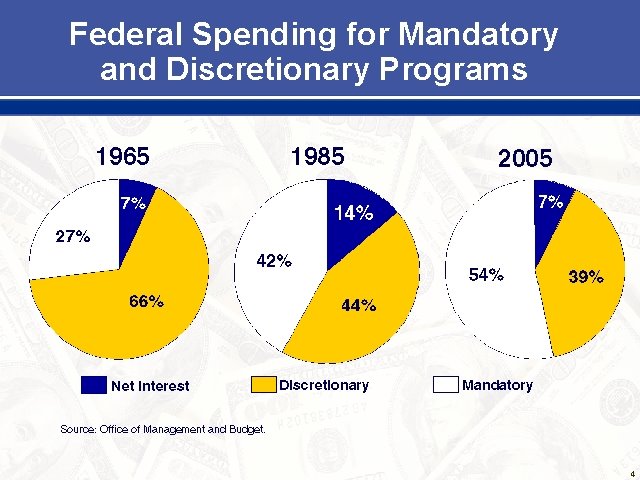

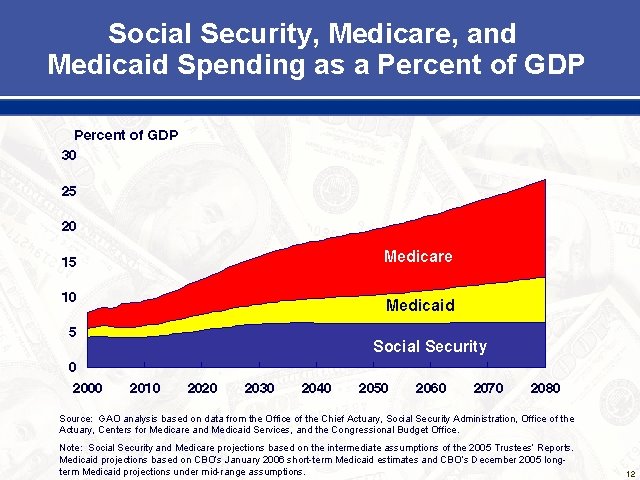
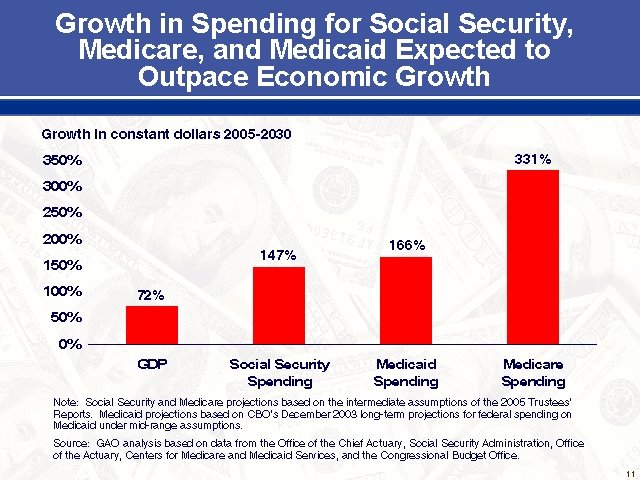
I have heard about the Social Security and Medicare crises, but this really helps to bring home the fact that in fact our debt burden is largely one of entitlement spending. (OK, admittedly any model that goes out to 2080 isn't the most reliable, but still anything remotely close to a quarter of GDP's got to make you sit up and take notice)
I was at a talk by Dr Peter Rodrigeuz of the Darden School of Business at the University of Viriginia earlier this week, where he explained why the changes in demographics in the US and Europe would require them to renegotiate social contracts. It appears that the Hon'ble David Walker's suggesting we may have to do the same.
Wednesday, April 19, 2006
Quote of the Day
I've found myself reading more history recently, especially the history of the American Revolution. One of the great writers of that era, Thomas Paine had this to say about the turmoils of that day (and maybe this one too?)
These are the times that try men's souls. The summer soldier and the sunshine patriot will, in this crisis, shrink from the service of their country; but he that stands it now, deserves the love and thanks of man and woman. Tyranny, like hell, is not easily conquered; yet we have this consolation with us, that the harder the conflict, the more glorious the triumph.
Tuesday, April 18, 2006
The Next Sex Frontier?
CAUTION: This post contains some material which some readers may find offensive ... although I guess you're used to some form of offensivespeak if you've ever read my blog, this time it isn't political!
MSNBC recently covered a story about research going into the development of robotic sexual partners which could cater to every fantasy. It even has a name, "teledildonics" (get it?). Hmm, ok so maybe I'm a bit of a prude, but WHAT!! Teledildonics - gimme a break!
Maybe this is why we are having trouble holding relationships together! Sex is the ultimate expression of emotional intimacy, but we have divorced all emotion and converted it into a merely physical activity. And we wonder where the love's gone. I mean, how f**ked up you gotta to be that you want to get it on with a robot, when there are some wonderful people out there with whom you can enjoy the excitation of not just the body but so much more.
That really is a damning indictment of our societal mindset - we just can't appreciate quality any more. It's like eating dinner at McDonald's because you don't have the time and energy and love to put together a sumptious meal! I don't know if I read it somewhere or I just made it up, but a saying comes to mind:
Whether its a soft loving carress of a partner, or the melodious chirping of the birds, or that faint whiff of spices in your dinner, it's the little things that make life worthwhile. Without them, living, and yes even "pleasure", is a chore!
MSNBC recently covered a story about research going into the development of robotic sexual partners which could cater to every fantasy. It even has a name, "teledildonics" (get it?). Hmm, ok so maybe I'm a bit of a prude, but WHAT!! Teledildonics - gimme a break!
Maybe this is why we are having trouble holding relationships together! Sex is the ultimate expression of emotional intimacy, but we have divorced all emotion and converted it into a merely physical activity. And we wonder where the love's gone. I mean, how f**ked up you gotta to be that you want to get it on with a robot, when there are some wonderful people out there with whom you can enjoy the excitation of not just the body but so much more.
That really is a damning indictment of our societal mindset - we just can't appreciate quality any more. It's like eating dinner at McDonald's because you don't have the time and energy and love to put together a sumptious meal! I don't know if I read it somewhere or I just made it up, but a saying comes to mind:
Life is always about the little things
Whether its a soft loving carress of a partner, or the melodious chirping of the birds, or that faint whiff of spices in your dinner, it's the little things that make life worthwhile. Without them, living, and yes even "pleasure", is a chore!
Sunday, April 16, 2006
The Palestinian Implosion?
I was in a passionate debate with a Muslim friend today about Israel-Palestinian politics. This friend argued, like many other Muslims, that the Palestinians are fighting a just war for their lands, and were martyrs. While there may have been historic injustices to the Palestinians, I find it hard to accept a struggle based on violence, especially one directed at innocent men, women and even children.
I cherish the Indian freedom movement's peaceful roots, which later served as role models for great movements such as Martin Luther King's civil rights protests, the battle against apartheid and the like. Peaceful protest has incredibly great power not just of galvanising the outside world to support your cause, but also controlling the spread of violence internally. Palestinians are already starting to see the cracks in their society, such as armed militants storming the office of the Prime Minister. Ethnic conflicts propped by violence have a tendency for those violent tendencies to backfire on the individual societies, and it's only a matter of time before Palestine implodes. Western aid drying up and a lack of true aid in excess of lip service from the Arab countries could prove the catalyst.
Hamas would do well then to take some time to read the history of global conflicts, not for the sake of the Jewish people who they target, but for the sake of their own people.
I cherish the Indian freedom movement's peaceful roots, which later served as role models for great movements such as Martin Luther King's civil rights protests, the battle against apartheid and the like. Peaceful protest has incredibly great power not just of galvanising the outside world to support your cause, but also controlling the spread of violence internally. Palestinians are already starting to see the cracks in their society, such as armed militants storming the office of the Prime Minister. Ethnic conflicts propped by violence have a tendency for those violent tendencies to backfire on the individual societies, and it's only a matter of time before Palestine implodes. Western aid drying up and a lack of true aid in excess of lip service from the Arab countries could prove the catalyst.
Hamas would do well then to take some time to read the history of global conflicts, not for the sake of the Jewish people who they target, but for the sake of their own people.
Saturday, April 15, 2006
The Rich Pay Too Much!
USAToday reported that most Americans think the tax system is unfair, according to the latest Ipsos poll. Most middle-class Americans think they, as well as lower income earners, pay way too much in income, while rich Americans pay too little. This goes well with political hype from the left about tax cuts for the top 5% while the poor are being left to roost, bread and butter for those in the Left. As a low wage-earner, I certainly am tempted to believe this is true. After all, even the books that promise you the secret of wealth usually tell you the rich don't pay as much in taxes, using loopholes and what have you.
Unfortunately, it's a giant lie! The reality is that the richest Americans already pay a disproportionate share of their incomes to support our tax system. But don't take my word for it - check out this table from the Congressional Budget Office. Now, there are some corrections to be applied to their stats (they don't, for example, count estate taxes and the like) but for the most part, it tells an interesting story. The lowest quintile of wage-earners (that's 25% percentile, or the people who make less than 75% of all wage-earners) pay under 5% of their income to Uncle Sam, as of 2002. The top quintile? Almost 19% The top 5%? Almost 30% The top 1%? Almost a third!
A third? WOW!! That's incredible. I can't think of how you can be accused of being derilict in your civil duty when you fork over a third of your income to Uncle Sam. Remember, this is after deductions for charitable work and the like. The reality is that it's always tempting to skew rules to favor the majority. Most Americans would like to see someone but them pay for the roads they drive on, the clean water they drink, the clean air they breathe, the police force that protects them, and all of the other things that I would argue disproportionately favors the middle and lower classes (after all, rich people don't, for example, need cops, they hire their own security service!)
So suck it up and stop complaining about how you're being screwed by the rich white folk!
Unfortunately, it's a giant lie! The reality is that the richest Americans already pay a disproportionate share of their incomes to support our tax system. But don't take my word for it - check out this table from the Congressional Budget Office. Now, there are some corrections to be applied to their stats (they don't, for example, count estate taxes and the like) but for the most part, it tells an interesting story. The lowest quintile of wage-earners (that's 25% percentile, or the people who make less than 75% of all wage-earners) pay under 5% of their income to Uncle Sam, as of 2002. The top quintile? Almost 19% The top 5%? Almost 30% The top 1%? Almost a third!
A third? WOW!! That's incredible. I can't think of how you can be accused of being derilict in your civil duty when you fork over a third of your income to Uncle Sam. Remember, this is after deductions for charitable work and the like. The reality is that it's always tempting to skew rules to favor the majority. Most Americans would like to see someone but them pay for the roads they drive on, the clean water they drink, the clean air they breathe, the police force that protects them, and all of the other things that I would argue disproportionately favors the middle and lower classes (after all, rich people don't, for example, need cops, they hire their own security service!)
So suck it up and stop complaining about how you're being screwed by the rich white folk!
Oh, To Be Laid Off By GM
You hear all these stories of GM and Ford laying off workers and images of struggling families come to mind. Well, that may be an illusion, according to this article by George Will. Here's the part that just stunned me:
jWow, if that's correct, that's incredible - a lot more than I'll probably ever make in my life, even with a PhD! And for doing nothing, zilch, nada!
I loved the last line of this article:
Incidentally, if you are looking for an investment tip, Ford bonds may not be a bad buy, considering the juicy yields and this fact:
Under contracts negotiated, beginning in 1984, with the United Auto Workers (UAW), there are about 14,700 laid-off autoworkers in the "Jobs Bank." About 7,500 of them are from GM. They get paid most of their wages and benefits -- between $100,000 and $130,000 a year, for an annual cost to GM of $750 million to $900 million.
jWow, if that's correct, that's incredible - a lot more than I'll probably ever make in my life, even with a PhD! And for doing nothing, zilch, nada!
I loved the last line of this article:
Detroit today is having what Washington will eventually have -- a wrenching rendezvous with promises that seemed compassionate, or at least convenient, when originally made but that cannot be kept without ruinous consequences.
Incidentally, if you are looking for an investment tip, Ford bonds may not be a bad buy, considering the juicy yields and this fact:
Jay Palmer of Barron's says Ford cannot win concessions from workers by credibly threatening bankruptcy because "CEO Bill Ford and other descendants of founder Henry Ford own roughly 40% of the company's voting equity. A bankruptcy would in one stroke eliminate a huge chunk of their fortune and effectively sever the family's ties with the company."
Friday, April 14, 2006
Fire the Accountant!
Vice President Dick Cheney, arguably one of the most powerful men in the world, cannot seem to afford a decent accountant! What else would explain that he overpaid his income taxes by about $1.93 million this year. Even at a modest 3% rate of interest, that's a LOT of money that Uncle Sam got for free. I don't get it, me with my measly stipend try to get my tax burden right to avoid giving a interest-free loan, you think Cheney with his bevy of accountants could do a little better than that?
The Smallest Quiz
Someone forwarded me an e-mail link for the smallest quiz that helps put you on the map in terms of political and economic views with just 10 questions. Interesting, although I question its validity despite rave reviews. Anyway, just FYI, I'm a centrist - scored 50% on Personal Issues (dead center) and 80% on economic issues (conservative).
Cheers,
Karthik
Cheers,
Karthik
Wednesday, April 12, 2006
Ouch ... We're Even More in Debt!
The US budget deficit edged up in March, thanks in large part due to a 13.7% increase in spending compared to last March. Yes, the actual deficit increased by a lot less due to increased tax receipts, but that doesn't take away from the fact that we've got runaway spending. Talk about the collaboration of villians - a White House and its clones that just don't seem to care about deficits (in fact, Cheney loves to talk about how "Reagan proved deficits don't matter") and an opposition party that to whom the solution to deficits is not spending cuts but tax raises.
First the idea that Reagan somehow proved deficits don't matter. I'd love to see evidence that this was the case. The reality is that we have had a serious deficit crisis building for the last several decades, one that was temporarily ameliorated by the booming '90s (see the figure, taken from this page at K-State)
The red line's the Federal government's projects for the deficit. Keep in mind they are required to cut the budget in half within the next 5 years, so I'd take their projections with more than a grain of salt. The question is will tax receipts be able to reduce deficits? Given the multitude of asset bubbles we have at present, it appears unlikely that we will see even constant, let alone booming, receipts without a sharp increase in tax rates. We might, but it hardly is a given. Prudence then requires we focus on the spending side.
But of course, all this leads back to politicians. How many pols win elections talking about deficits as opposed to their favorite pet projects, be it war, protection of entitlement spending or what have you? And so we can continue to see growing deficits and more macroeconomic concern.
First the idea that Reagan somehow proved deficits don't matter. I'd love to see evidence that this was the case. The reality is that we have had a serious deficit crisis building for the last several decades, one that was temporarily ameliorated by the booming '90s (see the figure, taken from this page at K-State)
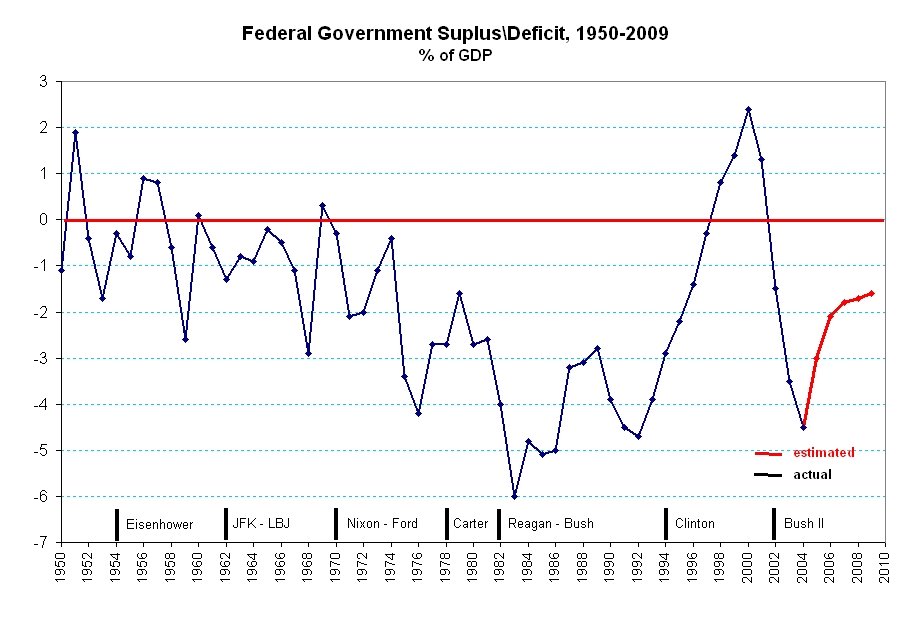
The red line's the Federal government's projects for the deficit. Keep in mind they are required to cut the budget in half within the next 5 years, so I'd take their projections with more than a grain of salt. The question is will tax receipts be able to reduce deficits? Given the multitude of asset bubbles we have at present, it appears unlikely that we will see even constant, let alone booming, receipts without a sharp increase in tax rates. We might, but it hardly is a given. Prudence then requires we focus on the spending side.
But of course, all this leads back to politicians. How many pols win elections talking about deficits as opposed to their favorite pet projects, be it war, protection of entitlement spending or what have you? And so we can continue to see growing deficits and more macroeconomic concern.
Tuesday, April 11, 2006
The Muzzles Go to ...
The Thomas Jefferson Center for the Protection of Free Speech announced the recipients of the 2006 Jefferson Muzzles for attempting to suppress free speech. Besides the usual suspects in President Bush, Dept of Justice, FCC, Dept of Homeland Security, there were a few not-so-familiar ones. Here are a couple I found interesting:
Rep. Joe Barton, for attempting to bully climate change scientists, using not a citation from a peer-reviewed journal but the Wall Street Journal! I'm all ears for any respectable scientist who wants to present data arguing against global warming, but when we decide to pressure scientists for policy reasons, that crosses the line.
William Paterson University. This is a sad reality of how hypersensitive and freaking PC people have gotten. A professor sent an e-mail about some lesbian films that were to be screened, and inviting comments from the university readership. A student who was offended responded by calling the acts "a perversion" and offensive to his religious beliefs. The university went on to file sexual harrassment charges against the student, with the professor claiming it caused her to "feel threatened in her workplace" GIVE ME A FREAKING BREAK!
The reality is free speech is threatened, but not only by those in the federal government. I have noticed in my very own college newspaper a definitive tendency to publish liberal garbage rather than conservative speak, a scenario where a leftist may criticize the Christian faith, but a Christian cannot enunciate his views on abortion or homosexuality, to print extensive essays on the need for a "living wage", but not even a letter (which I have tried to submit on multiple occasions) on why the call for a living wage is misplaced.
The reality is free speech is threatened, but not only by those in the federal government. I have noticed in my very own college newspaper a definitive tendency to publish liberal garbage rather than conservative speak, a scenario where a leftist may criticize the Christian faith, but a Christian cannot enunciate his views on abortion or homosexuality, to print extensive essays on the need for a "living wage", but not even a letter (which I have tried to submit on multiple occasions) on why the call for a living wage is misplaced.
Free File Isn't That Free
So the IRS has a program called Free File whereby taxpayers who make less than $50,000 can e-file their taxes for free using a third-party vendor. Except maybe free isn't always free. For a second year in a row, I grew frustrated with several wasted hours on H&R Block before I chucked the computer for the good ol' paper and pen (ok, not quite - I did fill my tax forms online with Acrobat, but then printed them out and will postal mail them). It appears that at least H&R Block wants to be confusing, forcing you constantly to consider abandoning the Free File for time with a consultant. Amazingly, it's a lot easier to figure things out by reading the tax booklets (never thought I'd live to say this!)
The IRS' refusal to provide an e-file platform is senseless. MSNBC reported Bert DuMars, IRS director of electronic tax administration, giving his interpretation of Congress statutues was "that IRS should stay out of the tax software preparation business." Sure, no one wants the IRS to hire software programmers to manage this work. But the IRS can, for a very small amount of money, hire a third-party vendor to manage this free platform. My state, Virginia has done this, and I must say, even given that state taxes are a lot simpler than federal tax returns, it was a pleasure to finish filing your taxes and pay your shortfall in all of 5 minutes!
Appears to me like some firms are seeing healthy returns on their lobbying investments, while the average taxpayer gets screwed!
The IRS' refusal to provide an e-file platform is senseless. MSNBC reported Bert DuMars, IRS director of electronic tax administration, giving his interpretation of Congress statutues was "that IRS should stay out of the tax software preparation business." Sure, no one wants the IRS to hire software programmers to manage this work. But the IRS can, for a very small amount of money, hire a third-party vendor to manage this free platform. My state, Virginia has done this, and I must say, even given that state taxes are a lot simpler than federal tax returns, it was a pleasure to finish filing your taxes and pay your shortfall in all of 5 minutes!
Appears to me like some firms are seeing healthy returns on their lobbying investments, while the average taxpayer gets screwed!
Monday, April 10, 2006
Immigration Rallies
The US has seen the largest rallies in its history since the Vietnam war, spearheaded by pro-immigrant groups, churches, unions and small businesses. Several small business leaders pointed out on news shows that they would go out of business without the labor these immigrants bring. One of them pointed out that for 8 of the 16 years of his firm, they used exclusively US citizens for labor, but reliable help was hard to find. Migrant workers work hard and prevent wage inflation, and reduce costs for all of us.
Much has been made by so-called conservatives about the fact that immigrants cost the country more than they benefit the economy. (I used the phrase "so-called" because a true conservative, in my opinion, is one who understands basic laws of supply and demand) Well, CBS News tonight had a few numbers and while they didn't intend to put them side-by-side, I made the connection! Illegal immigrants pay $10 billion in taxes currently, and if all were under the tax net, an additional $15 billion would be forthcoming. Later in the story, a number on how much they cost the exchequer - $2.2 billion in health spending. That means even the current tax revenues from illegal immigrants probably covers their healthcare costs. A guest worker program could end up being a tax bonanza for Uncle Sam, especially since non-citizens don't get the benefits from programs such as Social Security, even though they pay these taxes.
And while a small section of xenophobic Republicans have proved a stumbling block, the real shocker for immigrant groups must have been that in the end, we don't have a practical bill because of the Democrats. Here's the left-leaning Washington Post:
Much has been made by so-called conservatives about the fact that immigrants cost the country more than they benefit the economy. (I used the phrase "so-called" because a true conservative, in my opinion, is one who understands basic laws of supply and demand) Well, CBS News tonight had a few numbers and while they didn't intend to put them side-by-side, I made the connection! Illegal immigrants pay $10 billion in taxes currently, and if all were under the tax net, an additional $15 billion would be forthcoming. Later in the story, a number on how much they cost the exchequer - $2.2 billion in health spending. That means even the current tax revenues from illegal immigrants probably covers their healthcare costs. A guest worker program could end up being a tax bonanza for Uncle Sam, especially since non-citizens don't get the benefits from programs such as Social Security, even though they pay these taxes.
And while a small section of xenophobic Republicans have proved a stumbling block, the real shocker for immigrant groups must have been that in the end, we don't have a practical bill because of the Democrats. Here's the left-leaning Washington Post:
Democrats - whether their motive was partisan advantage or legitimate fear of a bad bill emerging from conference with the House - are the ones who refused, in the end, to proceed with debate on amendments, which is, after all, how legislation gets made. The unfortunate result is that the momentum toward balanced reform may be lost. ‘The Democratic leadership played politics with the prospect of 10 million immigrants getting on a path to citizenship,’ said Frank Sharry, executive director of the National Immigration Forum, a pro-immigration group. ‘It seems that Democratic leaders wanted an issue, not a bill.’”
Friday, April 07, 2006
Black Men Dropping Out
As a scientist, I tend to approach even mainstream articles and politics with a critical view, and found a lot of bone to pick with this article by Michael Ross. He correctly worries about the increasing drop-out of black men from the labor force, but then goes on to list the usual suspects for reasons why - discrimination, high incidence of prison stay, etc. All of which might well be true - I'm no expert on the social problems of the black community - but doesn't explain why black women are improving their lot. Being in a university, I'm struck by how so few American black men (i.e. non-immigrants) are present in research settings compared to their female counterparts. I remember Newsweek also did a story where there's some social turmoil associated with a widening gap between the educational expectations of male and female.
There may be a good socialogical explanation for this, one I'd like to hear. Instead, we get "experts" in the media who'd rather rehash the same old cliches!
There may be a good socialogical explanation for this, one I'd like to hear. Instead, we get "experts" in the media who'd rather rehash the same old cliches!
Thursday, April 06, 2006
El-Erian Interview
I was reading an interview in Smart Money magazine with Mohammed El-Erian, formerly with PIMCO and Harvard's new endowment money manager, and I found some interesting insight about why China has been such an aggressive buyer of low-yielding Treasurys that I hadn't heard before. Most "experts" argue it's because US Treasuries are so safe, and what have you, but El-Erian had this to say:
[The Chinese] are not doing it out of charity; they're doing it out of self-interest. they know three things: One is that their export machine creates jobs, and they have a tremendous amount of people coming off the farms and coming out of state-owned enterprises. So there's a social need to create jobs, and exports are a good way of doing that. The second is that they are great students of history. International trade history tells you something very simple: once you capture market share, it's very difficult to lose. So there's the long term benefit to building their export business. The third issue is that once you've become an export machine, every single multinational will desperately want to set up a factory in your country. Suddenly, instead of paying for technology or paying for capital, it's all moving to you very cheaply. So China's view is, "Yeah, buying a 5-year Treasury at 4/3% may not make much sense, but look at what I'm getting in return,. I'm getting things that will contribute to my long-term development"
Tuesday, April 04, 2006
Tainted Journos?
So Katie Couric may be moving over to CBS, taking over from Bob Schieffer. I think she'll pull in new viewers for a while, but as a huge fan of Bob Schieffer, one who switched to the CBS Evening News after he took over from Dan Rather, I gotta say I'm disappointed. But the discomfort with Katie Couric taking over had me investigating if I had a bias against women journalists as hosts.
Not true, I concluded. I really like PBS' two female journalists - Gwen Ifill and Margaret Warner. I think either of them could host an news program and attract me (actually both do when Jim Lehrer isn't in town). Gwen hosts Washington Week, which is one of my must-not-miss political shows (the other two are McLaughlin Group on PBS and Chris Mathews Show on NBC). So why the discomfort with Katie Couric or Elizabeth Vargas or Connie Chung?
Well, here's my conclusion. Serious news viewers (and we're a small breed) don't want a journalist tainted by a non-news background. We would shudder to think of a sportscaster taking over the evening news, and we certainly don't like someone who spent the last 10 years of their life talking about minutae like fashion or cooking to migrate to the serious business of news. The network evening news are already suffering from an overdose on non-news and the lack of analysis, and I guess I have a deep-seated fear that a journo tainted with non-news will bring more of it with him or her.
So I may still continue to watch CBS News, but in the meanwhile, how about a network asking Gwen or Margaret to migrate over? Aw heck, it'll never happen. Neither of them would degrade themselves into talking the crap that network news would want on there anyway!
Not true, I concluded. I really like PBS' two female journalists - Gwen Ifill and Margaret Warner. I think either of them could host an news program and attract me (actually both do when Jim Lehrer isn't in town). Gwen hosts Washington Week, which is one of my must-not-miss political shows (the other two are McLaughlin Group on PBS and Chris Mathews Show on NBC). So why the discomfort with Katie Couric or Elizabeth Vargas or Connie Chung?
Well, here's my conclusion. Serious news viewers (and we're a small breed) don't want a journalist tainted by a non-news background. We would shudder to think of a sportscaster taking over the evening news, and we certainly don't like someone who spent the last 10 years of their life talking about minutae like fashion or cooking to migrate to the serious business of news. The network evening news are already suffering from an overdose on non-news and the lack of analysis, and I guess I have a deep-seated fear that a journo tainted with non-news will bring more of it with him or her.
So I may still continue to watch CBS News, but in the meanwhile, how about a network asking Gwen or Margaret to migrate over? Aw heck, it'll never happen. Neither of them would degrade themselves into talking the crap that network news would want on there anyway!
Saturday, April 01, 2006
Bring 'em Back to the Ground
You ever noticed how the media tends to create angelic companies. We've been inundated with stories about how Google's motto is "first do no harm" or how great Apple is. But when you take the hype away, you see these companies for what they fundamentally are - companies which are in the business of making money. Now, I'm a free-market capitalist and don't have a problem with that, but I am sick and tired of the propoganda.
Apple refused to share source code that would allow other MP3 players to access the iTunes website, even though they are legally different segments of the business. When Microsoft did that, there was an outrage, but for Apple, there was nary a whisper. Apple tends to keep pushing new versions of the OS and software, and offers poor support on their old versions ... nothing?
As for Google, well, they certainly violated their stated motto by doing serious harm to their stockholder with their plans to offer a secondary stock offering. For more analysis on this issue, read this article on the Motley Fool website.
My intent is not to denigrate these companies or to prop up Microsoft. I have been gradually steering away from Word and even Powerpoint for my work applications (moving to Latex and Acrobat instead). But open-source isn't the answer for everyone - it's hard to understand, there's no support and basically isn't worth your while if you aren't a geek willing to spend your precious free time on it. The point is there are several good vendors offering different products that may be good or crappy depending on your application. All of them are in to make a profit, as they should, and none of them have some greater social goal, except where it lines up with their business interests.
Apple refused to share source code that would allow other MP3 players to access the iTunes website, even though they are legally different segments of the business. When Microsoft did that, there was an outrage, but for Apple, there was nary a whisper. Apple tends to keep pushing new versions of the OS and software, and offers poor support on their old versions ... nothing?
As for Google, well, they certainly violated their stated motto by doing serious harm to their stockholder with their plans to offer a secondary stock offering. For more analysis on this issue, read this article on the Motley Fool website.
My intent is not to denigrate these companies or to prop up Microsoft. I have been gradually steering away from Word and even Powerpoint for my work applications (moving to Latex and Acrobat instead). But open-source isn't the answer for everyone - it's hard to understand, there's no support and basically isn't worth your while if you aren't a geek willing to spend your precious free time on it. The point is there are several good vendors offering different products that may be good or crappy depending on your application. All of them are in to make a profit, as they should, and none of them have some greater social goal, except where it lines up with their business interests.
Bring Back the Uniform
A high school student has sued to force school officials to allow her to wear clothes with the Confederate flag on it. The Confederate flag is one of those intriguing symbols that at the same time represents heritage and the sacrifice of Southern soldiers, but also prejudice and slavery, equated by some along with the Nazi symbol. But this post is not about the Confederate symbol, but about school uniforms. That's right, uniforms!
I went to a school with uniforms, and I can tell you I'm appreciative. Not just because of contentious debate over Confederate flags or the like. Students in uniforms mean kids expend less energy at school being distracted by others' clothing. The lines between the preppy and the nerdy begins to dim. It means poor families no longer have to deal with their teen needing to wear fashionable clothing to school. It allows for better homogenization among different groups, but more importantly, as a consequence, it allows students to focus on the subjects in the classroom, rather than external factors. Oh, and I'd have strict rules on hair and grooming ... sorry, I don't think a school has to honor a kid's freedom of expression by wearing a purple mohawk!
Of course, what exactly we focus on in school is another issue. George Will wrote a brilliant piece where he pointed out that we seem to be spending more energy and attention on "helping kids discover themselves" rather than teaching them core subjects, like science and mathematics. This might have been ok in the past, but in an increasing age of global competiveness, this won't do!
I went to a school with uniforms, and I can tell you I'm appreciative. Not just because of contentious debate over Confederate flags or the like. Students in uniforms mean kids expend less energy at school being distracted by others' clothing. The lines between the preppy and the nerdy begins to dim. It means poor families no longer have to deal with their teen needing to wear fashionable clothing to school. It allows for better homogenization among different groups, but more importantly, as a consequence, it allows students to focus on the subjects in the classroom, rather than external factors. Oh, and I'd have strict rules on hair and grooming ... sorry, I don't think a school has to honor a kid's freedom of expression by wearing a purple mohawk!
Of course, what exactly we focus on in school is another issue. George Will wrote a brilliant piece where he pointed out that we seem to be spending more energy and attention on "helping kids discover themselves" rather than teaching them core subjects, like science and mathematics. This might have been ok in the past, but in an increasing age of global competiveness, this won't do!
Sunday, March 26, 2006
Guest Worker Program
My brother and I were having an interesting discussion on immigration politics when the topic of the guest worker program came up, and my brother pronounced it dead-on-arrival. That's now new, but his reasoning certainly was. Employers using a guest worker permit would have to pay their workers a minimum wage, and he postulates that real wages are so far below the mandated state limit than a widespread use of a guest worker program would send price shocks through the economy, and many a company or farm would collapse under the burden.
Workers being paid such low wages isn't an indication of a perfect system, but politicians eyeing elections later this year seem unwary of their ability to screw things up big time. Even if a guest worker program does come through, we will need discussion of how we will transition the higher costs into the economy at large. And God forbid, the opponents of immigration succeed, they need to be able to explain where corporations and small businesses and especially farms are going to find labor at the costs they can afford.
Workers being paid such low wages isn't an indication of a perfect system, but politicians eyeing elections later this year seem unwary of their ability to screw things up big time. Even if a guest worker program does come through, we will need discussion of how we will transition the higher costs into the economy at large. And God forbid, the opponents of immigration succeed, they need to be able to explain where corporations and small businesses and especially farms are going to find labor at the costs they can afford.
Friday, March 24, 2006
The Sound of Popping
Well, the latest piece of evidence in the popping of the real estate bubble is the 10.5% drop in seasonally-adjusted new home sales, and the fourth month of decline in median sale price. All the bullish arguments for why home prices would not fall have been shown to be bullsh*t instead! We should see prices continue to drop in the months to come, especially if the US hits a recession at some point in the near term(you know the GDP can't just keep growing!)
I forecast that even places without local real estate bubbles will see a downturn. Why? Simply because of how prices are set. Price is determined by emotion as much as reality, and if and when stories flood the newspaper of individuals losing their shirts (rather than some abstract economic headline number), sellers will be more pressured to compromise on price, while buyers will be encouraged to bargain harder. That's why a recession or even economic slowdown could be significant - a seller who has either lost his/her job or fears doing so is more likely to try to reduce his/her mortgage liabilities for what he/she can.
I forecast that even places without local real estate bubbles will see a downturn. Why? Simply because of how prices are set. Price is determined by emotion as much as reality, and if and when stories flood the newspaper of individuals losing their shirts (rather than some abstract economic headline number), sellers will be more pressured to compromise on price, while buyers will be encouraged to bargain harder. That's why a recession or even economic slowdown could be significant - a seller who has either lost his/her job or fears doing so is more likely to try to reduce his/her mortgage liabilities for what he/she can.
Quote of the Day
Senator Hillary Clinton, critizing the new immigration bill on the floor of the House, that would make it a criminal activity to help an illegal immigrant, even at a homeless shelter.
This bill would literally criminalize the Good Samaritan and probably even Jesus himself.
Thursday, March 23, 2006
Can the US Stay Ahead?
I often find tales of the US' reduced dominance to be a little overplayed, but thought this article in USNews to be interesting, despite the hyped title. I'll let you read the article, but I found some numbers at the end of the article very interesting:
Estimated amount U.S. companies spend annually on R&D: $194 Billion
Estimated amount U.S. companies spend annually on tort litigation: $205 Billion
Percent of engineering Ph.D's awarded in the United States that go to foreign-born students: 56
Number of the world's Top 25 information-technology companies based in the U.S.: 6
Number of the world's Top 25 information-technology companies based in Asia: 14
U.S. trade balance in high-tech manufactured goods, 1990: $33 Billion
U.S. trade balance in high-tech manufactured goods, 2004: -24 Billion
Estimated amount U.S. companies spend annually on R&D: $194 Billion
Estimated amount U.S. companies spend annually on tort litigation: $205 Billion
Percent of engineering Ph.D's awarded in the United States that go to foreign-born students: 56
Number of the world's Top 25 information-technology companies based in the U.S.: 6
Number of the world's Top 25 information-technology companies based in Asia: 14
U.S. trade balance in high-tech manufactured goods, 1990: $33 Billion
U.S. trade balance in high-tech manufactured goods, 2004: -24 Billion
Wednesday, March 22, 2006
A Moralizing Government?
Missisipi outlawed sex toys, according to this posting in the Abrams report on MSNBC. Whoa, hold your horses, congressman! Don't you think you're stretching the definition of government a little too far?
I'm an odd person to be arguing for sex toys. I've never seen, much less used, a sex toy in real life. I'm very conservative not only in my personal life but also in public policy. I support the conservative movement in a number of issues, from the value of abstinence education to the role of faith-based charity and religion in our society. But there is such a thing as taking a good point too far.
Government has some valid responsibilities in personal life, but only when they are related to the protection of the vulnerable or the future of society. It is appropriate for people to dictate, through their government, their definition of marriage, for example, in the interests of parental rights or social structure, but they cannot prohibit homosexuality when practiced in the confines of one home, even if they consider it immoral behavior. That's the hallmark of our freedoms - you as consenting adults can do what you like in the privacy of your homes, but the minute an individual who is not a consenting adult is involved, society at large will step in in the interests of that individual, and society at large.
Sex toys and pornography should be protected by the First Amendment, as should the right to have sex outside of marriage. Just because our lawmakers consider them to be abhorant behavior is not reason enough to ban them.
Oh, and while we are at it, do we really need to have as many restrictions on smoking? If the concern is that smokers are at increased risk for lung cancer and may strain the public health system, we can simply argue that co-pays will go up for smokers, or lung cancer will not be covered to the same extent by Medicare. Cruel? Sure - but in an ownership society, individuals have to pay for their actions. But along with that comes the liberty to make those choices. Cigarettes are a legal product that can be enjoyable and yet harmful - no different than that order of fries at McDonald's. When government starts intervening in personal decisions such as these, we threaten the very definition of a free society.
I'm an odd person to be arguing for sex toys. I've never seen, much less used, a sex toy in real life. I'm very conservative not only in my personal life but also in public policy. I support the conservative movement in a number of issues, from the value of abstinence education to the role of faith-based charity and religion in our society. But there is such a thing as taking a good point too far.
Government has some valid responsibilities in personal life, but only when they are related to the protection of the vulnerable or the future of society. It is appropriate for people to dictate, through their government, their definition of marriage, for example, in the interests of parental rights or social structure, but they cannot prohibit homosexuality when practiced in the confines of one home, even if they consider it immoral behavior. That's the hallmark of our freedoms - you as consenting adults can do what you like in the privacy of your homes, but the minute an individual who is not a consenting adult is involved, society at large will step in in the interests of that individual, and society at large.
Sex toys and pornography should be protected by the First Amendment, as should the right to have sex outside of marriage. Just because our lawmakers consider them to be abhorant behavior is not reason enough to ban them.
Oh, and while we are at it, do we really need to have as many restrictions on smoking? If the concern is that smokers are at increased risk for lung cancer and may strain the public health system, we can simply argue that co-pays will go up for smokers, or lung cancer will not be covered to the same extent by Medicare. Cruel? Sure - but in an ownership society, individuals have to pay for their actions. But along with that comes the liberty to make those choices. Cigarettes are a legal product that can be enjoyable and yet harmful - no different than that order of fries at McDonald's. When government starts intervening in personal decisions such as these, we threaten the very definition of a free society.
Monday, March 20, 2006
Random Late-Night Funnies
"The FBI is investigating Americans -- just for opposing the war. You know, maybe when we're done establishing a democracy in Iraq, we could try it over here. Stop, I don't want to get investigated, don't applaud!" --Jay Leno
"Former President Bill Clinton is telling people that his gut is saying that America is ready for a woman president. And I would say to President Clinton that's not your gut talking." --David Letterman
"First Lady Laura Bush said she started exercising when she married President Bush because it was already part of his lifestyle. Isn't that nice? Yeah, that also explains why she stopped reading." --Conan O'Brien
"Snap! Censure! A moral condemnation of the president so severe it's only happened once before to President Andrew Jackson, who was never heard from again. Oh, wait [picture of the $20 bill]." --Jon Stewart, on Sen. Russ Feingold's motion to censure President Bush
"Former President Bill Clinton is telling people that his gut is saying that America is ready for a woman president. And I would say to President Clinton that's not your gut talking." --David Letterman
"First Lady Laura Bush said she started exercising when she married President Bush because it was already part of his lifestyle. Isn't that nice? Yeah, that also explains why she stopped reading." --Conan O'Brien
"Snap! Censure! A moral condemnation of the president so severe it's only happened once before to President Andrew Jackson, who was never heard from again. Oh, wait [picture of the $20 bill]." --Jon Stewart, on Sen. Russ Feingold's motion to censure President Bush
An Immigration Crisis
I've been recently interacting with a fair number of graduating international students who have complained about the complexity and stress involved with visa transfers that would allow them to switch to a worker visa. The process was relatively simplified (relative being the key word!) during the booming '90s, but in a post-9/11 world, the restrictions are suffocating. A graduating student would, for example, have to guess when visa quotas for a given year might expire, and how long the process may take, and then try to graduate at the right time, assuming of course, that funding was available until that time.
This clearly is out of control. We cannot have a system where students are required to navigate these loopholes or retain a lawyer. In the end, the US will lose, as students will choose easier pastures. In the past, there were few such options, but in the present era of competitive globalization, penalties for excessive regulation will be severe!
Postscript: Looks like Bill Gates is in Washington trying to lobby for support to increase the cap for the number of foreign workers from 65,000, a number that was 3 times as high a few years ago. More on the Gates visit here
This clearly is out of control. We cannot have a system where students are required to navigate these loopholes or retain a lawyer. In the end, the US will lose, as students will choose easier pastures. In the past, there were few such options, but in the present era of competitive globalization, penalties for excessive regulation will be severe!
Postscript: Looks like Bill Gates is in Washington trying to lobby for support to increase the cap for the number of foreign workers from 65,000, a number that was 3 times as high a few years ago. More on the Gates visit here
Tuesday, March 14, 2006
Inept Legal Team
How on earth can you allow such an inept legal team on possibly the most important legal case in contempory times - the trial of Zacarias Moussaoui, the "20th suicide bomber" on 9/11. Coaching witnesses! Lieing to the defense that certain witnesses were unwilling to talk to the defense, without ever talking to those witnesses. Not conveying to the witnesses the judge's orders against following the news. Discussing testimony with witnesses. No wonder an exasperated Judge Brinkema exclaimed, "I wouldn’t trust anything [Transportation Security Agency prosecutor Carla] Martin had anything to do with at this point"
Yes Virginia, You Are Overvalued!
I have not talked about real estate in a while, in part because it's been all over the mainstream media, more so than it really deserves (most stories have no new content, and rehash the same old crap!) But National City Corp. reported estimates of fair value for real estate in several cities yesterday and found several cities to be vastly overvalued. My own state of Virginia as well as my former state of Arizona are positively bloated - I live in Charlottesville, where houses are 30% overvalued! The most overvalued? Naples, FL - 96% overvalued. The most undervalued? College Station, TX - almost 23% undervalued. Texas accounted for 8 of the 10 most undervalued cities, while California and Florida for 18 of the 20 most overvalued.
Saturday, March 11, 2006
In the Doctor's Backyard
I just watched some of the coverage on MSNBC on the Southern Republican Leadership Conference. Sen Bill Frist, not exactly my favorite man, won the straw poll in his backyard, but the most interesting development, I thought, was Sen John McCain urging people to write in President Bush's name, as a sign of support for him in these tough times. It was an interesting strategy, one emphasized by an interview with his ally, Sen Lindsey Graham. The McCain campaign is obviously investing heavily in the idea that the candidate blessed by the incumbent tends to win the primaries. It is odd that McCain, a greater hawk than Bush, has to embrace the President to appear conservative enough.
I also heard Mitt Romney's speech, and while he struck a chord at a couple of points, for the most part I was not impressed. I didn't get to hear George Allen or Brownback or or Tancredo or others who represent the body of the Republican party that's anti-immigration. Listen, I'm all for talking tough on the topic, but as I have ranted before, illegals come because we in this country have a serious shortage of cheap labor. Anyone who's ever been to a farm will know we couldn't enjoy the good life without the poor illegals willing to work for peanuts!
The other person I heard interviewed was Sen Trent Lott, and I must say I was very impressed. Here's a guy who seemed to be articulate, and at least in the course of the interview, lacked the venom so pervasive in the Beltway.
Oh, and if you can vote, do so for John McCain ... you know it's the right thing to do!
I also heard Mitt Romney's speech, and while he struck a chord at a couple of points, for the most part I was not impressed. I didn't get to hear George Allen or Brownback or or Tancredo or others who represent the body of the Republican party that's anti-immigration. Listen, I'm all for talking tough on the topic, but as I have ranted before, illegals come because we in this country have a serious shortage of cheap labor. Anyone who's ever been to a farm will know we couldn't enjoy the good life without the poor illegals willing to work for peanuts!
The other person I heard interviewed was Sen Trent Lott, and I must say I was very impressed. Here's a guy who seemed to be articulate, and at least in the course of the interview, lacked the venom so pervasive in the Beltway.
Oh, and if you can vote, do so for John McCain ... you know it's the right thing to do!
Subscribe to:
Posts (Atom)
