Sunday, January 28, 2007

Unhappy Meals

You've got to love an essay that starts like this:
Eat food. Not too much. Mostly plants. That, more or less, is the short answer to the supposedly incredibly complicated and confusing question of what we humans should eat in order to be maximally healthy. I hate to give away the game right here at the beginning of a long essay, and I confess that I'm tempted to complicate matters in the interest of keeping things going for a few thousand more words.


What follows is Michael Pollan's brilliant (and humorous) essay in the International Herald Tribune, titled Unhappy Meals. But before you shut your browser and head out to snack on your favorite brand of potato chips, consider this:
And you're much better off eating whole fresh foods than processed food products. That's what I mean by the recommendation to eat "food." Once, food was all you could eat, but today there are lots of other edible foodlike substances in the supermarket. These novel products of food science often come in packages festooned with health claims, which brings me to a related rule of thumb: if you're concerned about your health, you should probably avoid food products that make health claims. Why? Because a health claim on a food product is a good indication that it's not really food, and food is what you want to eat.


In a piece that spans 14 pages, he turns to expose why our nutrition system is quite so confusing, exposing the politics and the economics of making things that way.
It's hard to imagine the low-fat craze taking off as it did if McGovern's original food-based recommendations had stood: eat fewer meat and dairy products. For how do you get from that stark counsel to the idea that another case of Snackwell's is just what the doctor ordered?


And fundamentally points to getting back to food, rather than nutrients in processed foods:
Of course it's also a lot easier to slap a health claim on a box of sugary cereal than on a potato or carrot, with the perverse result that the most healthful foods in the supermarket sit there quietly in the produce section, silent as stroke victims, while a few aisles over, the Cocoa Puffs and Lucky Charms are screaming about their newfound whole-grain goodness.


Here's another classic paragraph on why you should ignore the scientists and focus on what has worked for centuries:
Also, people don't eat nutrients, they eat foods, and foods can behave very differently than the nutrients they contain. Researchers have long believed, based on epidemiological comparisons of different populations, that a diet high in fruits and vegetables confers some protection against cancer. So naturally they ask, What nutrients in those plant foods are responsible for that effect? One hypothesis is that the antioxidants in fresh produce — compounds like beta carotene, lycopene, vitamin E, etc. — are the X factor. It makes good sense: these molecules (which plants produce to protect themselves from the highly reactive oxygen atoms produced in photosynthesis) vanquish the free radicals in our bodies, which can damage DNA and initiate cancers. At least that's how it seems to work in the test tube. Yet as soon as you remove these useful molecules from the context of the whole foods they're found in, as we've done in creating antioxidant supplements, they don't work at all. Indeed, in the case of beta carotene ingested as a supplement, scientists have discovered that it actually increases the risk of certain cancers. Big oops.


My intent is not to present too much of the article, for really it is best read as the author intended, in one piece, but I leave you with one last tidbit:
For reasons of economics, the food industry prefers to tease its myriad processed offerings from a tiny group of plant species, corn and soybeans chief among them. Today, a mere four crops account for two-thirds of the calories humans eat. When you consider that humankind has historically consumed some 80,000 edible species, and that 3,000 of these have been in widespread use, this represents a radical simplification of the food web. Why should this matter? Because humans are omnivores, requiring somewhere between 50 and 100 different chemical compounds and elements to be healthy. It's hard to believe that we can get everything we need from a diet consisting largely of processed corn, soybeans, wheat and rice.


Also, if you don't have the time to read the whole article (shame on you!), at least skip to page 12 to look for Pollan's tips on how to restructure your diet. You will lose a lot, but I guess it's better than losing it all!

Quote of the Day

Stephen Colbert, comedian and host of the Colbert report, on Bush's healthcare proposal to allow tax deductions to encourage greater access to health insurance among the uninsured:
It's simple. Most people who can't afford health insurance also are too poor to owe taxes. But if you give them a deduction from the taxes they don't owe, they can use the money they're not getting back from what they haven't given to buy the healthcare they can't afford.

Saturday, January 27, 2007

Bush and The 20% Reduction

You heard it on the State of the Union address by President Bush:
Let us build on the work we've done and reduce gasoline usage in the United States by 20 percent in the next 10 years.


Well, turns out this is a little different from what you might think. MSNBC reports the following:
environmentalists noted the 20 percent goal applies to how much gas is forecast to be used in 2017, not how much is used now. Because of an expected increase in consumption over the next decade, such a cut would not reduce the amount of gas currently consumed.


That is a big difference! The reality is the Bush administration is still not serious enough about the risk of climate change, and much of the moves interpreted in that direction are merely related to energy security, with Iran's threats to disrupt oil markets. Officials in California have pointed out that the Bush plan could raise CO2 levels by favoring alternate fuels that don't reduce the carbon footprint.

I didn't grade the SOTU on climate change, because I didn't consider Bush as having talked about it. But on the overall climate change issue, I give the administration an F grade!

Friday, January 26, 2007

Movie of the Day

The Boys of Baraka, an incredible story of a group of boys who were taken from their crime-ridden school in Baltimore to an experimental school in Kenya, and the dramatic turnaround in their lives. Without giving anything away, it's a damning indictment of the opportunities we afford our kids from the ghetto, and I think really makes a case for the voucher system.

While on the topic, here's a related quote of the day:
One of the most reliable predictors of whether a boy will succeed or fail in high school rests on a single question: does he have a man in his life to look up to? Too often, the answer is no. High rates of divorce and single motherhood have created a generation of fatherless boys. In every kind of neighborhood, rich or poor, an increasing number of boys—now a startling 40 percent—are being raised without their biological dads.


Be a mentor! You can't replace a dad, but if you can make a tiny bit of a difference in someone's life, then yours is a life worth living!

Wednesday, January 24, 2007

My Many Cents on the SOTU

So the State of the Union is out, and many have thrown in their opinions on President Bush's performance. Some called it tired, Bob Schieffer thought he'd done a better job than his press conference. So how could someone as opinionated as me not chime in?

I thought Bush didn't do very well, but not just because he appeared deflated. I thought he spent too much time with general cliches and not enough on specifics. Let's start with what he didn't, ...

Iraq


The let-freedom-ring rhetoric is wearing thin. What I thought he should have pointed out, something I heard from an embedded reporter on the Newshour with Jim Lehrer was that the additional troops serve an important function - to date, American troops only patrol hotspots, and the insurgents just wait out the patrols before wrecking havoc. The additional troops would actually help establish bases in the hotspots, a significant function.

To be fair, he did, for the first time, seem to get tough on the Iraqi government, at least verbally, putting them on notice asking them to deliver. I suspect this will not yield much though, since Maliki's butt belongs to the Shiite militias craving Sunni blood, but it's a start. Maliki doesn't want US troops to leave, and we need to start indicating that if he wants to kiss up to Sadr, maybe he'll have to step aside for Sadr when American troops leave.

GRADE: B-

Energy and Climate Change


Bush wants to cut oil consumption by 20% in the next 10 years - fuggadeboutit! Not happening! At present, none of the other technologies will dramatically reduce oil consumption by more than a few percent in the next ten years, as I understand it, and fuel efficiency standards improvements will probably be counterbalanced by greater consumption. Listen, it all comes down to this - now everyone's talking about this issue (don't get me wrong - as a tree-hugger, I love that people are) because of concerns about global warming, but especially because people still remember the high gas prices in the recent past. All the OPEC would need to do is allow low oil prices for a couple of years and people will return to their gas-guzzling ways!

I do think oil will eventually be on the downslide, but not quite yet. The optimists often point to how competitive alternate fuels are (I was in a talk Friday where someone from GE Energy has a similar chart) but these assume record oil prices which are largely driven by speculation. I do think every price spike encourages more money into R&D for alternate fuels, but I think Bush would have done well to detail more specific initiatives to help in the development of alt fuels. For wind power, for example, the greatest deterrant is that most farmers who can build the wind farms are not close enough to the grid to sell their generated power back. Tax and other initiatives in this area would go a lot longer than a wannabe green president.

GRADE: C

Healthcare


I'm with Bush on needing to reform the healthcare system. The tax initiatives are an interesting step, as is his push for Health Savings Accounts. But again, I think his plan to help uninsured is flawed - most of the uninsured pay little by way of income taxes, so tax initiatives are unlikely to spur them to buy insurance. I do think there is a need for a creative solution, and this isn't necessarily it.

GRADE: C

Immigration


Finally a topic where I thought Bush whacked it out of the park. Short but sweet! Securing the borders is nice, but impossible unless we reduce the stress. Allow legal workers and border agents can focus on drug dealers, criminals and terrorists. And by documenting this workers, we can keep track of them. Excellent! I couldn't say much more.

GRADE: A

Monday, January 22, 2007

Quote of the Day: The World's Happiest Man

Matthieu Ricard, 60, a French academic-turned-Buddhist monk, interpreter to the Dalai Lama, labelled the 'world's happiest man' after MRI images of his brain showed extraordinary left pre-frontal cortex activity associated with positive emotions, and suppressed activity for the right side associated with negative emotions. (The results were consistent with, although much more prominent than, images for other meditators)
The mind is malleable. Our life can be greatly transformed by even a minimal change in how we manage our thoughts and perceive and interpret the world. Happiness is a skill. It requires effort and time.

Sunday, January 21, 2007

Stay in College, Your Marriage Will Thank You!

The International Herald Tribune (a great newspaper to read, by the way!) had a fascinating story on why so many American women are single. You might imagine that it's because women are chosing careers over marriage. God, here's why you should love the numbers! It turns out educated women are more likely to marry, and less likely to divorce than their uneducated counterparts! The effect is true, although less significant for men. You should read the story for the full unadultered details, but I'll leave you with this quote:
"The way we used to look at marriage was that if women were highly educated, they had higher earning power, they were more culturally liberal and people might have predicted less marriage among them," [University of Maryland sociologist Steven] Martin said. "What's becoming more powerful is the idea that economic resources are conducive to stable marriages. Women who have more money or the potential for more money are married to men who have more stable income."


Yes, yes, I get excited when facts reveal distorted perceptions and urban legends!

Saturday, January 20, 2007

Book of the Day

The Initiate by Cyril Scott. This has many things a prospective reader may not like - archaic language, New Agey references, an excessively reverential style quite alien to the average American reader ... and despite all that, this book, if you are open to it, will blow your mind at times. The "Initiate" Justin Moreward Haig lives in the belief that it is possible to fashion a better life by simply changing your perspective - something that over the years I've had to remind myself.

Quote of the Day

To show that the quote of the day need not be inspirational, but can also be an indication of the retardness and partisan nature of our leaders, I give you Madame Speaker Nancy Pelosi:
The president knows that because the troops are in harm's way, that we won't cut off the resources. That's why he's moving so quickly to put them in harm's way.

War on Iran?

One would be justifiably incredulous about suggestions that the US might go to Iran, but when someone of the stature of Ted Koppel suggests his sources in the military suggest this is a possibility, you naturally sit up. Koppel thinks there were indications in a recent Bush speech to point to this, and the deployment of additional strike forces there. Now, the Bush administration surely couldn't be serious. I mean, Iran is a threat, and my personal belief is that Iraq factored into the equation in the first place because of Iran. The plan was once Afghanistan and Iraq become key US allies, a two-pronged ground attack on Iran was now possible. Too bad it can't work! Neither Iraq nor Afghanistan are viable bases for a military campaign (and I say this as a supporter of the war!), and the US now has to look to try to redefine its once grand vision.

I must say I'm amazed at all the talk of a military campaign, be it by the US or Israel, given how foolhardy it would be. Now, Israel genuinely has reasons to be concerned with Ahmadinejad's map-altering desires, but a full-blown war would only expose the Israeli people to more hostility. The Mossad is one of the best intel agencies in the world - I would think they would be able to deploy shoes on the ground (as opposed to boots) and take out key facilities with low-level tactical nukes or appropriate bombs. Given the secrecy in Iranian society and the desire for the ruling class not to reveal their embarassment, Iran will probably never admit it had a nuclear facility, let alone one Mossad was able to take out - which is all the better!

Friday, January 19, 2007

A Radical Solution to Spam and More

The Red Tape Chronicles on MSNBC, one of my favorite columns, had a piece on the resurgence of spam e-mail. The discussions that followed focused on technological solutions, ranging from better spam filters to including Verisign certificates, to ISP monitoring. There are some more radical solutions that haven't been considered yet though. One of my pet ideas, one that isn't originally mine but came from hearing an interview with one of the early architects of e-mail, was to have users pay per mail sent.

GASP! Wouldn't that go against the very spirit of e-mail and our Internet age? Maybe so, but the reality is that history tells us free resources are the most abused (look at the global warming issue - since nobody pays economically in the near term for emission of greenhouse gases, there is little incentive for a modified behavior) If every e-mail required a penny to transmit, to be shared among the ISPs that participate in the transmission (just like usage fees in gasoline pipelines), a legitimate user feels little financial burden - even if he/she sends 10 e-mails a day, that's about $37 a year, small compared to the saved productivity of not dealing with spam. But for a spammer, the economics change dramatically - a spammer's relying on sending 10,000 e-mails a day maybe, so now his operating costs go from nothing to about $37,000 a day - a dealbreaker! The ISPs for their part promise to invest the money in better spam filtration techniques (maybe even charge ISPs a fraction of a penny for every spam that makes it through?)

As an additional bonus, we might all get fewer silly forwards. I remember in India, text messaging (SMS as it is known) used to be free, but the volume of SMSs were HUGE due to people forwarding all kinds of nonsense, and this caused a rather large drain on productivity. The implementation of a nominal fee (not large enough, in my opinion) have reduced unnecessary mass message volumes.

Of course, this isn't a complete solution. One of the complicating factors in recent times is that a lot of spam comes from hijacked computers, i.e. computers that have been attacked by malicious programs. In these areas, a technological solution is still needed. But maybe here the e-mail usage fees can be invested in better security protocols across the board?

Thursday, January 18, 2007

Thoughts on Risk

Non-sports junkies: This is not a sports post!

In the recent few days, many a sports column has criticized the coach of the San Diego Chargers, Marty Schottenheimer for choosing to go for it on 4th and 11, rather than making the more conservative choices to punt or try to kick a field goal. Never mind if the Chargers had pulled the play off, he would have probably been hailed about a genius!

All of this got me to thinking about something I've been pondering a lot recently - risk. Risk is an essential element of our lives, but do we truly understand risk? The daily exhibition of this is stock pickers, who brag about how wonderfully their stock picks did, often doubling in value after they picked it. And yet, they achieve that by picking a speculative issue that may have no profits and no prospects beyond hype and hope. And yet, the lay person doesn't seem to understand that it is quite possible to make superior returns if you are willing to accept sufficient risk. Even the popular Motley Fool website joins in this game, egging its readers to find the "next Microsoft or Apple", even if in this pursuit, substantial money could be lost.

Mutual fund fund managers face it all the time - what GMO's Jeremy Grantham calls 'career risk'. If you want to be a brilliant stock picker, be prepared to have clients leave you by the drove when you deviate too far below the average, as happened to some of the most brilliant fund managers in the late 90s when they refused to buy into bubblevision.

But this isn't simply an issue in investing or sports. Every inspirational book or article you read is full of urges to follow your dreams, to believe in yourself. Don't take the safe route to a stable job; take risks and seek out your destiny. You'll read plenty of portraits of moguls who did that! Except Hollywood is full of washed-up wannabes, and the streets of America are lined with people who tried to make money with the next big idea.

To be fair, I'm not suggesting that we avoid risk. After all, risk avoidance presents its own risk, that of mediocrity. Bill Gates, Warren Buffet, Bill Bellichek and Morgan Freeman didn't get where they are today by risk avoidance. And risk avoidance can be detrimental - ask manufacturing workers who chose not to further their skills only to find their work outsourced to China. Or retirees who chose not to accept equity exposure only to find their savings corroded by inflation.

Nevertheless, it does strike me as odd that we persistently talk about success stories without talking about risk. That's like a group of gamblers talking about the one guy who hit the jackpot on the roulette!

Saturday, January 13, 2007

Schools and the 'Truth'

IDIOTIC! That's the best way I can describe a Seattle area school's decision not to allow the screening of Al Gore's movie, An Inconvenient Truth. It would have been one thing if their decision was based on a policy not to show movies, but instead it is based on a need to also then show a movie of the flip side of the argument. Great, so now our schools will have to wait for a global warming skeptic to make a movie calling the theory bunk! Oh no, wait, that's right, John Stossel made a special about global warming - maybe that can be the counterpiece ... so what if the scientific community thinks nothing of Stossel, or his science credentials! (For the record, I really like Stossel, even if he's out there at times, occasionally wrong and sometimes a damn liar!)

But in what I find most troubling was this quote from a parent:
The information that's being presented is a very cockeyed view of what the truth is. The Bible says that in the end times everything will burn up, but that perspective isn't in the DVD.

Wow, I mean ... wow! So now, we have parents who want us to teach science from the perspective of the Bible. I'm speechless!

By the way, if you haven't seen An Inconvenient Truth, do watch it - it is a great movie! There is some grandstanding by Gore, and some obvious efforts to influence potential future voters, but if you can ignore that, the pictures and facts are pretty amazing!

Thursday, January 11, 2007

Spiralling CEO Pay


While I am a firm believer that companies must pay for talent, and am opposed to mandated minimum wages, I have been disgusted recently by the megamillions CEOs have been drawing recently. This is a figure that brings home the reality of the recent years - it is from the group United for a Fair Economy, which describes itself as a nonpartisan nonprofit working for social change. I don't subscribe to their views, and have commented previously on how inequality doesn't mean prosperity for the poor (the poor in America compare favorably to the poor in Switzerland - they just make a lot less than the rich in America!). Nevertheless, this is part of what former Vanguard founder, John Bogle calls the battle for the soul of American capitalism.

Monday, January 08, 2007

Interesting News Articles

Here are some recent articles I found interesting ...

This article in the International Herald Tribune is about more that the mobile phone business. It shows how expanding to India and China is doing more than just cutting costs or opening new markets; it is transforming American companies too. One example:

"If we're going to be successful in Asia, we have to be successful in small cars," [Nick Reilly, president of GM Asia Pacific] added. "And that will give us the potential products to go back into our traditional markets of Europe and the U.S. with smaller cars, which we haven't had before."


Another article from the IHT - this time, about Asian enrollment in American universities. Here's the number that stunned me - this fall and last, the number of Asian-American freshmen at Berkeley has been at a record high, about 46 percent.

A Dallas food chain is starting to accept Mexican pesos instead of American dollars. While this will obviously outrage immigration opponents, this is interesting from a business perspective, especially for a company which caters predominantly to immigrants.

I was really terrified to read about this man losing his retirement savings due to identity theft. J.P.Morgan did refund his balance, but it hightlights the very real risks we face in a connected world. I called my broker, Scottrade and checked on their security policies, specifically under what circumstances they would send a check to a third party, and would suggest you all do the same.

Sunday, January 07, 2007

Played by the Shiites!

Even before I read this piece by John Burns of the New York Times detailing the execution of the former Iraqi dictator Saddam Hussein, I disapproved of the decision to hang him now. Not because I'm a death penalty opponent, and heaven knows if anyone needed to hang, it was Saddam. My objection was he was being hanged for the murder of just over a hundred Shiites, while his trial for the genocide of Kurds, ruled a genocide by The Hague, where Saddam established Holocaust-style concentration camps, using chemical weapons and sarin to exterminate anywhere between 50,000 and 170,000 Kurds was still underway. (More on the Al-Anfal campaign) A central mission in our criminal justice system is to allow victims to testify against the perpetrators, and justice to be delivered. What did the Iraqis achieve by failing to wait a few more months?

As the NY Times piece indicates, it really was all about the Shiites thirst for revenge. President Bush was generous in turning a blind eye, but the events indicate that the Shiites intended to send a message to Sunnis, hanging Saddam on a holy Sunni day, despite American pleas to avoid escalating the situation. But besides the motives, the Iraqis have made choices they never would have because of American protection. After all, when an inflammation in violence would have to be handled by US troops, it is hard to be overly concerned about not bowing to the thugs in your community. And yet, I wonder why the US bent over quite so easily. Not a single international observer at the hanging ... what an outrage!

And yet, despite my disgust with Maliki and his fellow scum, I do not support an American withdrawal. I think the vengence shown towards Saddam is just a preview of what might happen if American troops leave - masses of Shiites eliminating a Sunni population, and reprisal attacks from the Sunnis. I do think more though of another idea I used to oppose, partition of Iraq into independent ethnic countries.

Tuesday, January 02, 2007

Ignore the Press

Wish all you readers a wonderful new year, filled with love, happiness and success! While I'm not much of a resolution-type of a guy, now's a great time to reflect on your life and your own outlook.

Ok, so much for that! Now, with the new year comes many a piece arguing that you should invest more (which I support) in stocks (I'm not quite so sure of that) because the stock market is cheap (which I disagree!). During one such piece in USA Today, the author argued that one of the reasons stocks would go up is that "the supply" of stocks was reducing because of mergers & acquisitions. What a bunch of baloney! Investors in firms collectively often take on debt to buy stocks of other companies, and those left standing are suddenly worth more? (M&A's are only worth it when the acquired company is selling at a discount to intrinsic value - I'm yet to be convinced of the intrinsic value of Youtube!)

If my memory serves me right, I seem to recollect having read a few instances of M&A activity preceding a bear market, but since I'm trying to graduate, I don't have the time needed to research the topic further. M&A activity recently hit its all-time record of $3.76 billion, besting its Y2K record of $3.4 billion. Wikipedia reports historical M&A activity since 2001, and sure enough, M&A activity fell from $3.4 billion in 2000 to a low of $1.149 trillion in 2003. Let's see, using this relatively short period (which I would never do if I had access to better data or was being paid for it), it looks like M&A activity would serve better as a indicator of when to sell, peaking before the bubble burst and bottoming right before a decent runup to the S&P.

The M&A activity is especially focused on commodity businesses like steel and oil, the very businesses that have been having record profits, and more importantly strong stock market performance. Sounds eerily like the tech companies in 2000!

Friday, December 22, 2006

Goode and Islamophobia

Turns out I'm represented by a bigot! My congressman, Virgil Goode (R-VA) has shown himself to be a despicable hatred-monger. The figure is a copy of his letter to constituents, written on his official letter head where he starts off by saying that he will always swear on the Bible and not the Koran (duh!) and that somehow people swearing by the Quran (my preferred spelling!) indicates something despicable.


Goode is hardly alone in his vitriol. The story was made national headlines by talk-show host, Dennis Prager who had this to say:
America is interested in only one book, the Bible. If you are incapable of taking an oath on that book, don't serve in Congress.

Someone forgot to explain to zealots like Prager that that is a violation of the idea of America! Indeed, the Pew Forum on Religion and Public Life points out that Ellison is not even the first candidate to not swear on the Bible; his predecessors include one famous gentleman by the name of John Quincy Adams, who swore on a law volume instead. And yet Christian groups like the American Family Association are joining in the chorus, asking their members to pressure their legislatures to pass laws requiring a swearing with the Bible, and disallowing other religious texts. To these enlightened souls, I, an immigrant to this land, give you the First Amendment, the cornerstone of American democracy:
Congress shall make no law respecting an establishment of religion, or prohibiting the free exercise thereof; or abridging the freedom of speech, or of the press; or the right of the people peaceably to assemble, and to petition the government for a redress of grievances.

As you can tell, I'm disgusted by this hatred. When George Allen made his famous 'maccaca' remark, I gave him the benefit of doubt, suggesting he had not intended it as a slur. But now a much more insidious bedrock emerges ...

Wednesday, December 20, 2006

Speaking of Faith with Leila Ahmed

I recently heard a fantastic interview with Dr Leila Ahmed of the Harvard Divinity School on Islam and common Western misconceptions about Muslim women. This is really one of those insightful interviews everyone must listen to. Here's just one point to ponder - if Islamic women are really that repressed, then why is it that there have been 7 Muslim women heads of state, but only 2 or 3 in Europe, and none in the US?

Click play on the player to listen to the interview, or here for the Speaking of Faith page on American public radio.

Sunday, December 17, 2006

Schieffer on Bayh

I love Bob Schieffer and his program, 'Face the Nation', and I loved his commentary on Sen. Evan Bayh's decision not to run for the Democratic nomination for president in 2008:

Evan Bayh is a well-regarded, two-term Senator from Indiana but he is not exactly a household name. So when he announced two weeks ago that he was thinking about running for the Democratic presidential nomination, even he knew it was a long shot. He acknowledged it was a David-versus-Goliath kind of thing, but he remembered that David did pretty well. True enough, but yesterday Bayh realized why the smart money is usually on the giants — because they are giants — and he quit the race as quickly as he had entered.

"Whether there were too many Goliaths or whether I'm just not the right David, I concluded the odds were longer than I felt I could possibly pursue," he said. In other words, he took a look, realized he had no chance and decided not to waste his time or the country's.

How refreshing! None of this "I decided I wanted to spend more time with my family," or the catalogue of excuses we've come to expect from usual wanna-bes — or even worse, one of those ego trip campaigns that all involved know is headed nowhere except to get some TV time for the candidate. Bayh just concluded it wasn't to be and said so.

The one downside is, that is just the kind of straight talk we need more of in politics. A man so candid about himself and his chances might have had some interesting thoughts on other subjects. In a way, I'm sorry we won't get to hear them.

Tuesday, December 12, 2006

Shameful!

A recent UNICEF report finds that abortion rates for female fetuses have been rising in India despite the improved economic conditions, and actually increasing faster in richer states and among richer communities with access to medical technology that allows the determination of the sex of the baby. While India loves to flout their recent successes, this is a shocking failure of all spheres of life - the government, social groups and the populace at large. Needless to say, the federal government expressed "alarm" ... and yet they fail to do a damn thing. Want to stop this nonsense - become serious about prosecution. Declare a sex-based abortion as murder of highest priority, launch a special police force to target doctors who support the practice, and other enforcement actions. But also do more to improve the lot of women. Establish a variety of sops that make it financially beneficial to have girls, starting with (and this is hard for a conservative to say) subsidies for farmers for every girl child they have, and other aggressive actions.

Ok, that wasn't particularly specific, but my point is that a nation that can build a nuclear bomb, and grow its economy at 8% a year can come up with solutions for the female infanticide problem, if it was placed as a national priority!

Wednesday, December 06, 2006

Quote of the Day

Jagdish Bhagwati, professor at Columbia University and author of the book 'In Defense of Globalization', on the fear of the deficits with China, and calls for tariffs on Chinese goods:

The Chinese surplus is cited as the cause of the U.S. deficit. This is a non sequitur. If they were to revalue, and our excess spending through the budget deficit were to continue, our deficit would continue but be directed to other nations than China. China, and also India, are such large countries and rapidly growing economies that they inculcate unjustified fear.

Friday, December 01, 2006

The Smoking Isotope

Question: what do recently murdered ex-KGB spy Alexander Litvinenko and your favorite serving of Marlboro Lights have in common?

Answer: Poloniom 210.

Turns out that cigarettes contain the deadly radioactive isotope in sufficient quantities that pack and a half smokers get as much radiation as 300 chest X-rays a year! With an estimated 100 million dead from smoking already, now may be the time to put that cigarette away!

Steven the Vegan

I saw this Youtube video on a friend's blog and had to post it on here because it's gold, baby, gold! I'm not vegan, but I am vegetarian, and Steven really touched a nerve ... and made my laugh my ass off!

Thursday, November 30, 2006

Equity in Obesity

While incomes and living standards between rich and poor countries are constantly diverging, the Third World is catching up with the West in one area - obesity. I was shocked to read that obesity is a HUGE issue in Africa. Consider this:
More than one-third of African women and a quarter of African men are estimated to be overweight, and the World Health Organization predicts that will rise to 41 percent and 30 percent respectively in the next 10 years... Some 56 percent of South African women are now either obese or overweight, compared to fewer than 10 percent who are underweight. More than 17 percent of adolescents here are overweight _ for teenage girls, it's 25 percent, according to the Medical Research Council.

Already, diabetes is the fourth largest disease in most developed countries, with an estimated 194 million sufferers. This number is expected to skyrocket as the incidence of diabetes in the developing world increases, as is expected. Just how much is evident when you check out the Diabetes Atlas put out by the Internation Diabetes Foundation. Switch the year from 2003 to 2025, and bam!

Friday, November 24, 2006

Iraq Moves Towards Civil War

Today's carnage in Iraq, when Shiite mobs torched and killed more than 200 Sunnis in the deadliest day in that country, is a grim preview of what might become all too commonplace if US troops leave. Yes, many Americans want their men and women back; yes, intellectuals argue that the American presence might be inflammatory; yes, Iraq might already be in the midst of a civil war ... but are we really ready to see a large-scale genocide where tens of thousands of Shiites and Sunnis are butchered? And on whose hands would the blood be, given we deposed that crazy tyrant who kept the factions from killing each other. Well, yes, it was the Bush administration and the neocons who pushed for the case, but the US as a nation has a collective responsibility ... and indeed would have an ethical responsibility to prevent genocide if it were to happen.

Much has been talked about Darfur and the crisis there ... some Americans even support the idea of American boots on the ground to prevent the rape and massacre of the local people at the hands of Janjiweed militia. And yet, here in Iraq, we have boots on the ground, and the minute the boots leave, the killing will begin!

Monday, November 20, 2006

Young at Heart

I had a very distressing conversation with one of our janitors today, a wonderful woman whose 26-year old neice just passed because of a heart attack. While all deaths are tragic, the loss of a young single mother in the prime of her life of a disease considered an older-person's disease is truly shocking. So I looked on WebMD to see how common heart attacks among younger people are. The study they cite was quite shocking:
The investigators examined young people aged 15 to 34 who had died in a car accident, homicide, or suicide and found that even in men as young as 15, over 2% of them had advanced cholesterol plaques in the arteries of their heart. More than 20% of men aged 30 to 34 had these advanced plaques. Such plaques can turn into atherosclerosis, or hardening of the arteries. That can lead to complete blockages, heart attacks, and strokes.


They recommend that everyone over 20 check their cholestrol levels every five years. But in the end, for most people, there are the same familiar words: diet, exercise, lifestyle choices. So think about your mom weeping over your hospital bed or casket the next time you decide that fries are a vegetable or switching channels on a remote is exercise!

Sunday, November 19, 2006

Thoughts from Our Nation's Capital

I just returned from spending the weekend with a visiting aunt in Washington, DC. A very enjoyable trip indeed, it also gave me some pause for reflection. Two images in particular stand out in my memory .. and my phone memory too (ha, I did use my phone's camera after all!)


The first image is from the Korean War Veteran's Memorial. I loved the words "defend a country they never knew and a people they never met". People draw comparisons between the present war in Iraq with the failed war in Vietnam, but never consider that American "adventurism" is the reason the South Korean nation is strong and her people enjoy freedoms, unlike their starving brethen across the border. (Just to use per-capita GDP as a comparison, the Southerns' produce about $22,600 versus $1,700 for their communist compatriots)

American adventurism was often ridiculed, and sometimes justifiably, but we should never forget the ethical obligation we have to act to defeat dictators.

The other image that struck me was an exhibit from the Smithsonian Castle. (sorry for the poor image) These are samples of US currency notes (fiat currency as it is called). Why did it strike me? It reminds us that there is nothing sacrosant about the dollar. Indeed, the shells to the bottom right were valid currency at one time, just that they weren't backed by the famous "full faith of the US Treasury". Keep that in mind the next time you hear this nonsense of how the Chinese are fixing their currency, or what the underlying value of the US dollar is. A currency is a promissory note, that's it, nothing more, nothing less (which is why there's a school of thought which believes that money is gold and nothing else, which is interesting until you realize that if the value of a gold coin can fluctuate as significantly as has been the case, the whole store of value argument in a truckload of BS!)

Friday, November 17, 2006

Fast Food Nation: The Movie

I'm looking forward to the release of the movie version of Eric Schlosser's 'Fast Food Nation '. I loved the book, about the various facets of our fast food chains, from their meat handling practices to their pursuit of a temporary workforce, to what the implications of this culture are on our landscape. I am especially curious about the movie because it's fiction rather than a documentary. The International Herald Tribune gave it a pretty positive review, and I think so did NPR. This movie is currently playing in a theater near you.

Thursday, November 16, 2006

A New Values Revolution

I was talking yesterday with an acquaintance who is experiencing some difficulty with the father of her child with child support payments. Her quest to avoid the legal system for an amicable (and seeming more than reasonable) settlement has met with little besides resistance from the father. Add in the fact that the father has not visited his son once in 15 months, including for a period when they were within a 3-hour drive of each other, and let's just say that the gentleman in question isn't likely to win 'Father of the Year' any time soon.

That got me thinking about all the talk of values in this nation of ours. Social conservatives seem to think gay marriage, abortion and school prayer define the values debate, while liberals have tried to twist the issue into one of throwing money into social programs, success be damned. But there is a large swatch of societal morality that has nothing to do with sex or poverty that is left out.

There is an epidemic of deadbeat dads in this nation. In historic times, men fought and sometimes risked their lives to protect their kin. Thankfully, modern times have made the life of the father or husband somewhat simpler. And yet, among us live men (and yes, women) who abandon their responsibility to the children - a responsibility that should be upheld even with one's own life!

We love to talk about gay marriage, be us for or against it, but what about that institution of marriage that groups chose either to protect or diversify. With record divorce rates, it's worth pondering over whether we as a society have protected this institution at all. Without prejudging individuals, it is certainly a damning indictment on our society's ability to implant a spirit of compromise on its constituents.

I could go on, but it's obvious that we have clearly failed to address the values that truly matter. Because there's no point clinging to Jesus when you forsake the principles he stood for, and it's shallow to be croning about minimum wages when you fail to show that compassion for those around you.

More Troops for Iraq?

The British newspaper, the Guardian reported that the Bush administration planned to increase the troop levels in Iraq, rather than the withdrawal that Democrats and indeed many Americans have been calling for. This truly stunned me, and would probably be about the gutsiest thing Bush has ever done. Would it work? Tough to say. Sen. McCain has been pushing this viewpoint for a while now, but Gen. Abizaid publicly disagreed with the utility of this strategy a few days ago. The best guess is noone knows - just like everything else that has happened in Iraq. It's a strategy even Republicans will be uncomfortable with, and could alternately viewed as an out-of-touch presidency, or a president who doesn't rule by opinion polls like his predecessor.

Wednesday, November 15, 2006

The World May Be Warming ...

Amazingly for a tree-hugging conservative (how's that for an oxymoron!), this will be my first post on global warming! That's because I've been cautious about popular scientific predictions - be it the global warming warnings or the claims that the world is running out of oil. I simply do not know enough about the science of these subjects to make an intelligent argument one way or the other. I have watched 'An Inconvenient Truth', but still remain far from convinced that the science definitively states that the world is warming due to human activity. I'm impressed by the massive consensus in peer-reviewed literature that the world is warming due to human activity, but also know that sometimes the peer-review process forces consensus when none should exist. Add in the fact that scientists do not acquire grants for postulating the absence of a problem, and you have reasons to be skeptical of the scientific community.

So why have I chosen to break my silence on the topic? Simply because I've become convinced in the wisdom of one man. Jeremy Grantham, co-founder of Grantham, Mayo, Van Otterloo & Co. (or GMO) , an investment firm, pointed out in a recent newsletter that in reality, the need to act due to global warming despite the uncertainties is not unique to this topic. In fact, it is the underpinning of the insurance business. And therein lies the paradigm the policymakers need to embrace - dollars invested in a reduction of greenhouse gas emissions need not require certainty in the facts, but rathet simply that the consequences of a reasonably possible outcome far exceed the incremental costs to alleviate such an outcome.

Really the costs are not likely to be significant if an adequate trading system is implemented. Emissions in China (which contributes to 15% of global greenhouse gases) and other third-world countries is actually rather cheap to fix given adequate investments, which could be achieved in the form of purchase of carbon credits by firms in the developed world, which would have a much tougher challenge squeezing efficiencies from their already advanced systems. (There are other issues, including local air pollution that would have to be worked out)

The reality then is that while not simple, the global warming crisis (or threat) can be handled by approaches not unlike other threats. That the world's dominant economic superpower has not shown more leadership on this issue is then a travesty!

Wednesday, November 08, 2006

Let's Do Something - Even If It Does Nothing Good

So it now looks like all the minimum wage initiatives have or will pass - in Arizona, Colorado, Missouri, Montana, Nevada and Ohio. And voters in these states can pat themselves on their backs, deluding themselves that they have moved millions into a better life. Too bad it isn't true.

The whole argument in favor of raising the minimum wage has been something like this - an employee who earns $5.15 an hour and works full-time earns only $10,712 a year, which is too little. There is then this image that somehow huge swathes of people make do on $10,712 a year, often a guy supporting a wife and a few kids - truly a tragedy!

Unfortunately, it's a big hoax! According to the BLS (yes, I spend my spare time digging around in these places!), only 1.4% of all full-time workers make at or below the minimum wage. 71.9% of those workers are in the leisure and hospitality industry, where tip income, not wages, dominates take-home pay. That alone means that the targeted group is about 0.4% of employees. But wait, there's more:

6.3% of minimum wage earners are below the age of 25, a good number of whom are possibly high school or college students.

62% of minimum wage earners have never been married, while only 24% are currently married.

Ok, and save the best for last. You know all the hoopla of how the minimum wage adjusted for inflation is the lowest since 1955. I don't know if that's true, but here's what BLS data tells us ...

The percentage of hourly paid wage earners earning at or below the minimum wage has fallen from 13.4% in 1979 (and 15.1% in 1980) to a mere 2.7% in 2004!

Even more worrying than merely the increase in minimum wage is that the minimum wages are tied to inflation, with no upper cielings (except in Nevada, where the increase is capped at 3%). That means if, say oil prices surge, we could have a cost push inflation spiral that could result in stagflation!

Washed Away...

Whoa, the Republicans just got washed away by the Democratic storm! What a drubbing indeed! Bush and the others have a lot of thinking to do.

You know who else has a lot of thinking to do ... Democrats. This is their chance to define who they are, besides being anti-Republican. A big battle for the heart and soul of the Democratic party should ensue, between tax-loving big government leftists and the new centrists they attracted. And that could influence how potential voters like me exercise their rights in the future. (Ok, that was just rheotorical - I'm a foreigner and don't get to vote)

Tuesday, November 07, 2006

Wow for American Democracy!

I have recently been somewhat cynical about democracy, but one poll worker has restored my faith in the American democratic system. This lady refused to allow Gov. Mark Sanford (R-SC) from voting without his voter registration card. To his credit, he was quite a good sport about it, not throwing his weight around, and appreciating the woman's conscientious nature.

Monday, November 06, 2006

Stupid in Kerryland

My brother e-mailed me recently to question why I hadn't blogged about the botched Kerry joke about troops in Iraq, and more specifically, the Republican attack on what was obviously a botched joke. Well, quite frankly, because I don't expect anything else. Neither side can afford to pass on any opportunity at this stage in the game, and will use any weapon it can to try to eke an edge out.

Frankly, I'm at a stage in the campaign where I'm mostly filled with disgust! You'd think I'd be used to having to endure attack ads rather than a discussion of the issues, but I'm weakhearted enough to keep expecting politics to be about the issues that matter to the people.

So who will I be rooting for tomorrow? Well, this will shock the frequent readers to my blog, but I don't know. Part of me would like to see the Republicans pay for their arrogance, but that would imply the Democrats would win, and I don't know which Democratic party would take control of the House or Senate. If it is the wing that is pro-business, for fiscal discipline and in favor of tax cuts - the constituency Harold Ford seems to be shooting for - I say yay! But if it is the left-leaning tax-the-rich business-is-bad liberals like Nancy Pelosi, then we have something to be gloomy about.

Wednesday, November 01, 2006

Tyranny of the Majority

I have been contemplating on the nature of democracy recently, and it strikes me that there's a fine line seperating democracy from its less desirable peers. In all forms of government, abuse of power is a concern. In democracy, we often worry about our elected officials abusing their office, but we seldom fret about we, the people, doing the same.

What do I mean by that? We love to crone about the influence of money on politics, yet as a polity, we vote on issues where you have an equal say independent of how much the action will cost you. I have ranted previously that contrary to the rheoteric, the rich in America pay a disproportionate share of our taxes. The top 5% that Democrats love to crone about pay 30% of their income in taxes, while the lowest 25% wage-earners pay less than 5%. Why should politicians get to pander to that larger voting block promising freebies, paid for by the smaller voting block? To borrow an analogy from a columnist I can't remember, that would be like you going to a bar and offering to buy a homeless man a drink, and asking the bartender to put it on the tab of the guy across from you.

But the tyranny of the majority stretches past taxes. Think of our medicare system. In a free society, we each should be allowed to make choices, and part of me really dislikes restrictions on smoking or other behavior. If you want to kill yourself, you go right ahead.

But hold on a minute! Unfortunately, it isn't quite as simple as that. Medicare (ok, humanity too, but I'm trying to be economic here!) means I do care about your actions. There was a woman on the news who wasn't thrilled about KFC's recent decision to eliminate trans-fats, worried it might compromise the flavor of the dishes she loves. Good for you, woman... unless you are on a medical assistance program. Overweight and obesity problems cost over $75 billion a year, and over half of it is paid for by Medicare and Medicaid (source) Given that under 10% of the population uses this benefit (in insurance terms) paid for by the entire taxbase, one could argue there's some justifiable outrage at the frequent visitors to your neighborhood artery-clogging fast food joint. The same holds for smoking, which it has been estimated costs Medicare over $20 billion.

By the way, I'm not suggesting that fat people are always guilty for their fate. However, it does help to pause and think about the issues in this light. Democrats would do well to consider the fairness of their proposals on spending and taxes. Republicans may want to consider that their policy avoiding restrictions on businesses that kill, while consistent with a society where individuals make decisions for themselves, fails to take into account that we as taxpayers are having one major decision made for us - the decision to fund other people's behavior.

Monday, October 30, 2006

Numbers

Some interesting numbers to ponder over the next time you hear a story about the Federal Reserve or its chairman, Ben Bernanke. (Due to some unknown HTML artifact, you may have to scroll down some white space to see the rest of this post)


United States GDP$12.49 trillionsource
Market capitalization of companies listed on the NYSE$21 trillionsource
Money supply (M2) in the US as of August 2004$9.26 trillionsource
Total assets held by the Federal Reserve Banks, which supposedly control the US economy (FY2005)$0.065 trillion source


For insight into the miniscule size of the Federal Reserve Bank, I am thankful to Dr John Hussman of Hussman Econometrics and manager of the Hussman Funds.

Sunday, October 29, 2006

Democracy, Thy Name is Chaos!

Oh what a runup to the mid-terms it has been. You have liberals potraying Bush as the devil, and conservatives potraying Nancy Pelosi as ... the devil! You have liberals embracing a Reagan Republican in Jim Webb and a self-proclaimed "Jesus-loving gun-carrying" congressman in Harold Ford, Jr and the conservatives embracing a stem-cell bill they voted against! It's an anything goes environment, where Republicans point out correctly that for all his Jesus antics, Ford is on the guest list at the Playboy mansion, while also fudge the truth by running an ad claiming that a Democrat used taxpayer money to dial a phone-sex line, while it has been proven that it was an accidental misdial. And then in my own state, Jim Webb, whose writings range from the completely acceptable Sidney Sheldon-esque sexual content, to the much more disturbing writings involving dads and sons, and moms and sons in sexual encounters. But due Republicans have a limb to stand on, given that Dick Cheney's former chief of staff, "Scooter" Libby is himself the purveyor of sexual literature, including pedophilia?

In all this chaos, the one thing that rarely gets talked about are the issues. A discussion of the issues would correctly criticize the current administration for botching the war in Iraq, but would also question the specifics of what the Democrats would do. It would involve a discussion of what each party intends to do about entitlements, which is the single largest financial threat that threatens the US (see footnote). It would challenge each party for a pragmatic energy policy, or a plan to control skyrocketing healthcare costs ... economic policy, including taxes, minimum wages, ... oh, I could go on, but none of these issues are ever discussed. Democracy is supposed to be the people electing their representatives to implement their agendas. Funny, looking at our elections, I could be fooled.

Footnote: How serious a crisis entitlement spending is depends on how much of a commitment you think it is. Those who chose to play it down point to the fact that it isn't a contractual requirement, and if it ever causes serious economic harm, the US government could always chose to redefine its commitments. True, but that argument ignores the social unrest such an action might produce.

Tuesday, October 24, 2006

Debts and GDP

While I was driving home last night, I had the Diane Rehm show on NPR, who had two supposed "experts" on the deficit and debt. And yet, they were stunningly ignorant when it came to some issues, or maybe they had a political agenda? There was one caller who complained about the public debt approaching $9.6 trillion dollars, close to our GDP and the crisis it entailed, and the experts "concurred".

Stop right there! I dislike the deficits too, but cannot allow the propogation of falsehoolds! So I thought I'd try my lay-man's explanation of debt and deficits. (I'm not an economist, so if you think I'm wrong, please correct me!)

To simplify the issue, I am going to shrink all the numbers by 300 million, the population of the US. So we consider John Doe, making about $44,000 (source of 2005 GDP), having a debt of about $28,500 ( source), some investment-oriented e.g. mortgage on a home, loan for a small business) and some unproductive (credit card). A problem? Not exactly. The debt is not what is owed annually but the sum total of liabilities. The former number is the interest expense - about $1,350 a year( source). Turns out Mr. Doe's credit rating is so great that he will probably never ever have to pay back his debt - he could always borrow from another bank to return his debt from the present, the Banks of Japan and China. The interest expense is small compared to the annual pay hikes of about 3% post-inflation (so currently 6%), whereas his debt is currently accruing interest at about 4.5%, so compounding works in Mr. Doe's favor.

Another way to compare numbers is to match up the debt of $28,500 with Mr Doe's total assets, over $300,000 if I remember (I couldn't find my original source for this) - a debt to equity of under 10%. Nothing to lose any sleep over.

I will soon post why then I brood over the deficits, but for now, rest easy in the realization that we are not going to have the Chinese confiscate our properties!!

Sunday, October 22, 2006

Stupid in Omaha

Sometimes you can take a good idea too far, even to the point of stupidity. It seems that what Omaha police have done, asking people to report violations of an anti-smoking law by calling 9-1-1. The good idea is to place some restrictions on smoking in public places. I feel uncomfortable with how far that idea has been taking. I am a health freak, eating only whole-wheat products and working out several times a week, but I do enjoy the occasional cigarette. Silly, some people say, but I'd suggest people would do better to cut out all the fats in their diet than overreact to the occasional cigarette.

But this isn't even a rant of public smoking policy and the infringement on our freedoms under a fake pretext of public safety. It's a rant of the stupidity of crowding out 9-1-1 queues with these non-emergencies. Thankfully, so far the call volume related to this "crime" has been small, but I'd hate to think of the day (oh, and there will be one if this policy persists!) when a serious crime (you know, murder, theft ... what we used to call crimes before we started including petty nonsense) is not stopped because of someone reporting a public smoking offense!

Quote of the Day

Vahan Janjigian in his blog, MoneyMasters, on Google's stock price:
One valuable lesson I have learned over the years is that overvalued stocks can get a whole lot more overvalued before coming back to earth.... Google makes good money. But is it really worth 15 times sales and 45 times projected earnings? Amazon.com might provide a basis for comparison. At its peak, the stock was selling for 30 times sales. Today it sells for only 1.5 times sales.

Wednesday, October 18, 2006

Say No to a Minimum Wage

I have a new journo who I like - Tim Worstall of the Technology, Commerce and Society or TCS Daily. His latest offering, Spinimum Wage is a fascinating critique of the much-hyped letter from economists demanding an increase in the federal minimum-wage. He points to studies suggesting that the minimum wage is a relatively inefficient instrument to alleviate poverty, when compared with other federal programs. The reason: very few of those in poverty actually work full-time. Those few who do would move out of poverty with a minimum wage hike, but they would lose federal benefits such as Medicare. The net result: zilch! But no, actually negative, because the elevated costs would cause a reduction in the number of jobs available.

Liberals love to crone about how great Europe is, and how the US needs to be more like them, never mind the economic prosperity and low unemployment rates enjoyed by those of us on the right side of the ocean. In another piece here, Worstall points to data from the liberal Economic Policy Institute to show that for all the cries of how bad the poor in America are, the poor in America perform comparably to those in Europe. True, the disparity is greater, because the rich in America do so much better, but switching to a repressive regulatory regime like Germany would not improve the lot of the poor in the US, only serve to make the rest of the country see their standard of living to come down. Oh, and take this:
Wouldn't it be interesting if we were urged to adopt some other Swedish policies? Abolish inheritance tax (Sweden doesn't have one), have a pure voucher scheme to pay for the education system (as Sweden does), do not have a national minimum wage (as Sweden does not) and most certainly do not run the health system as a national monolith (as Sweden again does not). But then those policies don't accord with the liberal and progressive ideas in the USA so perhaps their being glossed over is understandable, eh?

Quote of the Day

Keith Whyte of the National Council on Problem Gambling, on the Unlawful Internet Gambling Enforcement Act:

I think the best way to sum up this bill is that it makes illegal what is illegal and it legalizes what is legal ... So, really, the prohibition of this bill -- it's illegal to gamble on the Internet in states where it illegal to gamble on the Internet. And in states where it is legal or that might want to legalize it, it's perfectly allowable.


I found the discussion on the Newshour on this Act very interesting - you can read the transcript or watch it online here.

Monday, October 16, 2006

Sanctions Don't Work ... Are You Ready for What May?

Much has been made about sanctions since North Korea's nuclear test. The sad reality is that it doesn't work. The present sanctions on Kim Jong Il's regime include a ban on luxury items, including jewellry and nuclear materials. Hmm, call me a skeptic, but how exactly will banning items the powerful will have access to anyway, and other items that were already banned prevent North Korea from going forward with their nuclear program?

There is one way that might work, but it is simply too hideous for anyone but thugs like Kim Jong Il. That is to stop the subsidy we are providing the Korean nuclear regime. You shaking your head wondering what I'm talking? Well, we provide the food needs of the Korean people, allowing the North Koreans to divert those resources to a military program. A cessation of food aid would cause massive starvation, but might lead to a revolt. But not even the most radical neocons would be able to digest that scenario. Alas, that's how the thugs win every time - because we in the civilized world are unable to call their bluff!

How the Other Half Lives

I was recently stunned to read Roger Lowenstein's column in Smart Money magazine, even if my conclusions were somewhat different from the author's.

precisely 21 percent of Americans have direct investments in listed stocks. And among those who do, the median portfolio value is $15,000... [Mutual funds] are owned by an even slimmer population - 15 percent. And among those who do own them, the median holding is $40,000.


That stunned me, but I reassured myself that the average Joe and Jane probably has money socked away in retirement accounts, and a house - one of the elements of an American Dream. Well, maybe not ... more from Lowenstein:

[Half of all families] have an indirect ownership in stocks and mutual funds via retirement accounts such as 401(k)s and IRAs. But the median value of such accounts is only $35,000...in fact, half of all families have total financial assets of less than $23,000.


That is incredible, when you think that the median family probably earns more than $35,000. How do they imagine they can retire on less than one year's earnings?

SHAME ON THE REPUBLICANS for not pushing financial education. An ownership society only works when you have informed participants - it is clear we do not, and the coming acopolypse will have to be funded by (horror!) taxpayers and tax increases!

SHAME ON THE DEMOCRATS for not seeking to push this issue either. If they really cared about the average Joe rather than electoral politics, they will stop ranting about outsourcing and start focusing on what really matters!

Among those who drop out of high school, median income is $19,000; for those who graduate $36,000. Among college graduates, the median is a respectable but hardly lavish $73,000. However, seven of 10 Americans are not college graduates. Why so few people go to college, given the rewards, is a mystery economists are yet to solve.


SHAME ON THE DEMOCRATS for not recognizing that the way to a better future for workers is not to try and hold blue collar jobs in the US; it is to improve educational opportunities to transition American workers to college and beyond.

SHAME ON THE REPUBLICANS for not investing adequately in our future. Since our economy is tied to the wages of our workers, there is a simple market to boost wages - encourage market participants to move up the skill ladder. However, as we have seen, participants aren't rational, which is why we need the government to educate and inform, and help people move along the path ... there are things a market doesn't efficiently do by itself!

Wednesday, October 11, 2006

Heads Must Roll!

I have waited to see what happens in the scandal where Rep. Mark Foley is alleged to have sexually solicited pages working for Congress. I'm amazed that this has become a partisan issue in some quarters. There are few values we hold higher than child protection and anyone involved must go, including the following:

  • Mark Foley from any position of any value (he has already resigned from Congress)
  • Speaker Denny Hastert and other committee chairs who may have known about the issue. It isn't enough to simply claim that they didnt know about the sexually explicit e-mails. In this day and age, simply the appearance of inappropriate conduct with children should have had alarm bells ringing, and triggered a thorough investigation.
  • Members of the FBI, who after having received e-mails that Foley sent the page 2 years ago, chose to do nothing. Even if the FBI is correct that the source's motives were questionable (see next bullet), it could have chosen to do some independent digging by at the very least dispatching some agents to talk to pages in the program. Oh, and it isn't ok to claim you weren't going to move if you didn't know how the source obtained the information!
  • Members of CREW and other liberal associates, if it turns out that they had access to e-mails Foley to the page as early as April, and (as the FBI claims) redacted several sections of the e-mails, and only sent the information to the FBI last month. Hmm, I smell a rat!

    Overall though, there's plenty of blame to go around. But we need to go past partisanship and protect our children. Otherwise, slogans of freedom and liberty are meaningless!
  • Friday, September 29, 2006

    Come Up With a Plan, Dammit!

    I'm sick and tired of Democrats whining about the "failed policy" in Iraq. Here's an idea ... come up with something better. The other day, NPR or PRI had an interview with some looney leftist member of the House of Reps, who used the usual cliches to complain about our failures. Her plan? One, withdraw troops from Iraq to the neighboring countries (which ones exactly would allow us to deploy there) Two, disarm the militia (ok, first it's a little hard to disarm the militia when you just left the country, and you really think the US army hasn't tried to do that?) And three, start a political dialogue (blah blah ... we have been doing that!)

    In a nutshell, most Democrats don't have a plan. There are a few sensible ones out there, but if the leftist wing of the party siezes control like they did in Connecticut, then it will be the demise of the party, and possibly our democratic system!

    I'm Ashamed of Hollywood

    So one more Hollywood celebrity talks about being ashamed for his country - this time, the nutjob in question is Oliver Stone. Well, Oliver, too bad you're so ashamed. Maybe you should swap citizenship with one of those hungry immigrants who survives the tortures of the desert, risking death, drinking his own urine to stay hydrated, getting poked in the face trying to get water from a cactus, all so that he can move to this shameful country.

    I mean, what do you mean we have to lose a few of our liberties? I mean, these are too precious for us intellectuals ... so what if a few average Joes die in terrorist attacks. Ideals count for more than lives! As Oliver notes, we should fight like the British or the Spanish ... slowly, allowing a ton of people to die in the process. We'll call them martyrs ... hey, we could make a few movies about it. I mean, you can't really make a movie about whipping some Taliban ass in Afghanistan ... that just doesnt sell. But a few more 9/11s ... we can do with. Movies about heroism inspire a nation, right? So what if some poor SOBs die in the process ...

    Oh yeah, and there's always a cabal that's taken over the government. Don't you people read your literature? They are hand in glove with the "terrorists". It's all a grand big plot to take over our lives.

    Monday, September 25, 2006

    Watch Out for CapOne!

    These days, surviving the financial world we live in seems to require a fair bit of due diligence! I learnt this the hard way when I discovered that Capital One reports your highest ever balance rather than your credit limit to credit bureaus, thereby potentially denting your credit score. (source)

    Let me back up for a second and explain how credit scores work. One of the big factors that affect your FICO score is your debt utilization rate. What that means is that if you have a balance of $1,000 on a card with a $5,000 credit limit, your debt utilization is 20% (1,000/5,000 * 100). You want that rate to be as low as possible for each of your cards - any time that rate goes up over 50%, your credit score gets dinged! That's why it's better to have your balance split between 5 cards than on one card, all things being equal.

    What Capitol One does is to report your highest ever balance rather than your credit limit. So if you currently have $50 on your card, and this is the first month you've ever charged on this card, a credit bureau will think I've maxed out my card, even if my credit limit is $100,000 (ok, it isn't, but you get the idea!) WHAM! So, I will have to pay off the Capital One card, which I was lured to get by a 0% introductory APR, defeating the purpose of getting the card in the first place. BOO to Capital One!

    One more thing - if you do pay off on a card, DO NOT close the account; this will end up hurting your score, because your overall debt utilization just went up!

    Thursday, September 21, 2006

    Lift 'Em Weights

    A new study in the Medicine and Science in Sports and Exercise (July 2006) shows that lifting weights can help to prevent and to treat diabetes (source). In the study, adolescent boys who implemented a twice-weekly weight training program for only 4 months built muscle, lost fat and decreased insulin resistance, dramatically reducing their risk of diabetes. So if you've been a couch potato, or even if you are one of those people who runs miles but never lifts, now is the time to pick up those weights. Studies have consistenly shown that there is no better way to lose weight than to lift weight!

    Sunday, September 17, 2006

    Viva Wal-Mart

    As a grad student, I live on a pretty tight budget. Heaven knows what I would have done without Wal-Mart and Sam's Club (although recently the prices and choices at Kroger has me wondering if I should renew my Sam's Club membership). So it obviously annoys me when constituents like me are ignored by rich anti-Walmart liberals who love to bash the chain and all capitalism stands for. Enter George Will to the rescue, with a passionate piece that puts numbers behind some of my arguments...

    Will notes that more than 25,000 people applied for the 325 openings for the Walmart at Evergreen Park, IL - a far cry from the cries of poverty level wages! In fact, Wal-mart hires 1.3 million employees, making it the largest private employer and with as many personnel as the US military. Saves shoppers $200 billion a year! Oh, I could go on, but just read the article for yourself... and say viva Wal-Mart!!

    Thursday, September 07, 2006

    The Lie of Diminishing Wages

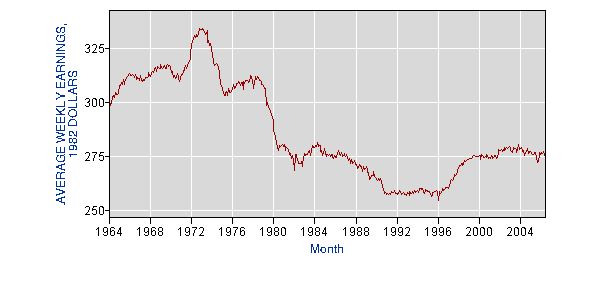
    The other day, I was listening to the McLaughlin Group on PBS, and Eleanor Clift of Newsweek (not exactly my favorite journo!) made a claim that workers are getting screwed, and after adjusting for inflation, the average worker earns less than what he/she did in 1973. I immediately thought this was a stunning claim that, if true, would have me question the merits of the capitalist society we live in.

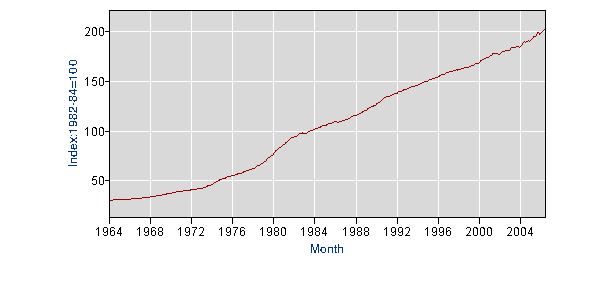
    Time allows a more rational analysis. First, why 1973? It seems an arbitrary starting point. Any time anyone makes a claim relative to a murky baseline, be suspicious ... be very suspicious. So I used the Bureau of Labor Statistics web site to probe the data and produce the graphs used in this post. (All data is for the duration that earnings data is available)was dramatic

    The first graph is a plot of the average weekly earnings in 1982$ (that is correcting for inflation). Now it becomes obvious why Clift uses 1973, it was the year of peak weekly earnings. Ok, but isn't her point true that the average worker makes less than he/she did in 1973? Well, yes it's true, but not because corporations have been screwing John and Jane Doe.


    This second chart presents the Consumer Price Index for all urban consumers (CPI-U). As you can see, inflation (rate of change of the CPI-U) soared in the 1970s, thanks in large part due to oil prices and stagflation, until about 1983, after which the inflation rate has been relatively stable. The real wages of workers reflects that fact - tumbling in the years following 1973, and stabilizing after 1983 (yes, there have been ups and downs related to economic climate, but that's natural).


    Critics of static wages use another subterfuge. They use a sleight-of-hand analogy to imply that the stagnant average weekly wages of a population imply stagnant wages for an individual worker. That is simply not true - people at the high end of the wage cycle retire, and are replaced by young men and women at the bottom of the cycle. The performance of average wages then is quite demographics of the population, and heaven knows Americans aren't having babies like there's no tomorrow. Then, in an ageing population, we should see real wages decline, and that we don't is a reflection of how the fruits of economic prosperity are translating into real wage improvements for the average worker!

    Saturday, September 02, 2006

    Respect the People

    The decision of a British television network, More4 to show a movie about the assasination of President George Bush, including using doctored photos of his likeness, is shameful! The director's claims that the intentions are simply to present a gripping story cut no ice - this could just as easily have been achieved using a fictional character, like scores of others have done.

    This is part of a worrying trend. Google failure, and the first hit you get is the bio of the President (the fact that Google hasn't fixed the problem is appalling!) You've heard liberals refer to Bush as the dictator and the autocrat, sometimes stretching it to the ridiculous. But whether you like him or not, you do need to respect his office and how he got there. As a lady from (I think) the United Press International berated Eleanor Clift (probably in the ranks of reporters I hate the most) of Newsweek for equating Bush with Putin and his thugs, President Bush was elected by a majority of the American people. Irrespective of his current popularity, we need to respect his office and all it represents ... the fact that the American people have chosen their leader, that they have a real choice (yes, if you are an independent, it's tough, but not impossible for you to win, and nobody breaks your bones for trying).

    In their quest to bash Bush, many liberals are unwittingly taking stabs on the very foundation of the idea of America. If we lose our respect for our ideals, then we would have inflicted a much more calamitous blow to free society than Osama bin Laden or his cronies could ever have hoped.

    Friday, September 01, 2006

    Interview with Warren

    Wow, it has been over 3 weeks since I blogged! My life has been crazy busy recently, but I do hope to getting back to being somewhat frequent with this blog.

    I read this article with Elizabeth Warren, author of the fascinating book The Two-Income Trap: Why Middle-Class Mothers and Fathers Are Going Broke.While I have read part of her book and now the central thesis, this fact still stunned me:
    The data show that more than half of the families who file for bankruptcy do so in the aftermath of a serious medical problem. And three quarters of those people have health insurance at the onset of the illness or accident that ultimately landed them in bankruptcy. Sometimes it's hospital bills, but more often, it's about co-pay, deductibles, uncovered treatments, drugs, rehab, supplies, all the things that aren't covered by insurance. So part of the answer is that the financial impact of a serious medical problem goes beyond hospital bills. Lost jobs, drugs, physicians, rehab, health supplies. It's expensive to get sick in America today—too expensive for the average family.

    Tuesday, August 08, 2006

    Road Trip

    'Home Sweet Home' is a special series on my visit back home to India after 3 years, hoping to document not just macroscopic changes in the world's populous democracy, but my own emotions on being back. While originally intended to be posted as events occurred, I was too busy to go online while in India, and I'm now posting these after my return to the US.

    There are changes in India that become evident only when you take a road trip. For one, the choices of quality cars available is phenomenal, and several with good gas mileage to boot. Our choice was my brother's Tata Indica V2 , a homegrown 70 hp compact. While 70 horses seems a bit too few on American roads, Indians seem to do well on Indian roads with lower power. The Indica under real conditions gives about 10 kmpl (23 mpg) under real city conditions, even though under test conditions, it is rated at 14 kmpl (32mpg).

    The National Highways are far improved from my days in India, thanks to the phenomenal Golden Quadrilateral project and other big infrastructure investments under the previous government. The GQ is a system of interstates linking the four largest cities in India by top-notch freeways. As we discovered on our drive to Bangalore, much of the freeway is now a toll road, but the Rs 150 ($3.20) spent on using the tolled highway saved us plenty of travel time.

    Maybe it's a fiction of my imagination, but it does seem villages along the GQ are less impoverished than I remember. With rural centers now better connected to commercial hubs, I guess it's logical to expect the rural economy close to the distribution system is booming.

    We stop at Natrampalli, a village that was my dad's first posting back in 1969, and now a town of just under 10,000 people. Let that number not fool you - in India, where populations are measured in rather large units, a town of just under 10,000 people is still a town in the middle of nowhere. So we were indeed surprised to walk into the bank and see an air-conditioned office, filled with computers. We learn that they will be inaugrating the ATM later that week .... imagine that, an ATM in the middle of nowhere! The branch manager also tells us they are part of the centralized computer banking system, that allows these villagers to access an account located anywhere in India. What change!

    But lest we get too euphoric, a touch of reality. We go over to the Ramakrishna Mission premises. The Mission is an order of monks attempting to change the world, but unlike the wealthy religious groups of today, they still maintain an austerity, and still believe in a mission to improve spirituality, to make the Hindu a better Hindu, the Muslim a better Muslim, the Christian a better Christian. Our purpose though is not a religious one. We talk to the gentleman in charge of the Mission office, and he tells us of their efforts in education, with the percentage of children passing up from 8% to 30%. However, getting them to a level where they can go to college is a difficult task. The challenge is finding teachers willing to come for low pay to a remote village like Natrampalli.

    After much discussion, the gentleman, in a reference to the previous government's electoral slogan 'India Shining', says, 'India is Shining, but only in the cities and highways'. He points out that when you get away from the highway, there are still myriad problems requiring solution. I still am an optimist, and I leave hopeful that the new successes in the economy will allow tutors from cities to come down for 1-2 weekends a month to help these children.

    Thursday, July 27, 2006

    Jet Airways

    My brother insists my experience on Jet Airways was atypical, and the crowds that swell India's airports mean that even a labor-ready country like India has started to incentivize electronic check-in with free frequent-flyer miles and the like. Just how much has travel increased? In 1996, there was one flight a day between Chennai and Bangalore (two cities about a half-hour flight apart) and one train line, both operated at some loss by the federal government. Today, there are no less than 31 flights, 4-5 train lines, countless sleeper and nonsleeper buses, almost all by private operators, and yet it's virtually impossible to get a ticket on any of these modes of transport on short-notice.

    Even the flight attendants on my Jet Airways flight reflected a change from the India of past. They were attractive women dressed in skirts rather than the traditional garb of a sari, although at least one of them seemed not to appreciate her natural aesthetics, donning enough makeup to serve as an endorsement for a budding rouge maker.

    The meal ... yes, Indian air operators still offer more than peanuts ... was delicious, leaving me tempted to ask if I could buy another serving, and was served on china and with silverware - a welcome fact for a food-loving tree-hugger like myself.

    The Nation's Capitol

    'Home Sweet Home' is a special series on my visit back home to India after 3 years, hoping to document not just macroscopic changes in the world's populous democracy, but my own emotions on being back.

    There were claps all around. As the acceleration kicked in our solar plexus, we were all glad to be off the ground. It had been a long 4.5 hours, sitting on the tarmac at Newark International, as rains had prevented us from taking off. Especially rough when you are at the start of a 14-hour flight to Delhi. Some time earlier, we were told that if we didn't make it by 53 minutes past midnight, we would have to call the whole venture off. As the deadline loomed, many of us were praying hard ... a cancellation would have been disastrous for me, with another local flight to catch in India. The takeoff was hence all the more exhilarating! Later, I managed to have a great chat with the head steward of the flight, talking about procedures and donut holes - no, not the food, but the fact that pilots are required by federal law to retire at 60, but can't claim pension benefits till 65! Turns out if we had returned to the gate under inclement weather, federal law would have required a new crew, which could have delayed departure even further. Hmm, a reminder that sometimes things aren't as simple as they seem ... I wish one of those serial complainers ("why can't they just return to the gate and reboard when they are ready to leave") could have heard!

    I got into Delhi well past midnight, and was rather excited to catch up with an aunt of mine. She works for a large publishing company and represents an interesting generation of worker caught between a traditional and a new aggressive paradigm. The new model, inspired by the new breed of MBAs, seek short-term explosive growth, often at the expense of a core business of some heritage value, and a lot of social values. What is the purpose of a business, and what are its social commitments? This is an interesting question even in mature economies like the US, but especially in a nascent economy like India where you cannot depend on governments alone to address the problems that plague the country.

    The next morning, I headed to Delhi's domestic airport, only to be shocked by the plethora of airlines operating. When I left India for the US, a private competitor had just come on to take on the federally run monolith, Indian Airlines. Now several private players controlled the market, and the effect was obvious. I waited for checking-in less than 10 min (something even operators in the US can't manage) and boarding was a breeze. I waited to board in a hall more reminiscent of a Greyhound bus stop than a plush airport (although a lot cleaner and with none of the seedy characters that dominate the landscape of the bus terminus in the US). The waiting room of the airport is an interesting place to watch people, and I think I got some perspective on Indian life, but none more interesting than that from a kid!

    This kid was playing on the ground and periodically engaging strangers including yours truly. If this had been in the US, the mother would have freaked out and held on to the child tight, but here the mother actually seemed to be encouraging the child to interact more ("what's that uncle's name?" and other such nudges). As it turned out, the family sat next to me on my Jet Airways flight, and I pointed out my observation to them. The lady was surprised that any parent would not allow their child interaction with the public phase. We love it when he plays with strangers, she said, it means he's learning important social skills.

    The family themselves represented an interesting demographic. He ran an Eicher dealership selling tractors, trucks and buses. Business had been very good recently, thanks to a booming economy, and they said there was no place better to see it than Faridabad, a sprawling industrial town outside of Delhi. I had noted the flood of new cars in Delhi, but they tell me it's peanuts compared to what's happening in the small towns, where industrial small businesses (as opposed to service workers) are truly reaping the benefits, and more importantly, spending money like never before. The change in spending patterns is new, and while at least partly represents a desire for present comforts over defered gratification, in some degree represents a confidence that the present boom isn't a cyclical uptick.

    This has become a long post, what with the lack of time to write, and I have a speech to prepare, to give at a local school on environmental issues, so the blogging will have to wait till I'm a little more in control of that.

    Thursday, July 20, 2006

    Home Sweet Home

    I will be blogging a special series titled 'Home Sweet Home', about my current visit to my homeland, India after 3 years. While much of it is couched in nostalgia and may be trivial information unworthy of anyone's attention but my own, my intent is to log my own experiences as sentiments to be able to revisit to get a sense for the nature of change and staticism in this dynamic land.

    Sunday, July 16, 2006

    The Deficit Does Matter

    Mike Norman wrote an article for the Motley Fool website arguing that the trade deficit is not a bad thing. His reasoning was something like this: ordinary people run trade deficits, with your grocer, your barber and what have you, buying goods and services from them, and selling nothing to them, and that's a good thing. Ditto for the country!

    Ah, but Mike forgot one little detail: true, we do run deficits with most of our vendors, trading services for IOUs (and cash really is a tradeable IOU). But there is at least one vendor we run a large surplus with, your employer - you export services to your employer, and in return, your employer gives you a large IOU called a paycheck, which you then use to import from your vendors. As long as you export more than you import, you have an excess of IOUs that can be invested and you are increasing your net wealth. However, when you have more imports, you are living on credit (like millions of Americans do).

    Now, indebtedness is by itself not awful if two conditions are met: the cost of borrowing is cheap, and the credit is used for additional revenue-generating assets. The Chinese have made sure the first is true, but what about the second? Most of their investments have been in government securities, and it is questionable if our governments are investing them in revenue-enhancing activities. (Think of the difference between investing in a rental property versus a car)

    And as an individual, you do have to worry about the spigot turning off. That's why you pay your way out of even a mortgage. In the case of the US, the trade deficit keeps increasing. What happens when foreign borrowers are now longer satisfied with their risk-reward profile? After all, a credit card gives you money because that's how it makes money, but at some point, the returns on a risk-adjusted basis are no longer appealing, and the spigot of easy money is turned off. How will the US cope in this event?

    Wednesday, July 12, 2006

    Perspectives on Terror

    The world has seen two very different responses to acts of terror in recent days. While Israel sought to attack Lebanon to recover its kidnapped soldiers, India has thus far maintained a much less aggressive tack after the Mumbai blasts that killed 200, at last count. Till earlier this evening, I wished India would adopt Israel's aggression, striking militant camps in Pakistan rather than waiting for its neighbor to seek them out. Over dinner, watching the Newshour gave me another perspective.

    I would encourage you to listen to or read the comments of Hisham Melhem, the Washington bureau chief for the Lebanese newspaper An-Nahar, and host of a weekly program on the Arab satellite channel Al-Arabiya on the Newshour. He made a lot of sense about how retaliation pushes the moderates out of the political space. For example, in the Lebanon case, he argued that the Lebanese government is not in a position to do anything about Hezbollah, not because they don't want to, but because Hezbollah is militarily more powerful than the government itself. The Lebanese government then has to try to coax the militant group to lay down its arms, something the recent offensive makes a lot more difficult.

    Postscript Soon after I posted this, I read this column by Saisuresh Sivaswamy arguing for a aggressive response, just as the US had done in the days after 9/11.

    The US Aint No Unhappy Place!

    I love how some crazy organization will periodically perform a study on happiness, and eventually tell us how unhappy people in the US and other rich countries are. And news organizations will report it as the holy word, so that you and I can sit and either feel miserable about our affluence, or pleased with our lack of it. Well, hooey! MSNBC reported that Vanuatu was rated as the happiest place in the world while the US, Russia and the UK came in at 150, 172 and 108 off the 178 places in the world. The conclusion - happiness is not correlated with economic success.

    Now, I live the US, and I know it certainly couldn't be the happiest place in the world, but come on ... 150! Something fishy ... Turns out the (Un)Happy Planet Index is an "innovative measure" (quotes from website) of true happiness. Except that they rigged the index to make industrial nations do poorly. The HPI is defined as:

    HPI = Life satisfaction x Life expectancy/Ecological Footprint

    Look at that for a moment. Assume life satisfaction surveys indicate that about the twice the percentage of people in the US are satisfied with their lives, as compared to oh say Malawi (a random African nation), but the US consumes 10 times as much. To achieve the same HPI, the US would have to have life expectancies 5 times as high as the Malawians, which means the average Malawian would have to live to less than 20 years of age.

    Listen, I don't believe affluence alone brings happiness. I think there are far more important factors, including social structures and a rich faith tradition. But to create "innovative measures" to justify poverty the world over makes me sick (which is what most leftist groups try to do)! The reality is that the average farmer in each of those purportedly happier countries would gladly accept higher incomes, better healthcare, and not having to commit suicide because the monsoon failed!

    Tuesday, July 11, 2006

    Time for Action

    The recent blasts in Mumbai, India are a grim reminder that the barbarian threat of terror still looms large. In the days to come, there will be much print dedicted to individual horror stories, and much condemnation of the gruesome acts. None of this is new. And yet, if every country condemning the acts were sincere, we have to ask if groups such as LeT and JeM would exist. And what of that most-wanted Dawood Ibrahim, terrorist financier, sought by India for well over a decade and a half now? And it is time the Indian political class go beyond photo-ops after rushing to the scene of the terror, and put the weight of the nation's largest democracy and second-most populous nation to exert pressure on the countries that allow these thugs to exist (read Pakistan, Saudi Arabia, and a handful of Gulf nations).

    The retarded Home minister, Shivraj Patil was on record as stating that an attack was expected, but no specifics were available as to location and timing. Why then were public places not put on high alert? Could it be that the pols were more busy with populism, be it quotas or bureaucratic battles, to bother about the issues that truly affect people?