I'm sick and tired of Democrats whining about the "failed policy" in Iraq. Here's an idea ... come up with something better. The other day, NPR or PRI had an interview with some looney leftist member of the House of Reps, who used the usual cliches to complain about our failures. Her plan? One, withdraw troops from Iraq to the neighboring countries (which ones exactly would allow us to deploy there) Two, disarm the militia (ok, first it's a little hard to disarm the militia when you just left the country, and you really think the US army hasn't tried to do that?) And three, start a political dialogue (blah blah ... we have been doing that!)
In a nutshell, most Democrats don't have a plan. There are a few sensible ones out there, but if the leftist wing of the party siezes control like they did in Connecticut, then it will be the demise of the party, and possibly our democratic system!
Friday, September 29, 2006

I'm Ashamed of Hollywood
So one more Hollywood celebrity talks about being ashamed for his country - this time, the nutjob in question is Oliver Stone. Well, Oliver, too bad you're so ashamed. Maybe you should swap citizenship with one of those hungry immigrants who survives the tortures of the desert, risking death, drinking his own urine to stay hydrated, getting poked in the face trying to get water from a cactus, all so that he can move to this shameful country.
I mean, what do you mean we have to lose a few of our liberties? I mean, these are too precious for us intellectuals ... so what if a few average Joes die in terrorist attacks. Ideals count for more than lives! As Oliver notes, we should fight like the British or the Spanish ... slowly, allowing a ton of people to die in the process. We'll call them martyrs ... hey, we could make a few movies about it. I mean, you can't really make a movie about whipping some Taliban ass in Afghanistan ... that just doesnt sell. But a few more 9/11s ... we can do with. Movies about heroism inspire a nation, right? So what if some poor SOBs die in the process ...
Oh yeah, and there's always a cabal that's taken over the government. Don't you people read your literature? They are hand in glove with the "terrorists". It's all a grand big plot to take over our lives.
I mean, what do you mean we have to lose a few of our liberties? I mean, these are too precious for us intellectuals ... so what if a few average Joes die in terrorist attacks. Ideals count for more than lives! As Oliver notes, we should fight like the British or the Spanish ... slowly, allowing a ton of people to die in the process. We'll call them martyrs ... hey, we could make a few movies about it. I mean, you can't really make a movie about whipping some Taliban ass in Afghanistan ... that just doesnt sell. But a few more 9/11s ... we can do with. Movies about heroism inspire a nation, right? So what if some poor SOBs die in the process ...
Oh yeah, and there's always a cabal that's taken over the government. Don't you people read your literature? They are hand in glove with the "terrorists". It's all a grand big plot to take over our lives.
Monday, September 25, 2006
Watch Out for CapOne!
These days, surviving the financial world we live in seems to require a fair bit of due diligence! I learnt this the hard way when I discovered that Capital One reports your highest ever balance rather than your credit limit to credit bureaus, thereby potentially denting your credit score. (source)
Let me back up for a second and explain how credit scores work. One of the big factors that affect your FICO score is your debt utilization rate. What that means is that if you have a balance of $1,000 on a card with a $5,000 credit limit, your debt utilization is 20% (1,000/5,000 * 100). You want that rate to be as low as possible for each of your cards - any time that rate goes up over 50%, your credit score gets dinged! That's why it's better to have your balance split between 5 cards than on one card, all things being equal.
What Capitol One does is to report your highest ever balance rather than your credit limit. So if you currently have $50 on your card, and this is the first month you've ever charged on this card, a credit bureau will think I've maxed out my card, even if my credit limit is $100,000 (ok, it isn't, but you get the idea!) WHAM! So, I will have to pay off the Capital One card, which I was lured to get by a 0% introductory APR, defeating the purpose of getting the card in the first place. BOO to Capital One!
One more thing - if you do pay off on a card, DO NOT close the account; this will end up hurting your score, because your overall debt utilization just went up!
Let me back up for a second and explain how credit scores work. One of the big factors that affect your FICO score is your debt utilization rate. What that means is that if you have a balance of $1,000 on a card with a $5,000 credit limit, your debt utilization is 20% (1,000/5,000 * 100). You want that rate to be as low as possible for each of your cards - any time that rate goes up over 50%, your credit score gets dinged! That's why it's better to have your balance split between 5 cards than on one card, all things being equal.
What Capitol One does is to report your highest ever balance rather than your credit limit. So if you currently have $50 on your card, and this is the first month you've ever charged on this card, a credit bureau will think I've maxed out my card, even if my credit limit is $100,000 (ok, it isn't, but you get the idea!) WHAM! So, I will have to pay off the Capital One card, which I was lured to get by a 0% introductory APR, defeating the purpose of getting the card in the first place. BOO to Capital One!
One more thing - if you do pay off on a card, DO NOT close the account; this will end up hurting your score, because your overall debt utilization just went up!
Thursday, September 21, 2006
Lift 'Em Weights
A new study in the Medicine and Science in Sports and Exercise (July 2006) shows that lifting weights can help to prevent and to treat diabetes (source). In the study, adolescent boys who implemented a twice-weekly weight training program for only 4 months built muscle, lost fat and decreased insulin resistance, dramatically reducing their risk of diabetes. So if you've been a couch potato, or even if you are one of those people who runs miles but never lifts, now is the time to pick up those weights. Studies have consistenly shown that there is no better way to lose weight than to lift weight!
Sunday, September 17, 2006
Viva Wal-Mart
As a grad student, I live on a pretty tight budget. Heaven knows what I would have done without Wal-Mart and Sam's Club (although recently the prices and choices at Kroger has me wondering if I should renew my Sam's Club membership). So it obviously annoys me when constituents like me are ignored by rich anti-Walmart liberals who love to bash the chain and all capitalism stands for. Enter George Will to the rescue, with a passionate piece that puts numbers behind some of my arguments...
Will notes that more than 25,000 people applied for the 325 openings for the Walmart at Evergreen Park, IL - a far cry from the cries of poverty level wages! In fact, Wal-mart hires 1.3 million employees, making it the largest private employer and with as many personnel as the US military. Saves shoppers $200 billion a year! Oh, I could go on, but just read the article for yourself... and say viva Wal-Mart!!
Will notes that more than 25,000 people applied for the 325 openings for the Walmart at Evergreen Park, IL - a far cry from the cries of poverty level wages! In fact, Wal-mart hires 1.3 million employees, making it the largest private employer and with as many personnel as the US military. Saves shoppers $200 billion a year! Oh, I could go on, but just read the article for yourself... and say viva Wal-Mart!!
Thursday, September 07, 2006
The Lie of Diminishing Wages
The other day, I was listening to the McLaughlin Group on PBS, and Eleanor Clift of Newsweek (not exactly my favorite journo!) made a claim that workers are getting screwed, and after adjusting for inflation, the average worker earns less than what he/she did in 1973. I immediately thought this was a stunning claim that, if true, would have me question the merits of the capitalist society we live in.
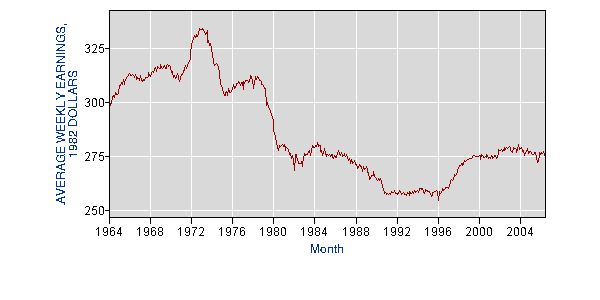
Time allows a more rational analysis. First, why 1973? It seems an arbitrary starting point. Any time anyone makes a claim relative to a murky baseline, be suspicious ... be very suspicious. So I used the Bureau of Labor Statistics web site to probe the data and produce the graphs used in this post. (All data is for the duration that earnings data is available)was dramatic
The first graph is a plot of the average weekly earnings in 1982$ (that is correcting for inflation). Now it becomes obvious why Clift uses 1973, it was the year of peak weekly earnings. Ok, but isn't her point true that the average worker makes less than he/she did in 1973? Well, yes it's true, but not because corporations have been screwing John and Jane Doe.
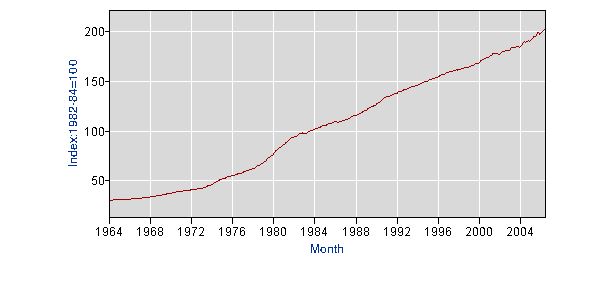
This second chart presents the Consumer Price Index for all urban consumers (CPI-U). As you can see, inflation (rate of change of the CPI-U) soared in the 1970s, thanks in large part due to oil prices and stagflation, until about 1983, after which the inflation rate has been relatively stable. The real wages of workers reflects that fact - tumbling in the years following 1973, and stabilizing after 1983 (yes, there have been ups and downs related to economic climate, but that's natural).
Critics of static wages use another subterfuge. They use a sleight-of-hand analogy to imply that the stagnant average weekly wages of a population imply stagnant wages for an individual worker. That is simply not true - people at the high end of the wage cycle retire, and are replaced by young men and women at the bottom of the cycle. The performance of average wages then is quite demographics of the population, and heaven knows Americans aren't having babies like there's no tomorrow. Then, in an ageing population, we should see real wages decline, and that we don't is a reflection of how the fruits of economic prosperity are translating into real wage improvements for the average worker!
Time allows a more rational analysis. First, why 1973? It seems an arbitrary starting point. Any time anyone makes a claim relative to a murky baseline, be suspicious ... be very suspicious. So I used the Bureau of Labor Statistics web site to probe the data and produce the graphs used in this post. (All data is for the duration that earnings data is available)was dramatic
The first graph is a plot of the average weekly earnings in 1982$ (that is correcting for inflation). Now it becomes obvious why Clift uses 1973, it was the year of peak weekly earnings. Ok, but isn't her point true that the average worker makes less than he/she did in 1973? Well, yes it's true, but not because corporations have been screwing John and Jane Doe.
This second chart presents the Consumer Price Index for all urban consumers (CPI-U). As you can see, inflation (rate of change of the CPI-U) soared in the 1970s, thanks in large part due to oil prices and stagflation, until about 1983, after which the inflation rate has been relatively stable. The real wages of workers reflects that fact - tumbling in the years following 1973, and stabilizing after 1983 (yes, there have been ups and downs related to economic climate, but that's natural).
Critics of static wages use another subterfuge. They use a sleight-of-hand analogy to imply that the stagnant average weekly wages of a population imply stagnant wages for an individual worker. That is simply not true - people at the high end of the wage cycle retire, and are replaced by young men and women at the bottom of the cycle. The performance of average wages then is quite demographics of the population, and heaven knows Americans aren't having babies like there's no tomorrow. Then, in an ageing population, we should see real wages decline, and that we don't is a reflection of how the fruits of economic prosperity are translating into real wage improvements for the average worker!
Saturday, September 02, 2006
Respect the People
The decision of a British television network, More4 to show a movie about the assasination of President George Bush, including using doctored photos of his likeness, is shameful! The director's claims that the intentions are simply to present a gripping story cut no ice - this could just as easily have been achieved using a fictional character, like scores of others have done.
This is part of a worrying trend. Google failure, and the first hit you get is the bio of the President (the fact that Google hasn't fixed the problem is appalling!) You've heard liberals refer to Bush as the dictator and the autocrat, sometimes stretching it to the ridiculous. But whether you like him or not, you do need to respect his office and how he got there. As a lady from (I think) the United Press International berated Eleanor Clift (probably in the ranks of reporters I hate the most) of Newsweek for equating Bush with Putin and his thugs, President Bush was elected by a majority of the American people. Irrespective of his current popularity, we need to respect his office and all it represents ... the fact that the American people have chosen their leader, that they have a real choice (yes, if you are an independent, it's tough, but not impossible for you to win, and nobody breaks your bones for trying).
In their quest to bash Bush, many liberals are unwittingly taking stabs on the very foundation of the idea of America. If we lose our respect for our ideals, then we would have inflicted a much more calamitous blow to free society than Osama bin Laden or his cronies could ever have hoped.
This is part of a worrying trend. Google failure, and the first hit you get is the bio of the President (the fact that Google hasn't fixed the problem is appalling!) You've heard liberals refer to Bush as the dictator and the autocrat, sometimes stretching it to the ridiculous. But whether you like him or not, you do need to respect his office and how he got there. As a lady from (I think) the United Press International berated Eleanor Clift (probably in the ranks of reporters I hate the most) of Newsweek for equating Bush with Putin and his thugs, President Bush was elected by a majority of the American people. Irrespective of his current popularity, we need to respect his office and all it represents ... the fact that the American people have chosen their leader, that they have a real choice (yes, if you are an independent, it's tough, but not impossible for you to win, and nobody breaks your bones for trying).
In their quest to bash Bush, many liberals are unwittingly taking stabs on the very foundation of the idea of America. If we lose our respect for our ideals, then we would have inflicted a much more calamitous blow to free society than Osama bin Laden or his cronies could ever have hoped.
Friday, September 01, 2006
Interview with Warren
Wow, it has been over 3 weeks since I blogged! My life has been crazy busy recently, but I do hope to getting back to being somewhat frequent with this blog.
I read this article with Elizabeth Warren, author of the fascinating book The Two-Income Trap: Why Middle-Class Mothers and Fathers Are Going Broke.While I have read part of her book and now the central thesis, this fact still stunned me:
I read this article with Elizabeth Warren, author of the fascinating book The Two-Income Trap: Why Middle-Class Mothers and Fathers Are Going Broke.While I have read part of her book and now the central thesis, this fact still stunned me:
The data show that more than half of the families who file for bankruptcy do so in the aftermath of a serious medical problem. And three quarters of those people have health insurance at the onset of the illness or accident that ultimately landed them in bankruptcy. Sometimes it's hospital bills, but more often, it's about co-pay, deductibles, uncovered treatments, drugs, rehab, supplies, all the things that aren't covered by insurance. So part of the answer is that the financial impact of a serious medical problem goes beyond hospital bills. Lost jobs, drugs, physicians, rehab, health supplies. It's expensive to get sick in America today—too expensive for the average family.
Tuesday, August 08, 2006
Road Trip
'Home Sweet Home' is a special series on my visit back home to India after 3 years, hoping to document not just macroscopic changes in the world's populous democracy, but my own emotions on being back. While originally intended to be posted as events occurred, I was too busy to go online while in India, and I'm now posting these after my return to the US.
There are changes in India that become evident only when you take a road trip. For one, the choices of quality cars available is phenomenal, and several with good gas mileage to boot. Our choice was my brother's Tata Indica V2 , a homegrown 70 hp compact. While 70 horses seems a bit too few on American roads, Indians seem to do well on Indian roads with lower power. The Indica under real conditions gives about 10 kmpl (23 mpg) under real city conditions, even though under test conditions, it is rated at 14 kmpl (32mpg).
The National Highways are far improved from my days in India, thanks to the phenomenal Golden Quadrilateral project and other big infrastructure investments under the previous government. The GQ is a system of interstates linking the four largest cities in India by top-notch freeways. As we discovered on our drive to Bangalore, much of the freeway is now a toll road, but the Rs 150 ($3.20) spent on using the tolled highway saved us plenty of travel time.
Maybe it's a fiction of my imagination, but it does seem villages along the GQ are less impoverished than I remember. With rural centers now better connected to commercial hubs, I guess it's logical to expect the rural economy close to the distribution system is booming.
We stop at Natrampalli, a village that was my dad's first posting back in 1969, and now a town of just under 10,000 people. Let that number not fool you - in India, where populations are measured in rather large units, a town of just under 10,000 people is still a town in the middle of nowhere. So we were indeed surprised to walk into the bank and see an air-conditioned office, filled with computers. We learn that they will be inaugrating the ATM later that week .... imagine that, an ATM in the middle of nowhere! The branch manager also tells us they are part of the centralized computer banking system, that allows these villagers to access an account located anywhere in India. What change!
But lest we get too euphoric, a touch of reality. We go over to the Ramakrishna Mission premises. The Mission is an order of monks attempting to change the world, but unlike the wealthy religious groups of today, they still maintain an austerity, and still believe in a mission to improve spirituality, to make the Hindu a better Hindu, the Muslim a better Muslim, the Christian a better Christian. Our purpose though is not a religious one. We talk to the gentleman in charge of the Mission office, and he tells us of their efforts in education, with the percentage of children passing up from 8% to 30%. However, getting them to a level where they can go to college is a difficult task. The challenge is finding teachers willing to come for low pay to a remote village like Natrampalli.
After much discussion, the gentleman, in a reference to the previous government's electoral slogan 'India Shining', says, 'India is Shining, but only in the cities and highways'. He points out that when you get away from the highway, there are still myriad problems requiring solution. I still am an optimist, and I leave hopeful that the new successes in the economy will allow tutors from cities to come down for 1-2 weekends a month to help these children.
There are changes in India that become evident only when you take a road trip. For one, the choices of quality cars available is phenomenal, and several with good gas mileage to boot. Our choice was my brother's Tata Indica V2 , a homegrown 70 hp compact. While 70 horses seems a bit too few on American roads, Indians seem to do well on Indian roads with lower power. The Indica under real conditions gives about 10 kmpl (23 mpg) under real city conditions, even though under test conditions, it is rated at 14 kmpl (32mpg).
The National Highways are far improved from my days in India, thanks to the phenomenal Golden Quadrilateral project and other big infrastructure investments under the previous government. The GQ is a system of interstates linking the four largest cities in India by top-notch freeways. As we discovered on our drive to Bangalore, much of the freeway is now a toll road, but the Rs 150 ($3.20) spent on using the tolled highway saved us plenty of travel time.
Maybe it's a fiction of my imagination, but it does seem villages along the GQ are less impoverished than I remember. With rural centers now better connected to commercial hubs, I guess it's logical to expect the rural economy close to the distribution system is booming.
We stop at Natrampalli, a village that was my dad's first posting back in 1969, and now a town of just under 10,000 people. Let that number not fool you - in India, where populations are measured in rather large units, a town of just under 10,000 people is still a town in the middle of nowhere. So we were indeed surprised to walk into the bank and see an air-conditioned office, filled with computers. We learn that they will be inaugrating the ATM later that week .... imagine that, an ATM in the middle of nowhere! The branch manager also tells us they are part of the centralized computer banking system, that allows these villagers to access an account located anywhere in India. What change!
But lest we get too euphoric, a touch of reality. We go over to the Ramakrishna Mission premises. The Mission is an order of monks attempting to change the world, but unlike the wealthy religious groups of today, they still maintain an austerity, and still believe in a mission to improve spirituality, to make the Hindu a better Hindu, the Muslim a better Muslim, the Christian a better Christian. Our purpose though is not a religious one. We talk to the gentleman in charge of the Mission office, and he tells us of their efforts in education, with the percentage of children passing up from 8% to 30%. However, getting them to a level where they can go to college is a difficult task. The challenge is finding teachers willing to come for low pay to a remote village like Natrampalli.
After much discussion, the gentleman, in a reference to the previous government's electoral slogan 'India Shining', says, 'India is Shining, but only in the cities and highways'. He points out that when you get away from the highway, there are still myriad problems requiring solution. I still am an optimist, and I leave hopeful that the new successes in the economy will allow tutors from cities to come down for 1-2 weekends a month to help these children.
Thursday, July 27, 2006
Jet Airways
My brother insists my experience on Jet Airways was atypical, and the crowds that swell India's airports mean that even a labor-ready country like India has started to incentivize electronic check-in with free frequent-flyer miles and the like. Just how much has travel increased? In 1996, there was one flight a day between Chennai and Bangalore (two cities about a half-hour flight apart) and one train line, both operated at some loss by the federal government. Today, there are no less than 31 flights, 4-5 train lines, countless sleeper and nonsleeper buses, almost all by private operators, and yet it's virtually impossible to get a ticket on any of these modes of transport on short-notice.
Even the flight attendants on my Jet Airways flight reflected a change from the India of past. They were attractive women dressed in skirts rather than the traditional garb of a sari, although at least one of them seemed not to appreciate her natural aesthetics, donning enough makeup to serve as an endorsement for a budding rouge maker.
The meal ... yes, Indian air operators still offer more than peanuts ... was delicious, leaving me tempted to ask if I could buy another serving, and was served on china and with silverware - a welcome fact for a food-loving tree-hugger like myself.
Even the flight attendants on my Jet Airways flight reflected a change from the India of past. They were attractive women dressed in skirts rather than the traditional garb of a sari, although at least one of them seemed not to appreciate her natural aesthetics, donning enough makeup to serve as an endorsement for a budding rouge maker.
The meal ... yes, Indian air operators still offer more than peanuts ... was delicious, leaving me tempted to ask if I could buy another serving, and was served on china and with silverware - a welcome fact for a food-loving tree-hugger like myself.
The Nation's Capitol
'Home Sweet Home' is a special series on my visit back home to India after 3 years, hoping to document not just macroscopic changes in the world's populous democracy, but my own emotions on being back.
There were claps all around. As the acceleration kicked in our solar plexus, we were all glad to be off the ground. It had been a long 4.5 hours, sitting on the tarmac at Newark International, as rains had prevented us from taking off. Especially rough when you are at the start of a 14-hour flight to Delhi. Some time earlier, we were told that if we didn't make it by 53 minutes past midnight, we would have to call the whole venture off. As the deadline loomed, many of us were praying hard ... a cancellation would have been disastrous for me, with another local flight to catch in India. The takeoff was hence all the more exhilarating! Later, I managed to have a great chat with the head steward of the flight, talking about procedures and donut holes - no, not the food, but the fact that pilots are required by federal law to retire at 60, but can't claim pension benefits till 65! Turns out if we had returned to the gate under inclement weather, federal law would have required a new crew, which could have delayed departure even further. Hmm, a reminder that sometimes things aren't as simple as they seem ... I wish one of those serial complainers ("why can't they just return to the gate and reboard when they are ready to leave") could have heard!
I got into Delhi well past midnight, and was rather excited to catch up with an aunt of mine. She works for a large publishing company and represents an interesting generation of worker caught between a traditional and a new aggressive paradigm. The new model, inspired by the new breed of MBAs, seek short-term explosive growth, often at the expense of a core business of some heritage value, and a lot of social values. What is the purpose of a business, and what are its social commitments? This is an interesting question even in mature economies like the US, but especially in a nascent economy like India where you cannot depend on governments alone to address the problems that plague the country.
The next morning, I headed to Delhi's domestic airport, only to be shocked by the plethora of airlines operating. When I left India for the US, a private competitor had just come on to take on the federally run monolith, Indian Airlines. Now several private players controlled the market, and the effect was obvious. I waited for checking-in less than 10 min (something even operators in the US can't manage) and boarding was a breeze. I waited to board in a hall more reminiscent of a Greyhound bus stop than a plush airport (although a lot cleaner and with none of the seedy characters that dominate the landscape of the bus terminus in the US). The waiting room of the airport is an interesting place to watch people, and I think I got some perspective on Indian life, but none more interesting than that from a kid!
This kid was playing on the ground and periodically engaging strangers including yours truly. If this had been in the US, the mother would have freaked out and held on to the child tight, but here the mother actually seemed to be encouraging the child to interact more ("what's that uncle's name?" and other such nudges). As it turned out, the family sat next to me on my Jet Airways flight, and I pointed out my observation to them. The lady was surprised that any parent would not allow their child interaction with the public phase. We love it when he plays with strangers, she said, it means he's learning important social skills.
The family themselves represented an interesting demographic. He ran an Eicher dealership selling tractors, trucks and buses. Business had been very good recently, thanks to a booming economy, and they said there was no place better to see it than Faridabad, a sprawling industrial town outside of Delhi. I had noted the flood of new cars in Delhi, but they tell me it's peanuts compared to what's happening in the small towns, where industrial small businesses (as opposed to service workers) are truly reaping the benefits, and more importantly, spending money like never before. The change in spending patterns is new, and while at least partly represents a desire for present comforts over defered gratification, in some degree represents a confidence that the present boom isn't a cyclical uptick.
This has become a long post, what with the lack of time to write, and I have a speech to prepare, to give at a local school on environmental issues, so the blogging will have to wait till I'm a little more in control of that.
There were claps all around. As the acceleration kicked in our solar plexus, we were all glad to be off the ground. It had been a long 4.5 hours, sitting on the tarmac at Newark International, as rains had prevented us from taking off. Especially rough when you are at the start of a 14-hour flight to Delhi. Some time earlier, we were told that if we didn't make it by 53 minutes past midnight, we would have to call the whole venture off. As the deadline loomed, many of us were praying hard ... a cancellation would have been disastrous for me, with another local flight to catch in India. The takeoff was hence all the more exhilarating! Later, I managed to have a great chat with the head steward of the flight, talking about procedures and donut holes - no, not the food, but the fact that pilots are required by federal law to retire at 60, but can't claim pension benefits till 65! Turns out if we had returned to the gate under inclement weather, federal law would have required a new crew, which could have delayed departure even further. Hmm, a reminder that sometimes things aren't as simple as they seem ... I wish one of those serial complainers ("why can't they just return to the gate and reboard when they are ready to leave") could have heard!
I got into Delhi well past midnight, and was rather excited to catch up with an aunt of mine. She works for a large publishing company and represents an interesting generation of worker caught between a traditional and a new aggressive paradigm. The new model, inspired by the new breed of MBAs, seek short-term explosive growth, often at the expense of a core business of some heritage value, and a lot of social values. What is the purpose of a business, and what are its social commitments? This is an interesting question even in mature economies like the US, but especially in a nascent economy like India where you cannot depend on governments alone to address the problems that plague the country.
The next morning, I headed to Delhi's domestic airport, only to be shocked by the plethora of airlines operating. When I left India for the US, a private competitor had just come on to take on the federally run monolith, Indian Airlines. Now several private players controlled the market, and the effect was obvious. I waited for checking-in less than 10 min (something even operators in the US can't manage) and boarding was a breeze. I waited to board in a hall more reminiscent of a Greyhound bus stop than a plush airport (although a lot cleaner and with none of the seedy characters that dominate the landscape of the bus terminus in the US). The waiting room of the airport is an interesting place to watch people, and I think I got some perspective on Indian life, but none more interesting than that from a kid!
This kid was playing on the ground and periodically engaging strangers including yours truly. If this had been in the US, the mother would have freaked out and held on to the child tight, but here the mother actually seemed to be encouraging the child to interact more ("what's that uncle's name?" and other such nudges). As it turned out, the family sat next to me on my Jet Airways flight, and I pointed out my observation to them. The lady was surprised that any parent would not allow their child interaction with the public phase. We love it when he plays with strangers, she said, it means he's learning important social skills.
The family themselves represented an interesting demographic. He ran an Eicher dealership selling tractors, trucks and buses. Business had been very good recently, thanks to a booming economy, and they said there was no place better to see it than Faridabad, a sprawling industrial town outside of Delhi. I had noted the flood of new cars in Delhi, but they tell me it's peanuts compared to what's happening in the small towns, where industrial small businesses (as opposed to service workers) are truly reaping the benefits, and more importantly, spending money like never before. The change in spending patterns is new, and while at least partly represents a desire for present comforts over defered gratification, in some degree represents a confidence that the present boom isn't a cyclical uptick.
This has become a long post, what with the lack of time to write, and I have a speech to prepare, to give at a local school on environmental issues, so the blogging will have to wait till I'm a little more in control of that.
Thursday, July 20, 2006
Home Sweet Home
I will be blogging a special series titled 'Home Sweet Home', about my current visit to my homeland, India after 3 years. While much of it is couched in nostalgia and may be trivial information unworthy of anyone's attention but my own, my intent is to log my own experiences as sentiments to be able to revisit to get a sense for the nature of change and staticism in this dynamic land.
Sunday, July 16, 2006
The Deficit Does Matter
Mike Norman wrote an article for the Motley Fool website arguing that the trade deficit is not a bad thing. His reasoning was something like this: ordinary people run trade deficits, with your grocer, your barber and what have you, buying goods and services from them, and selling nothing to them, and that's a good thing. Ditto for the country!
Ah, but Mike forgot one little detail: true, we do run deficits with most of our vendors, trading services for IOUs (and cash really is a tradeable IOU). But there is at least one vendor we run a large surplus with, your employer - you export services to your employer, and in return, your employer gives you a large IOU called a paycheck, which you then use to import from your vendors. As long as you export more than you import, you have an excess of IOUs that can be invested and you are increasing your net wealth. However, when you have more imports, you are living on credit (like millions of Americans do).
Now, indebtedness is by itself not awful if two conditions are met: the cost of borrowing is cheap, and the credit is used for additional revenue-generating assets. The Chinese have made sure the first is true, but what about the second? Most of their investments have been in government securities, and it is questionable if our governments are investing them in revenue-enhancing activities. (Think of the difference between investing in a rental property versus a car)
And as an individual, you do have to worry about the spigot turning off. That's why you pay your way out of even a mortgage. In the case of the US, the trade deficit keeps increasing. What happens when foreign borrowers are now longer satisfied with their risk-reward profile? After all, a credit card gives you money because that's how it makes money, but at some point, the returns on a risk-adjusted basis are no longer appealing, and the spigot of easy money is turned off. How will the US cope in this event?
Ah, but Mike forgot one little detail: true, we do run deficits with most of our vendors, trading services for IOUs (and cash really is a tradeable IOU). But there is at least one vendor we run a large surplus with, your employer - you export services to your employer, and in return, your employer gives you a large IOU called a paycheck, which you then use to import from your vendors. As long as you export more than you import, you have an excess of IOUs that can be invested and you are increasing your net wealth. However, when you have more imports, you are living on credit (like millions of Americans do).
Now, indebtedness is by itself not awful if two conditions are met: the cost of borrowing is cheap, and the credit is used for additional revenue-generating assets. The Chinese have made sure the first is true, but what about the second? Most of their investments have been in government securities, and it is questionable if our governments are investing them in revenue-enhancing activities. (Think of the difference between investing in a rental property versus a car)
And as an individual, you do have to worry about the spigot turning off. That's why you pay your way out of even a mortgage. In the case of the US, the trade deficit keeps increasing. What happens when foreign borrowers are now longer satisfied with their risk-reward profile? After all, a credit card gives you money because that's how it makes money, but at some point, the returns on a risk-adjusted basis are no longer appealing, and the spigot of easy money is turned off. How will the US cope in this event?
Wednesday, July 12, 2006
Perspectives on Terror
The world has seen two very different responses to acts of terror in recent days. While Israel sought to attack Lebanon to recover its kidnapped soldiers, India has thus far maintained a much less aggressive tack after the Mumbai blasts that killed 200, at last count. Till earlier this evening, I wished India would adopt Israel's aggression, striking militant camps in Pakistan rather than waiting for its neighbor to seek them out. Over dinner, watching the Newshour gave me another perspective.
I would encourage you to listen to or read the comments of Hisham Melhem, the Washington bureau chief for the Lebanese newspaper An-Nahar, and host of a weekly program on the Arab satellite channel Al-Arabiya on the Newshour. He made a lot of sense about how retaliation pushes the moderates out of the political space. For example, in the Lebanon case, he argued that the Lebanese government is not in a position to do anything about Hezbollah, not because they don't want to, but because Hezbollah is militarily more powerful than the government itself. The Lebanese government then has to try to coax the militant group to lay down its arms, something the recent offensive makes a lot more difficult.
Postscript Soon after I posted this, I read this column by Saisuresh Sivaswamy arguing for a aggressive response, just as the US had done in the days after 9/11.
I would encourage you to listen to or read the comments of Hisham Melhem, the Washington bureau chief for the Lebanese newspaper An-Nahar, and host of a weekly program on the Arab satellite channel Al-Arabiya on the Newshour. He made a lot of sense about how retaliation pushes the moderates out of the political space. For example, in the Lebanon case, he argued that the Lebanese government is not in a position to do anything about Hezbollah, not because they don't want to, but because Hezbollah is militarily more powerful than the government itself. The Lebanese government then has to try to coax the militant group to lay down its arms, something the recent offensive makes a lot more difficult.
Postscript Soon after I posted this, I read this column by Saisuresh Sivaswamy arguing for a aggressive response, just as the US had done in the days after 9/11.
The US Aint No Unhappy Place!
I love how some crazy organization will periodically perform a study on happiness, and eventually tell us how unhappy people in the US and other rich countries are. And news organizations will report it as the holy word, so that you and I can sit and either feel miserable about our affluence, or pleased with our lack of it. Well, hooey! MSNBC reported that Vanuatu was rated as the happiest place in the world while the US, Russia and the UK came in at 150, 172 and 108 off the 178 places in the world. The conclusion - happiness is not correlated with economic success.
Now, I live the US, and I know it certainly couldn't be the happiest place in the world, but come on ... 150! Something fishy ... Turns out the (Un)Happy Planet Index is an "innovative measure" (quotes from website) of true happiness. Except that they rigged the index to make industrial nations do poorly. The HPI is defined as:
HPI = Life satisfaction x Life expectancy/Ecological Footprint
Look at that for a moment. Assume life satisfaction surveys indicate that about the twice the percentage of people in the US are satisfied with their lives, as compared to oh say Malawi (a random African nation), but the US consumes 10 times as much. To achieve the same HPI, the US would have to have life expectancies 5 times as high as the Malawians, which means the average Malawian would have to live to less than 20 years of age.
Listen, I don't believe affluence alone brings happiness. I think there are far more important factors, including social structures and a rich faith tradition. But to create "innovative measures" to justify poverty the world over makes me sick (which is what most leftist groups try to do)! The reality is that the average farmer in each of those purportedly happier countries would gladly accept higher incomes, better healthcare, and not having to commit suicide because the monsoon failed!
Now, I live the US, and I know it certainly couldn't be the happiest place in the world, but come on ... 150! Something fishy ... Turns out the (Un)Happy Planet Index is an "innovative measure" (quotes from website) of true happiness. Except that they rigged the index to make industrial nations do poorly. The HPI is defined as:
HPI = Life satisfaction x Life expectancy/Ecological Footprint
Look at that for a moment. Assume life satisfaction surveys indicate that about the twice the percentage of people in the US are satisfied with their lives, as compared to oh say Malawi (a random African nation), but the US consumes 10 times as much. To achieve the same HPI, the US would have to have life expectancies 5 times as high as the Malawians, which means the average Malawian would have to live to less than 20 years of age.
Listen, I don't believe affluence alone brings happiness. I think there are far more important factors, including social structures and a rich faith tradition. But to create "innovative measures" to justify poverty the world over makes me sick (which is what most leftist groups try to do)! The reality is that the average farmer in each of those purportedly happier countries would gladly accept higher incomes, better healthcare, and not having to commit suicide because the monsoon failed!
Tuesday, July 11, 2006
Time for Action
The recent blasts in Mumbai, India are a grim reminder that the barbarian threat of terror still looms large. In the days to come, there will be much print dedicted to individual horror stories, and much condemnation of the gruesome acts. None of this is new. And yet, if every country condemning the acts were sincere, we have to ask if groups such as LeT and JeM would exist. And what of that most-wanted Dawood Ibrahim, terrorist financier, sought by India for well over a decade and a half now? And it is time the Indian political class go beyond photo-ops after rushing to the scene of the terror, and put the weight of the nation's largest democracy and second-most populous nation to exert pressure on the countries that allow these thugs to exist (read Pakistan, Saudi Arabia, and a handful of Gulf nations).
The retarded Home minister, Shivraj Patil was on record as stating that an attack was expected, but no specifics were available as to location and timing. Why then were public places not put on high alert? Could it be that the pols were more busy with populism, be it quotas or bureaucratic battles, to bother about the issues that truly affect people?
The retarded Home minister, Shivraj Patil was on record as stating that an attack was expected, but no specifics were available as to location and timing. Why then were public places not put on high alert? Could it be that the pols were more busy with populism, be it quotas or bureaucratic battles, to bother about the issues that truly affect people?
Customer Nonservice
That's it - I'm officially sick and tired about the nincompoops who work at customer nonservice centers. My latest run-in was with a nitwit at Capital One. I applied for a credit card that promised me 0% APR on purchases and balance transfers, but when I activated, I was told I was getting 0% on purchases only. I tried to explain to the genius that that's not my offer stated, that I had my offer right in front of me, and yet he kept parroted like a broken record that the APR was for purchases only, and that I must be looking at the wrong offer (even after I pointed out that I had notated the offer for my records). After a tiring exchange that had me feel like I was talking to a wall, I asked for his supervisor, only to be put on hold for 15 minutes before I gave up and hung up!
What the hell is wrong with companies these days? Why do they think they can treat us like worthless pieces of crap, and that we will put up with it. I for one would never use Capital One, unless my letter to the complaints department yields an apology and more. Shame on you, Capital One, for forgetting that old adage in business - customer is king!
What the hell is wrong with companies these days? Why do they think they can treat us like worthless pieces of crap, and that we will put up with it. I for one would never use Capital One, unless my letter to the complaints department yields an apology and more. Shame on you, Capital One, for forgetting that old adage in business - customer is king!
Thursday, July 06, 2006
Quote of the Day
Former House Speaker and architect of the GOP's Contract with America, Newt Gingrich on Democrats and their bloggers:
This is a core problem [the Democrats] have. ... I don't think you can write a Contract with Vermont and San Francisco. ... Al Gore has refused to endorse his vice presidential running mate [Lieberman]. A party which is so driven by its left that—I don't know if you saw the blogger meeting in Las Vegas? From the standpoint of an average American, some of that stuff was weird. Candidates out there run a risk of resembling the people they're trying to appeal to. Normal people I think become distanced by that stuff. I think the Republican Party has few allies more effective than the Daily Kos. It puts them into an echo chamber of listening to each other. There was a reason [2004 Democratic presidential nominee John] Kerry looked normal—because Howard Dean looked so strange. So you have Dean as national chair, you have Gore coming back as a true left winger to Hillary's left, you have Lieberman unacceptably pro-national security, you have Nancy Pelosi from San Francisco... Let's drop Nancy Pelosi into a typical exurban swing district and see how she does. You listen to her talk and it's all about the counterculture, unilateral disarmament type of babble.
Tuesday, July 04, 2006
History Repeats Itself?
You've been hearing it all the time recently - the rise of India and China, how the US is losing out to the competition, how the Asian Tigers are where all the action, and profits, are. Oh, and China is manipulating it's currency, and if we just impose anti-dumping tarrifs on Chinese imports, American manufacturing will be A-OK. Well, in line with my recent obsession to learn from history's lessons, I have been reading (ok, only a few pages at a time) Bill Emmott's historic book, 'The Sun Also Sets'. Why historic? Because writing at the height of the Japanese boom, he called for a collapse in the Japanese economy. OK, I haven't gotten to that part, but it amazes me how much alike the Japan story of those days is to India and China today - booming economies, increased consumer spending and the wealth effect, speculative asset bubbles in stocks and real estate ... Oh, and let's not forget Washington politicians accusing the Japanese of manipulating the yen rather than tackling America's self-made problem with trade deficits.
To be sure, there are several differences between the Japan of past and India and China today, not least of which are size and demographics. Nevertheless, the next time you come across a story suggesting you learn Chinese, you may just want to pass.
To be sure, there are several differences between the Japan of past and India and China today, not least of which are size and demographics. Nevertheless, the next time you come across a story suggesting you learn Chinese, you may just want to pass.
Sunday, July 02, 2006
Alter on Flag Burning
My brother sent me this wonderful piece by Jonathan Alter on the recent efforts by the Senate to pass a flag-burning amendment. I thought John Glenn put it best, as quoted by Alter:
Those 10 amendments we call the Bill of Rights have never been changed or altered by one iota, not by one word, not a single time in all of American history. There was not a single change during any of our foreign wars, and not during recessions or depressions or panics. Not a single change when we were going through times of great emotion and anger like the Vietnam era, when flag after flag was burned or desecrated. There is only one way to weaken our nation. The way to weaken our nation would be to erode the freedom that we all share.”
Subscribe to:
Posts (Atom)