Thursday, June 08, 2006

Killers Be Damned

It is indeed a joyous occasion when a mass murder becomes the victim of his own game. Today, when US forces ended the life of Abu Musab al-Zarqawi, the murders of thousands of innocent Iraqi citizens was avenged. Just how significant is this?
Over the last several years, no single person on this planet has had the blood of more innocent men, women and children on his hands than Zarqawi. He personified the dark, sadistic and medieval vision of the future, of beheadings, suicide bombings, and indiscriminate killings, a behavior pattern that has been rejected by the overwhelming majority of the Iraqi people, whether Sunni, Shias or Kurds, and certainly by the overwhelming majority of Muslims worldwide.

- Defense Secretary Donald Rumsfeld

Monday, June 05, 2006

Garbage on Groceries

I am a regular reader of Forbes magazine, but of their stock opinions. I don't expect to embrace healthy living or societal choices from reading this magazine. So when MSNBC reproduced this piece of junk, titled Healthier eating would raise grocery bills, I threw a fit! Gosh, did they get someone from the National Council of Chain Restaurants to write this crap? The article argues that healthier choices would spike up grocery bills, and disses Eric Schlosser's (author of Fast Food Nation) call to migrate to less processed foods. The author of this piece grudgingly acknowledges Schlosser's observation that the premium is small compared to the medical savings from avoiding Big Macs.

But how can someone writing about a financial magazine be so blind to economies of scale. Here's one observation about organic food:
Unfortunately, organic food is typically more expensive than industrialized food, usually costing 25 percent to 100 percent as much. That may explain why Whole Foods Market, which has capitalized on the public's interest in more natural foods, has been nicknamed "Whole Paycheck" for its high prices. An example: Last week in downtown Chicago, a dozen large regular eggs cost $1.79, while a dozen large organic, cage-free eggs sold for $3.39.

Yes, but as more people embrace organic food, costs come down. Whole Foods Market sells the cheapest organic tofu in town, cheaper than the non-organic tofu at Kroger or other giant retail stores. How? As a WFM sales assistant told me, once they have enough scale, prices come tumbling down. Most of the prices aren't production-related, they are distribution costs.

That's not to say organic food's gonna be cheaper anytime soon. It's to say I look forward to the day a tightwad like me can buy organic food. And with WalMart getting into the business, that day may not be too far away!

Saturday, June 03, 2006

Book of the Day

My pick for Book of the Day is Suburban Nation: The Rise of Sprawl and the Decline of the America Dream - Andres Duany, Elizabeth Plater-Zyberk, Jeff Speck. The authors are architects who designed several sensible communities, and argue persuasively that the current design of suburbia is fundamentally flawed, and seek to take us back (and forward) to the days when communities were not zoned residential and commerical, where pedestrian-friendly designs meant you didn't drive to the store, where traffic jams are nonexistant because of the dispersion of the road network (where all traffic doesn't feed into a collector), accident rates are significantly lower, and most important, where residents can feel a sense of community, where rich and poor live in the same neighborhood. The book drives these points home with several photographs of communities good and bad, and had it not been the pangs of hunger, I may never have put the book down.

Thursday, June 01, 2006

Lip Service

There are days when I feel excited about the prospect of the world's only superpower supporting free regimes all over the world. And then there are days when reality bites me in the ass. This is one of the latter days. Recently, that saint of democracy, Aung San Suu Kyi had her detention extended by the military junta in Myanmar. Suu Kyi has been under house arrest since 1990, after winning by a landslide a general election. And yet, the military has had no trouble detaining her for the last 16 years, ruling Myanmar with an iron fist.

Are we truly serious about freedom? Yes, the US and Europe, as also many other countries, protest every extension, and have a representative to "conduct talks with" with the junta. And yet, precious little has come up. Surely the powers of the world can do better if they cared!

Shame Shame Shame!

Monday, May 29, 2006

Radio Nuggets

I took a little road trip yesterday, and when you spend 5 hours on the road and listen to as much talk radio (no heavens, not Rush Limbaugh!) as I do, you learn a lot of interesting information. Here are some snippets of things I remember:

  • According to Dr Kathleen Hall, founder and President of the Stress Institute, studies have showed that stress levels are sometimes higher in people stuck in traffic than fighter pilots in combat!
  • I heard an interview with James Loewen, author of Lies Across America: What Our Historic Sites Get Wrong. The interview was by a local (northern VA) station, and focused mostly on the inaccuracies in several monuments in Virginia and DC, but was fascinating. I intend to add this book to my "wishlist" reading list of books I intend to read in the near future.
  • Good suggestions for interviewing and looking for jobs (which I'm not doing in the near future!) from Ford Myers of Career Potential, including trap questions to skip over and negotiating.

    Well, those were all I could remember for now. Hope the websites will provide you with good information.
  • Saturday, May 27, 2006

    Nutritional Biohazards

    One of the websites I visit every day is Men's Health. Yes, it's filled with advice I would never follow, often of a morally questionable nature or that requires you to spend such an incredible amount of time grooming yourself that you might as well be gay! But it's fitness and nutritional information is top-notch, and a daily visit gives me several new ideas to live my life.

    Here's one y'all (men and otherwise) could use - four nutritional biohazards. They are:

  • High Fructose Corn Syrup
  • Trans Fats
  • Saturated Fats
  • Refined Carbs

  • Do be aware of some caveats, of course. For example, peanut butter is rich in saturated fats, but the good kind (rich in omega-3). But even in peanut butter, there is considerable nutritional variety between brands, and the generic brands are sometimes better. My preferred brand is Kroger, which does not have the crappy partially hydrogenated oils that Jif and some other brands have.

    So live healthy and enjoy your life!

    Thursday, May 25, 2006

    Indian Bees

    I was just reading about the results of the 2006 Geography Bee contest and I was amazed that the top three finishers were Indian American. Three of the last four winners of the Spelling Bee were Indian American too. Tell me immigration hasn't caused a lot of smart new American kids!

    Wednesday, May 24, 2006

    Negotiation Delays

    Several newspapers published stories today about the "resilience" in real estate markets, with the number of new homes sold hitting a new high. These stories did note that the median price of the homes sold did drop, but failed to connect it with the sale volumes. Well, I'm no economist, but here's the way I see it (hmm, I keep pointing out I'm no economist, but then propose my theory on economic issues ... oh well, that's why I have a blog!)

    Price in free markets is fixed by a negotiation process. If sales of say new cars aren't doing very well, offer a discount and sales should improve - simple enough. I like to call this 'negotiation delay', although I'm sure there's a technical term for it. In stock markets, information is transmitted quickly, and hence a reluctance to pay higher prices for equity assets quickly results in sellers reducing prices until there are buyers at the new price. Negotiation delays can be longer in real estate markets, especially when individuals are reluctant to sell for a loss (or even for less than what a neighbor got for theirs). After a few months of seeing prices decline, sellers (especially speculators) recognize new information (the bubble may be bursting) and are keen to get out at existing prices, even if it represents a loss.

    It is then rational that we should see increased sales at lower prices. It isn't a sign of resilience, just a sign that speculators and some non-speculative sellers recognize the sound of a bubble popping!

    Monday, May 22, 2006

    Bribe the People

    As I fret about the pervasiveness of populism, be it in the capitalist model-state of the United States, or in the still-ambivalent New World, including my own India, I came across this quotation from Alexis de Tocqueville that struck a chord:
    The American Republic will endure, until politicians realize they can bribe the people with their own money.

    Bribe the people indeed! In my home state of Tamil Nadu in India, the DMK party won the recent state elections by promising subsidized rice, a free television for every family and a variety of such pork that would make a conservative shudder. No one ever asked why the party was unwilling instead to commit to provide a robust economy that would alleviate the need for subsidized rice or free TVs.

    Here in the US, as our governments rack up record deficits from being unable to cut out our spending sprees, we would do well to remember those words.

    Saturday, May 20, 2006

    Leave Americans to Baseball

    Sambit Bal, writing for the online magazine Cricinfo, questions the merit of seeking to expand the game of cricket beyond its present sphere of influence, and in doing so, touches a chord this this:
    Cricket is not an easy game to start liking. It is a complex and baffling game. It demands utter devotion, infinite patience, certain intellectual engagement, and that utterly scarce commodity: time, lots of it. Also, the cricket lover, particularly those attracted to the alluring charms of Test cricket, must be prepared to enjoy the journey for the sake of it, without obsessing about the destination. Try convincing your American friend that a drawn Test is not a waste of five days.

    (For my American friends, as Bal puts it, a game of Test cricket lasts 5 days and quite regularly ends with neither team winning the game!)

    Thursday, May 18, 2006

    Understanding Risk

    Even if you are not mathematically inclined, bare with the geektalk on this post for what I hope will be a useful revelation

    My monthly newsletter from T Rowe Price included a note from one of their bond fund managers who noted that a 50-50 stock and bond allocation has been shown to produce 85% of the returns of stock-only portfolios while substantially reducing volatility. I flipped the page - I'm not the kind of guy who sells when the market crashes, and hence don't worry about volatility.

    But maybe I should. A new day brings new insight, and I wondered what volatility does to "terminal values", which really is what you and I care about. A terminal value is the value of an investment after some lengthy period of time. So, for example, how does volatility affect the value of a $1,000 investment after 20 years? Intuitively, we all seem to think it doesn't matter - as long as the timeframe is "sufficiently long", the returns will approximate the mean returns, things will average out. But is that true?

    So as I chomped on my lunch, I wrote a little program to simulate terminal values (yes, sad is the life of a geek!) And the results were revealing. I simulated two artificial portfolios - fund A has a mean return of 8% and standard deviation of 8%, while fund B has a mean return of 16% and a standard deviation of 24%. The simulated mean returns after 20 years, not surprisingly showed that fund B was a lot better than fund A - your $1,000 investment was now worth $20,540 in the former, as opposed to $4,690 in the latter. Ah, the joys of compounding!

    But what about the ranges? Your terminal values in fund A could have ranged from $1,700 to $11,600, while in fund B, you could have been left with $630 to $178,440. That is, even after what you consider a long time, the volatily in fund B could have caused you to lose money, although it just might have made you phenomenally rich!

    This is the part left out of the literature for the common investor. Risk matters ... in fact, risk is pivotal. I understand that many publications are trying to get excessively conservative investors to embrace risk (the ones who refuse anything riskier than a bank deposit), but the average Joe and Jane do have to worry about risk. This is especially true when they read stories of people who invested in a speculative issue or hot real estate market and ended richer than you could ever dream - yes, it can happen to you, but you could lose your shirt and a lot more.

    It strikes me that a statistically appropriate measure while planning for retirement would then be to study this dispersion, and have a certain degree of confidence in achieving some basic milestone. (So you may want to be 90% confident of retiring with a $1 million)

    Postscript Since the time of this post, I have noticed several articles and mutual fund companies refer to similar probabilities, even though they are closer to a 75-80% chance of adequate savings (a higher probability causes a dramatic rise in the required savings, as one can determine from the shape of a Bell curve). Nevertheless, I still think this aspect is underplayed in articles and most personal investors do not have an appreciation for risk.

    Wednesday, May 17, 2006

    The Retirement Apocalypse

    PBS' Frontline did a special called 'Can You Afford to Retire' focusing on the retirement disaster for so many. I only caught parts of it, but it really drove home how underprepared so many are for the challenge of retirement. (The full video should be available online on Thursday here. I was horrified to hear that the average family balance on a 401(k) account was $29,000. How on earth do people expect to retire with that kind of paltry sum?

    Some of the best insight came from Brooks Hamilton, founder of Brooks Hamilton and Partners, a firm that designs 401(k) plans for large clients. Here was one excerpt where Hamilton challenges the notion that employees can manage their own 401(k) plans:
    I should have seen it sooner, but my gut told me that forcing novices ... to direct their own investments was not really a good thing to do. I used to ask the CEO, CFO of my major clients, often in an environment, conference room. Some young employee would bring in coffee and all and as they would be leaving, I would ask the CEO, "Fred let me ask you: Would you allow that employee to direct the investment of your account in the 401(k) plan?" And they always thought I was some kind of idiot. It's kind of like, "Don't they teach you anything down in Texas, Brooks? Of course not. I wouldn't let them touch my account with a 10-foot pole." And I said, "But you force them to manage their own! And they are running their money into the ground. They are novices. They don't know what they are doing. They don't know a stock from a bond. They don't know the Indianapolis 500 from the S&P [Standard & Poor's] 500."


    Here was an interesting fact Hamilton points out:
    The Department of Labor pointed out that when ERISA went on the books, of all contributions that were being made to plans, the worker put in 11 percent; the company put in 89 percent. That was in 1974. Fast-forward to 2000, and the same source of data, the Department of Labor, the same said that of all contributions being made, workers are putting in 51 percent, companies 49 percent. The contributions have also gone down. We're not putting in 6 and 8 percent of payroll anymore; we're putting in far less, maybe half of that, most of it by the worker. So the companies are putting in 1 or 2 percent of payroll, as a general statement, to a 401(k) plan.


    And then there was John Bogle, founder of Vanguard, who pointed out that a hypothetical $10,000 investment compounding at 8% annually grows to $140,000 in 65 years, while an expense ratio of 2.5% means that at the end of those 65 years, you'll have made $30,000 while the fund company would have made $110,000! (Bogle calls it the tyranny of compounding costs)

    This is a real concern. As a young graduate student, I feel guilty about not contributing to a Roth IRA. Imagine my shock when I discover several staff members at the university who have never heard, let alone contribute to a Roth. An incredible number of people are underprepared, relying on faith of time or a solvent pension plan to see them through. And yet, state and corporate pension plans are phenomenally underfunded. I am often tempted (and have been guilty of) coaxing especially older employees to be more aggressive with retirement investing, but I suspect it often falls on deaf years (plus it means I'm not a particularly popular fella these days!).

    Guard the Border

    PBS' Newshour had an interesting panel discussion on the administration's plans to use National Guard troops to reduce illegal immigration. Former Pentagon official Lawrence Korb suggested what I had suspected as a lay person, that the move was largely symbolic - he thought you'd need 50-60,000 troops to make a difference. Brig Gen David McGinnis, a 29-year veteran and former Director of strategic plans and analysis, thought 6,000 troops was doable, but suggested that the approach used by the present administration wasn't very smart, and that allowing the National Guard to develop a solution using technology such as the use of sensors would have been much more effective.

    All this is window dressing. President Bush and every realistic politician knows we aren't going to stop illegal immigration as long as life is as miserable in Mexico, and jobs are so available in the US of A. Bush probably wants to give some to get some. No problem with that, except I don't see a guest worker program passing through the House and Senate any time soon. That's the incredible nature of Washington - a lot of talk and no action!

    Tuesday, May 16, 2006

    Are You Sure?

    This story of a man exonerated by DNA evidence after 10 years in jail reminds me again why I'm so uncomfortable with the death sentence. I don't have problems accepting the murder of a heinous criminal, but can we ever be sure that we have the right man or woman? This story highlights that even a confession isn't failproof, and I certainly think there is room for DNA evidence to be misinterpreted.

    And yet, part of me thinks some b*st*rds, you know the ones who rape and kill and harm children, that they don't deserve to live. It may be illogical, and may be wanting to play God, but that's just how it is ...

    Saturday, May 13, 2006

    Don't Help?

    This report of ill-treatment of an Afghan man who had saved a US Navy Seal outraged me. It isn't enough for the military to simply refuse to comment on the topic. After all, could it be that such apparent boneheadedness means many others will chose not to help US troops in trouble in this and other hotspots?

    Hush, Big Brother's Watching ... Well, Sort Of!

    The revelations this week that Big Brother was building a master database of telephone calls were startling and cause for concern. Readers of this blog will recollect that I supported the Bush administration in bypassing the special Foreign Intelligence (FISA) courts to obtain warrants on suspected terrorists. This new program, however, goes a lot further. Suddenly we aren't just collecting information on suspected contacts of terrorists, we're collecting information on everyone.

    Polls suggest a majority of the American people support even this new program. But I think that misses the point. I'm not worried that Bush and his cronies are going to start spying on my activities (actually, if they do, I'd really be worried because these top brains are wasting their time on my boring life!). I do worry however that a very real scenario exists 10 years down the road that a politician will influence could use this database to discredit or blackmail his opponents.

    And where does surveillance stop? Reports have indicated that our intelligence services have been spying on Quaker, vegetarian and peace groups. Is there any evidence that any of these groups support a militant process?

    That is one thing that's great about America - our checks and balances. I'm willing to sacrifice some of our liberties for protection from the evildoers, but at some point, the Bush administration line starts to get old. That power can easily be abused towards an end was evident in two cases this week. One was the revelation that the NSA blackmailed Qwest that failure to provide the records they requested (which Qwest wanted a court order for) could result in them being blacklisted for federal contracts. The other was down in North Carolina, where the police arrested a cab driver for an old unrelated shoplifting charge, which gave the impression of witness intimidation (the cab driver's testimony was supportive of defense claims in the Duke rape case).

    I don't mean to suggest that all this needs to be done in the open. I certainly appreciate national security concerns, but checks and balances can be achieved by a closed-door session of Congress, or even just relevant committees, developing guidelines for what's permissable. That's the least we can do to prevent the good ol' US of A from becoming to a Putin-ocracy!

    Sunday, May 07, 2006

    Why So Silent?

    There are times in a man's (and yes, a woman's too) life when very public musings are abandoned for very private introspections, and this time is one such in my own life. I hope the adherent to this blog is not disappointed by the lack of activity on this brimming bazaar of cyberspace - rest assured, my rants will continue with ever more fervor when this phase passes.

    In the meanwhile, I thought I'd share a list of books I'm currently reading (some of which are listed on the panel on the right under 'Recent Book List', others which aren't), as well as list a 'wishlist' of books I intend to read. If you wonder how it is that a person could possibly read multiple books at the same time, it springs from my association of books with friends. Sometimes you desire a chirpy companion, at others your heart is warmed by a passionate friend, while there are moments when your mind is sent on an exploration by the philosophies of some.

    I invite you all to suggest books that you have found interesting or personally enriching, by using the comment feature of this blog.

    Current Reading List
  • American Vertigo: Traveling America in the Footsteps of Tocqueville - Bernard-Henri Levy
  • Setting the World Ablaze: Washington, Adams, Jefferson, and the American Revolution - John Ferling
  • Downsize This! Random Threats from an Unarmed American - Michael Moore
  • Empire of Debt: The Rise of an Epic Financial Crisis - William Bonner, Addison Wiggin

    Wish List
  • Democracy in America Alexis de Tocqueville
  • Hunger of Memory: The Education of Richard Rodriguez (want to read a second time!)
  • Me Talk Pretty One Day David Sedaris
  • Saturday, April 22, 2006

    Empire of Debt

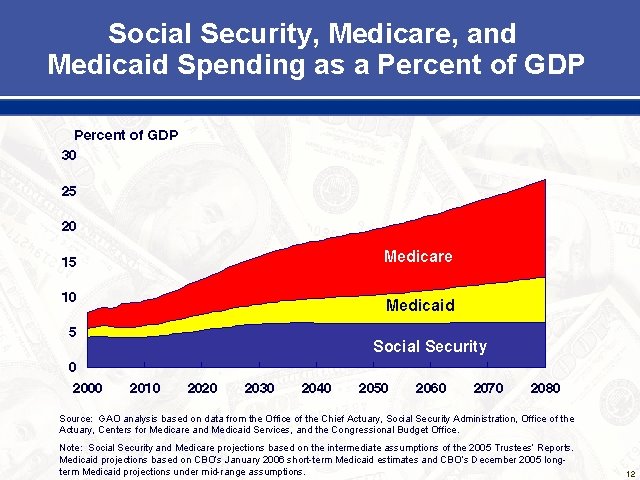
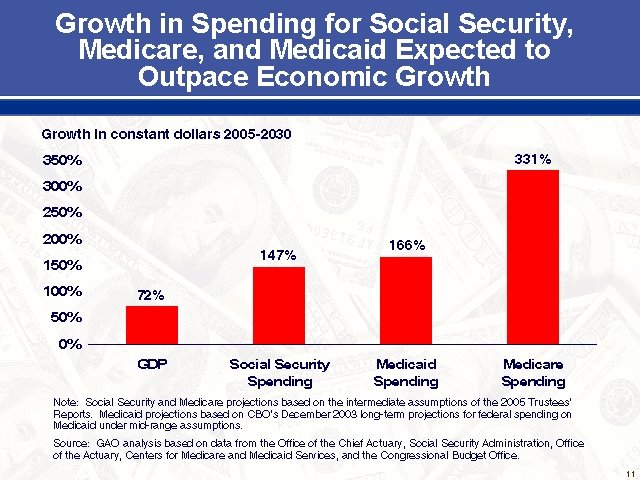
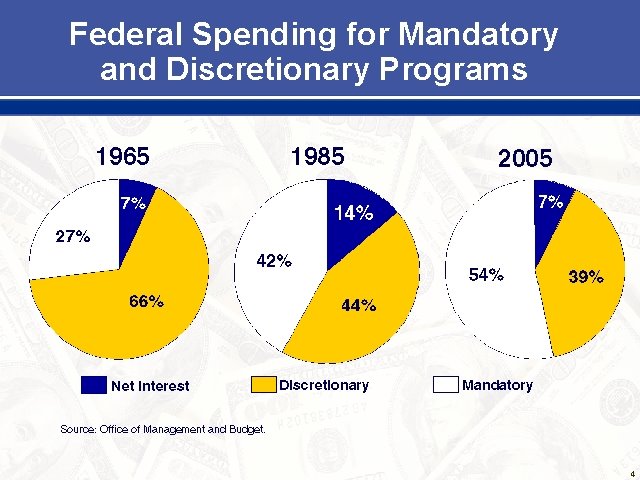
    Earlier this week, I was reading a very interesting book called 'Empire of Debt', where the authors fret over rising debt and arrogance in the US, drawing parallels to the decaying of the Roman empire. While I'm not sure I completely buy all their arguments or even their tone, it does make for a fascinating read and good perspective. But a quote from David Walker, the Comptroller General of the US, got my attention, so I tracked down a presentation he gave for some similar numbers. The images below are slides in a talk he gave to the National Conference of State Legislatures on April 8, 2006.


    I have heard about the Social Security and Medicare crises, but this really helps to bring home the fact that in fact our debt burden is largely one of entitlement spending. (OK, admittedly any model that goes out to 2080 isn't the most reliable, but still anything remotely close to a quarter of GDP's got to make you sit up and take notice)

    I was at a talk by Dr Peter Rodrigeuz of the Darden School of Business at the University of Viriginia earlier this week, where he explained why the changes in demographics in the US and Europe would require them to renegotiate social contracts. It appears that the Hon'ble David Walker's suggesting we may have to do the same.

    Wednesday, April 19, 2006

    Quote of the Day

    I've found myself reading more history recently, especially the history of the American Revolution. One of the great writers of that era, Thomas Paine had this to say about the turmoils of that day (and maybe this one too?)
    These are the times that try men's souls. The summer soldier and the sunshine patriot will, in this crisis, shrink from the service of their country; but he that stands it now, deserves the love and thanks of man and woman. Tyranny, like hell, is not easily conquered; yet we have this consolation with us, that the harder the conflict, the more glorious the triumph.

    Tuesday, April 18, 2006

    The Next Sex Frontier?

    CAUTION: This post contains some material which some readers may find offensive ... although I guess you're used to some form of offensivespeak if you've ever read my blog, this time it isn't political!

    MSNBC recently covered a story about research going into the development of robotic sexual partners which could cater to every fantasy. It even has a name, "teledildonics" (get it?). Hmm, ok so maybe I'm a bit of a prude, but WHAT!! Teledildonics - gimme a break!

    Maybe this is why we are having trouble holding relationships together! Sex is the ultimate expression of emotional intimacy, but we have divorced all emotion and converted it into a merely physical activity. And we wonder where the love's gone. I mean, how f**ked up you gotta to be that you want to get it on with a robot, when there are some wonderful people out there with whom you can enjoy the excitation of not just the body but so much more.

    That really is a damning indictment of our societal mindset - we just can't appreciate quality any more. It's like eating dinner at McDonald's because you don't have the time and energy and love to put together a sumptious meal! I don't know if I read it somewhere or I just made it up, but a saying comes to mind:
    Life is always about the little things

    Whether its a soft loving carress of a partner, or the melodious chirping of the birds, or that faint whiff of spices in your dinner, it's the little things that make life worthwhile. Without them, living, and yes even "pleasure", is a chore!

    Sunday, April 16, 2006

    The Palestinian Implosion?

    I was in a passionate debate with a Muslim friend today about Israel-Palestinian politics. This friend argued, like many other Muslims, that the Palestinians are fighting a just war for their lands, and were martyrs. While there may have been historic injustices to the Palestinians, I find it hard to accept a struggle based on violence, especially one directed at innocent men, women and even children.

    I cherish the Indian freedom movement's peaceful roots, which later served as role models for great movements such as Martin Luther King's civil rights protests, the battle against apartheid and the like. Peaceful protest has incredibly great power not just of galvanising the outside world to support your cause, but also controlling the spread of violence internally. Palestinians are already starting to see the cracks in their society, such as armed militants storming the office of the Prime Minister. Ethnic conflicts propped by violence have a tendency for those violent tendencies to backfire on the individual societies, and it's only a matter of time before Palestine implodes. Western aid drying up and a lack of true aid in excess of lip service from the Arab countries could prove the catalyst.

    Hamas would do well then to take some time to read the history of global conflicts, not for the sake of the Jewish people who they target, but for the sake of their own people.

    Saturday, April 15, 2006

    The Rich Pay Too Much!

    USAToday reported that most Americans think the tax system is unfair, according to the latest Ipsos poll. Most middle-class Americans think they, as well as lower income earners, pay way too much in income, while rich Americans pay too little. This goes well with political hype from the left about tax cuts for the top 5% while the poor are being left to roost, bread and butter for those in the Left. As a low wage-earner, I certainly am tempted to believe this is true. After all, even the books that promise you the secret of wealth usually tell you the rich don't pay as much in taxes, using loopholes and what have you.

    Unfortunately, it's a giant lie! The reality is that the richest Americans already pay a disproportionate share of their incomes to support our tax system. But don't take my word for it - check out this table from the Congressional Budget Office. Now, there are some corrections to be applied to their stats (they don't, for example, count estate taxes and the like) but for the most part, it tells an interesting story. The lowest quintile of wage-earners (that's 25% percentile, or the people who make less than 75% of all wage-earners) pay under 5% of their income to Uncle Sam, as of 2002. The top quintile? Almost 19% The top 5%? Almost 30% The top 1%? Almost a third!

    A third? WOW!! That's incredible. I can't think of how you can be accused of being derilict in your civil duty when you fork over a third of your income to Uncle Sam. Remember, this is after deductions for charitable work and the like. The reality is that it's always tempting to skew rules to favor the majority. Most Americans would like to see someone but them pay for the roads they drive on, the clean water they drink, the clean air they breathe, the police force that protects them, and all of the other things that I would argue disproportionately favors the middle and lower classes (after all, rich people don't, for example, need cops, they hire their own security service!)

    So suck it up and stop complaining about how you're being screwed by the rich white folk!

    Oh, To Be Laid Off By GM

    You hear all these stories of GM and Ford laying off workers and images of struggling families come to mind. Well, that may be an illusion, according to this article by George Will. Here's the part that just stunned me:
    Under contracts negotiated, beginning in 1984, with the United Auto Workers (UAW), there are about 14,700 laid-off autoworkers in the "Jobs Bank." About 7,500 of them are from GM. They get paid most of their wages and benefits -- between $100,000 and $130,000 a year, for an annual cost to GM of $750 million to $900 million.

    jWow, if that's correct, that's incredible - a lot more than I'll probably ever make in my life, even with a PhD! And for doing nothing, zilch, nada!

    I loved the last line of this article:
    Detroit today is having what Washington will eventually have -- a wrenching rendezvous with promises that seemed compassionate, or at least convenient, when originally made but that cannot be kept without ruinous consequences.


    Incidentally, if you are looking for an investment tip, Ford bonds may not be a bad buy, considering the juicy yields and this fact:
    Jay Palmer of Barron's says Ford cannot win concessions from workers by credibly threatening bankruptcy because "CEO Bill Ford and other descendants of founder Henry Ford own roughly 40% of the company's voting equity. A bankruptcy would in one stroke eliminate a huge chunk of their fortune and effectively sever the family's ties with the company."

    Friday, April 14, 2006

    Fire the Accountant!

    Vice President Dick Cheney, arguably one of the most powerful men in the world, cannot seem to afford a decent accountant! What else would explain that he overpaid his income taxes by about $1.93 million this year. Even at a modest 3% rate of interest, that's a LOT of money that Uncle Sam got for free. I don't get it, me with my measly stipend try to get my tax burden right to avoid giving a interest-free loan, you think Cheney with his bevy of accountants could do a little better than that?

    The Smallest Quiz

    Someone forwarded me an e-mail link for the smallest quiz that helps put you on the map in terms of political and economic views with just 10 questions. Interesting, although I question its validity despite rave reviews. Anyway, just FYI, I'm a centrist - scored 50% on Personal Issues (dead center) and 80% on economic issues (conservative).

    Cheers,
    Karthik

    Wednesday, April 12, 2006

    Ouch ... We're Even More in Debt!

    The US budget deficit edged up in March, thanks in large part due to a 13.7% increase in spending compared to last March. Yes, the actual deficit increased by a lot less due to increased tax receipts, but that doesn't take away from the fact that we've got runaway spending. Talk about the collaboration of villians - a White House and its clones that just don't seem to care about deficits (in fact, Cheney loves to talk about how "Reagan proved deficits don't matter") and an opposition party that to whom the solution to deficits is not spending cuts but tax raises.

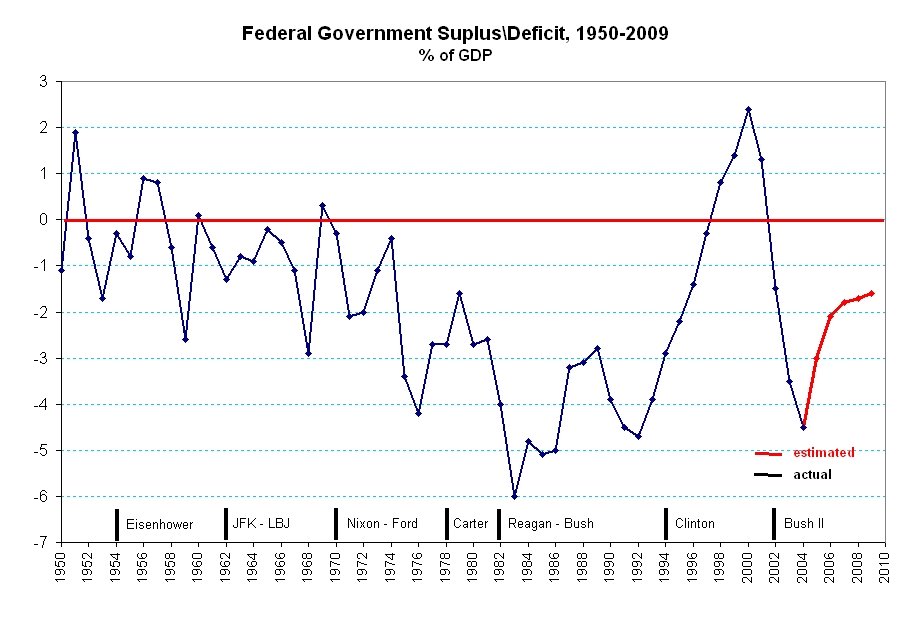
    First the idea that Reagan somehow proved deficits don't matter. I'd love to see evidence that this was the case. The reality is that we have had a serious deficit crisis building for the last several decades, one that was temporarily ameliorated by the booming '90s (see the figure, taken from this page at K-State)


    The red line's the Federal government's projects for the deficit. Keep in mind they are required to cut the budget in half within the next 5 years, so I'd take their projections with more than a grain of salt. The question is will tax receipts be able to reduce deficits? Given the multitude of asset bubbles we have at present, it appears unlikely that we will see even constant, let alone booming, receipts without a sharp increase in tax rates. We might, but it hardly is a given. Prudence then requires we focus on the spending side.

    But of course, all this leads back to politicians. How many pols win elections talking about deficits as opposed to their favorite pet projects, be it war, protection of entitlement spending or what have you? And so we can continue to see growing deficits and more macroeconomic concern.

    Tuesday, April 11, 2006

    The Muzzles Go to ...

    The Thomas Jefferson Center for the Protection of Free Speech announced the recipients of the 2006 Jefferson Muzzles for attempting to suppress free speech. Besides the usual suspects in President Bush, Dept of Justice, FCC, Dept of Homeland Security, there were a few not-so-familiar ones. Here are a couple I found interesting:

  • Rep. Joe Barton, for attempting to bully climate change scientists, using not a citation from a peer-reviewed journal but the Wall Street Journal! I'm all ears for any respectable scientist who wants to present data arguing against global warming, but when we decide to pressure scientists for policy reasons, that crosses the line.
  • William Paterson University. This is a sad reality of how hypersensitive and freaking PC people have gotten. A professor sent an e-mail about some lesbian films that were to be screened, and inviting comments from the university readership. A student who was offended responded by calling the acts "a perversion" and offensive to his religious beliefs. The university went on to file sexual harrassment charges against the student, with the professor claiming it caused her to "feel threatened in her workplace" GIVE ME A FREAKING BREAK!

    The reality is free speech is threatened, but not only by those in the federal government. I have noticed in my very own college newspaper a definitive tendency to publish liberal garbage rather than conservative speak, a scenario where a leftist may criticize the Christian faith, but a Christian cannot enunciate his views on abortion or homosexuality, to print extensive essays on the need for a "living wage", but not even a letter (which I have tried to submit on multiple occasions) on why the call for a living wage is misplaced.
  • Free File Isn't That Free

    So the IRS has a program called Free File whereby taxpayers who make less than $50,000 can e-file their taxes for free using a third-party vendor. Except maybe free isn't always free. For a second year in a row, I grew frustrated with several wasted hours on H&R Block before I chucked the computer for the good ol' paper and pen (ok, not quite - I did fill my tax forms online with Acrobat, but then printed them out and will postal mail them). It appears that at least H&R Block wants to be confusing, forcing you constantly to consider abandoning the Free File for time with a consultant. Amazingly, it's a lot easier to figure things out by reading the tax booklets (never thought I'd live to say this!)

    The IRS' refusal to provide an e-file platform is senseless. MSNBC reported Bert DuMars, IRS director of electronic tax administration, giving his interpretation of Congress statutues was "that IRS should stay out of the tax software preparation business." Sure, no one wants the IRS to hire software programmers to manage this work. But the IRS can, for a very small amount of money, hire a third-party vendor to manage this free platform. My state, Virginia has done this, and I must say, even given that state taxes are a lot simpler than federal tax returns, it was a pleasure to finish filing your taxes and pay your shortfall in all of 5 minutes!

    Appears to me like some firms are seeing healthy returns on their lobbying investments, while the average taxpayer gets screwed!

    Monday, April 10, 2006

    Immigration Rallies

    The US has seen the largest rallies in its history since the Vietnam war, spearheaded by pro-immigrant groups, churches, unions and small businesses. Several small business leaders pointed out on news shows that they would go out of business without the labor these immigrants bring. One of them pointed out that for 8 of the 16 years of his firm, they used exclusively US citizens for labor, but reliable help was hard to find. Migrant workers work hard and prevent wage inflation, and reduce costs for all of us.

    Much has been made by so-called conservatives about the fact that immigrants cost the country more than they benefit the economy. (I used the phrase "so-called" because a true conservative, in my opinion, is one who understands basic laws of supply and demand) Well, CBS News tonight had a few numbers and while they didn't intend to put them side-by-side, I made the connection! Illegal immigrants pay $10 billion in taxes currently, and if all were under the tax net, an additional $15 billion would be forthcoming. Later in the story, a number on how much they cost the exchequer - $2.2 billion in health spending. That means even the current tax revenues from illegal immigrants probably covers their healthcare costs. A guest worker program could end up being a tax bonanza for Uncle Sam, especially since non-citizens don't get the benefits from programs such as Social Security, even though they pay these taxes.

    And while a small section of xenophobic Republicans have proved a stumbling block, the real shocker for immigrant groups must have been that in the end, we don't have a practical bill because of the Democrats. Here's the left-leaning Washington Post:
    Democrats - whether their motive was partisan advantage or legitimate fear of a bad bill emerging from conference with the House - are the ones who refused, in the end, to proceed with debate on amendments, which is, after all, how legislation gets made. The unfortunate result is that the momentum toward balanced reform may be lost. ‘The Democratic leadership played politics with the prospect of 10 million immigrants getting on a path to citizenship,’ said Frank Sharry, executive director of the National Immigration Forum, a pro-immigration group. ‘It seems that Democratic leaders wanted an issue, not a bill.’”

    Friday, April 07, 2006

    Black Men Dropping Out

    As a scientist, I tend to approach even mainstream articles and politics with a critical view, and found a lot of bone to pick with this article by Michael Ross. He correctly worries about the increasing drop-out of black men from the labor force, but then goes on to list the usual suspects for reasons why - discrimination, high incidence of prison stay, etc. All of which might well be true - I'm no expert on the social problems of the black community - but doesn't explain why black women are improving their lot. Being in a university, I'm struck by how so few American black men (i.e. non-immigrants) are present in research settings compared to their female counterparts. I remember Newsweek also did a story where there's some social turmoil associated with a widening gap between the educational expectations of male and female.

    There may be a good socialogical explanation for this, one I'd like to hear. Instead, we get "experts" in the media who'd rather rehash the same old cliches!

    Thursday, April 06, 2006

    El-Erian Interview

    I was reading an interview in Smart Money magazine with Mohammed El-Erian, formerly with PIMCO and Harvard's new endowment money manager, and I found some interesting insight about why China has been such an aggressive buyer of low-yielding Treasurys that I hadn't heard before. Most "experts" argue it's because US Treasuries are so safe, and what have you, but El-Erian had this to say:
    [The Chinese] are not doing it out of charity; they're doing it out of self-interest. they know three things: One is that their export machine creates jobs, and they have a tremendous amount of people coming off the farms and coming out of state-owned enterprises. So there's a social need to create jobs, and exports are a good way of doing that. The second is that they are great students of history. International trade history tells you something very simple: once you capture market share, it's very difficult to lose. So there's the long term benefit to building their export business. The third issue is that once you've become an export machine, every single multinational will desperately want to set up a factory in your country. Suddenly, instead of paying for technology or paying for capital, it's all moving to you very cheaply. So China's view is, "Yeah, buying a 5-year Treasury at 4/3% may not make much sense, but look at what I'm getting in return,. I'm getting things that will contribute to my long-term development"

    Tuesday, April 04, 2006

    Tainted Journos?

    So Katie Couric may be moving over to CBS, taking over from Bob Schieffer. I think she'll pull in new viewers for a while, but as a huge fan of Bob Schieffer, one who switched to the CBS Evening News after he took over from Dan Rather, I gotta say I'm disappointed. But the discomfort with Katie Couric taking over had me investigating if I had a bias against women journalists as hosts.

    Not true, I concluded. I really like PBS' two female journalists - Gwen Ifill and Margaret Warner. I think either of them could host an news program and attract me (actually both do when Jim Lehrer isn't in town). Gwen hosts Washington Week, which is one of my must-not-miss political shows (the other two are McLaughlin Group on PBS and Chris Mathews Show on NBC). So why the discomfort with Katie Couric or Elizabeth Vargas or Connie Chung?

    Well, here's my conclusion. Serious news viewers (and we're a small breed) don't want a journalist tainted by a non-news background. We would shudder to think of a sportscaster taking over the evening news, and we certainly don't like someone who spent the last 10 years of their life talking about minutae like fashion or cooking to migrate to the serious business of news. The network evening news are already suffering from an overdose on non-news and the lack of analysis, and I guess I have a deep-seated fear that a journo tainted with non-news will bring more of it with him or her.

    So I may still continue to watch CBS News, but in the meanwhile, how about a network asking Gwen or Margaret to migrate over? Aw heck, it'll never happen. Neither of them would degrade themselves into talking the crap that network news would want on there anyway!

    Saturday, April 01, 2006

    Bring 'em Back to the Ground

    You ever noticed how the media tends to create angelic companies. We've been inundated with stories about how Google's motto is "first do no harm" or how great Apple is. But when you take the hype away, you see these companies for what they fundamentally are - companies which are in the business of making money. Now, I'm a free-market capitalist and don't have a problem with that, but I am sick and tired of the propoganda.

    Apple refused to share source code that would allow other MP3 players to access the iTunes website, even though they are legally different segments of the business. When Microsoft did that, there was an outrage, but for Apple, there was nary a whisper. Apple tends to keep pushing new versions of the OS and software, and offers poor support on their old versions ... nothing?

    As for Google, well, they certainly violated their stated motto by doing serious harm to their stockholder with their plans to offer a secondary stock offering. For more analysis on this issue, read this article on the Motley Fool website.

    My intent is not to denigrate these companies or to prop up Microsoft. I have been gradually steering away from Word and even Powerpoint for my work applications (moving to Latex and Acrobat instead). But open-source isn't the answer for everyone - it's hard to understand, there's no support and basically isn't worth your while if you aren't a geek willing to spend your precious free time on it. The point is there are several good vendors offering different products that may be good or crappy depending on your application. All of them are in to make a profit, as they should, and none of them have some greater social goal, except where it lines up with their business interests.

    Bring Back the Uniform

    A high school student has sued to force school officials to allow her to wear clothes with the Confederate flag on it. The Confederate flag is one of those intriguing symbols that at the same time represents heritage and the sacrifice of Southern soldiers, but also prejudice and slavery, equated by some along with the Nazi symbol. But this post is not about the Confederate symbol, but about school uniforms. That's right, uniforms!

    I went to a school with uniforms, and I can tell you I'm appreciative. Not just because of contentious debate over Confederate flags or the like. Students in uniforms mean kids expend less energy at school being distracted by others' clothing. The lines between the preppy and the nerdy begins to dim. It means poor families no longer have to deal with their teen needing to wear fashionable clothing to school. It allows for better homogenization among different groups, but more importantly, as a consequence, it allows students to focus on the subjects in the classroom, rather than external factors. Oh, and I'd have strict rules on hair and grooming ... sorry, I don't think a school has to honor a kid's freedom of expression by wearing a purple mohawk!

    Of course, what exactly we focus on in school is another issue. George Will wrote a brilliant piece where he pointed out that we seem to be spending more energy and attention on "helping kids discover themselves" rather than teaching them core subjects, like science and mathematics. This might have been ok in the past, but in an increasing age of global competiveness, this won't do!

    Sunday, March 26, 2006

    Guest Worker Program

    My brother and I were having an interesting discussion on immigration politics when the topic of the guest worker program came up, and my brother pronounced it dead-on-arrival. That's now new, but his reasoning certainly was. Employers using a guest worker permit would have to pay their workers a minimum wage, and he postulates that real wages are so far below the mandated state limit than a widespread use of a guest worker program would send price shocks through the economy, and many a company or farm would collapse under the burden.

    Workers being paid such low wages isn't an indication of a perfect system, but politicians eyeing elections later this year seem unwary of their ability to screw things up big time. Even if a guest worker program does come through, we will need discussion of how we will transition the higher costs into the economy at large. And God forbid, the opponents of immigration succeed, they need to be able to explain where corporations and small businesses and especially farms are going to find labor at the costs they can afford.

    Friday, March 24, 2006

    The Sound of Popping

    Well, the latest piece of evidence in the popping of the real estate bubble is the 10.5% drop in seasonally-adjusted new home sales, and the fourth month of decline in median sale price. All the bullish arguments for why home prices would not fall have been shown to be bullsh*t instead! We should see prices continue to drop in the months to come, especially if the US hits a recession at some point in the near term(you know the GDP can't just keep growing!)

    I forecast that even places without local real estate bubbles will see a downturn. Why? Simply because of how prices are set. Price is determined by emotion as much as reality, and if and when stories flood the newspaper of individuals losing their shirts (rather than some abstract economic headline number), sellers will be more pressured to compromise on price, while buyers will be encouraged to bargain harder. That's why a recession or even economic slowdown could be significant - a seller who has either lost his/her job or fears doing so is more likely to try to reduce his/her mortgage liabilities for what he/she can.

    Quote of the Day

    Senator Hillary Clinton, critizing the new immigration bill on the floor of the House, that would make it a criminal activity to help an illegal immigrant, even at a homeless shelter.
    This bill would literally criminalize the Good Samaritan and probably even Jesus himself.

    Thursday, March 23, 2006

    Can the US Stay Ahead?

    I often find tales of the US' reduced dominance to be a little overplayed, but thought this article in USNews to be interesting, despite the hyped title. I'll let you read the article, but I found some numbers at the end of the article very interesting:

    Estimated amount U.S. companies spend annually on R&D: $194 Billion

    Estimated amount U.S. companies spend annually on tort litigation: $205 Billion

    Percent of engineering Ph.D's awarded in the United States that go to foreign-born students: 56

    Number of the world's Top 25 information-technology companies based in the U.S.: 6

    Number of the world's Top 25 information-technology companies based in Asia: 14

    U.S. trade balance in high-tech manufactured goods, 1990: $33 Billion

    U.S. trade balance in high-tech manufactured goods, 2004: -24 Billion

    Wednesday, March 22, 2006

    A Moralizing Government?

    Missisipi outlawed sex toys, according to this posting in the Abrams report on MSNBC. Whoa, hold your horses, congressman! Don't you think you're stretching the definition of government a little too far?

    I'm an odd person to be arguing for sex toys. I've never seen, much less used, a sex toy in real life. I'm very conservative not only in my personal life but also in public policy. I support the conservative movement in a number of issues, from the value of abstinence education to the role of faith-based charity and religion in our society. But there is such a thing as taking a good point too far.

    Government has some valid responsibilities in personal life, but only when they are related to the protection of the vulnerable or the future of society. It is appropriate for people to dictate, through their government, their definition of marriage, for example, in the interests of parental rights or social structure, but they cannot prohibit homosexuality when practiced in the confines of one home, even if they consider it immoral behavior. That's the hallmark of our freedoms - you as consenting adults can do what you like in the privacy of your homes, but the minute an individual who is not a consenting adult is involved, society at large will step in in the interests of that individual, and society at large.

    Sex toys and pornography should be protected by the First Amendment, as should the right to have sex outside of marriage. Just because our lawmakers consider them to be abhorant behavior is not reason enough to ban them.

    Oh, and while we are at it, do we really need to have as many restrictions on smoking? If the concern is that smokers are at increased risk for lung cancer and may strain the public health system, we can simply argue that co-pays will go up for smokers, or lung cancer will not be covered to the same extent by Medicare. Cruel? Sure - but in an ownership society, individuals have to pay for their actions. But along with that comes the liberty to make those choices. Cigarettes are a legal product that can be enjoyable and yet harmful - no different than that order of fries at McDonald's. When government starts intervening in personal decisions such as these, we threaten the very definition of a free society.

    Monday, March 20, 2006

    Random Late-Night Funnies

    "The FBI is investigating Americans -- just for opposing the war. You know, maybe when we're done establishing a democracy in Iraq, we could try it over here. Stop, I don't want to get investigated, don't applaud!" --Jay Leno

    "Former President Bill Clinton is telling people that his gut is saying that America is ready for a woman president. And I would say to President Clinton that's not your gut talking." --David Letterman

    "First Lady Laura Bush said she started exercising when she married President Bush because it was already part of his lifestyle. Isn't that nice? Yeah, that also explains why she stopped reading." --Conan O'Brien

    "Snap! Censure! A moral condemnation of the president so severe it's only happened once before to President Andrew Jackson, who was never heard from again. Oh, wait [picture of the $20 bill]." --Jon Stewart, on Sen. Russ Feingold's motion to censure President Bush

    An Immigration Crisis

    I've been recently interacting with a fair number of graduating international students who have complained about the complexity and stress involved with visa transfers that would allow them to switch to a worker visa. The process was relatively simplified (relative being the key word!) during the booming '90s, but in a post-9/11 world, the restrictions are suffocating. A graduating student would, for example, have to guess when visa quotas for a given year might expire, and how long the process may take, and then try to graduate at the right time, assuming of course, that funding was available until that time.

    This clearly is out of control. We cannot have a system where students are required to navigate these loopholes or retain a lawyer. In the end, the US will lose, as students will choose easier pastures. In the past, there were few such options, but in the present era of competitive globalization, penalties for excessive regulation will be severe!

    Postscript: Looks like Bill Gates is in Washington trying to lobby for support to increase the cap for the number of foreign workers from 65,000, a number that was 3 times as high a few years ago. More on the Gates visit here

    Tuesday, March 14, 2006

    Inept Legal Team

    How on earth can you allow such an inept legal team on possibly the most important legal case in contempory times - the trial of Zacarias Moussaoui, the "20th suicide bomber" on 9/11. Coaching witnesses! Lieing to the defense that certain witnesses were unwilling to talk to the defense, without ever talking to those witnesses. Not conveying to the witnesses the judge's orders against following the news. Discussing testimony with witnesses. No wonder an exasperated Judge Brinkema exclaimed, "I wouldn’t trust anything [Transportation Security Agency prosecutor Carla] Martin had anything to do with at this point"

    Yes Virginia, You Are Overvalued!

    I have not talked about real estate in a while, in part because it's been all over the mainstream media, more so than it really deserves (most stories have no new content, and rehash the same old crap!) But National City Corp. reported estimates of fair value for real estate in several cities yesterday and found several cities to be vastly overvalued. My own state of Virginia as well as my former state of Arizona are positively bloated - I live in Charlottesville, where houses are 30% overvalued! The most overvalued? Naples, FL - 96% overvalued. The most undervalued? College Station, TX - almost 23% undervalued. Texas accounted for 8 of the 10 most undervalued cities, while California and Florida for 18 of the 20 most overvalued.

    Saturday, March 11, 2006

    In the Doctor's Backyard

    I just watched some of the coverage on MSNBC on the Southern Republican Leadership Conference. Sen Bill Frist, not exactly my favorite man, won the straw poll in his backyard, but the most interesting development, I thought, was Sen John McCain urging people to write in President Bush's name, as a sign of support for him in these tough times. It was an interesting strategy, one emphasized by an interview with his ally, Sen Lindsey Graham. The McCain campaign is obviously investing heavily in the idea that the candidate blessed by the incumbent tends to win the primaries. It is odd that McCain, a greater hawk than Bush, has to embrace the President to appear conservative enough.

    I also heard Mitt Romney's speech, and while he struck a chord at a couple of points, for the most part I was not impressed. I didn't get to hear George Allen or Brownback or or Tancredo or others who represent the body of the Republican party that's anti-immigration. Listen, I'm all for talking tough on the topic, but as I have ranted before, illegals come because we in this country have a serious shortage of cheap labor. Anyone who's ever been to a farm will know we couldn't enjoy the good life without the poor illegals willing to work for peanuts!

    The other person I heard interviewed was Sen Trent Lott, and I must say I was very impressed. Here's a guy who seemed to be articulate, and at least in the course of the interview, lacked the venom so pervasive in the Beltway.

    Oh, and if you can vote, do so for John McCain ... you know it's the right thing to do!

    Friday, March 10, 2006

    Shame on You, Pols!

    US politicians have once again proven that politicians everywhere are more interested in short-term political gains rather than the long-term interests of the country and the world. By interfering with Dubai Ports World's purchase of P&O under the guise of national security, they have raised serious concerns over the rise of protectionism in this country, especially coming after the hoopla over China's CNOOC trying to buy Unocal.

  • "But what about national security?" 80% of US ports are operated by foreign entities. That number is 90% in the UK, incidentally. So why the uproar now?
  • "Because now the entity is a foreign government" There's never been a good reason why there should be an issue with a state-run entity as opposed to a foreign corporate body. But ignore that for a moment. The reality is that we already have foreign state-run operators in this country. Didn't hear that in the soundbites, did you? Well, port terminals in Oakland, LA, Seattle and Alaska are run by a company majority-owned by Singapore. What's that you say, Singapore is a friend? Well, then how about the fact that the Port of Long Beach is OWNED by COSCO, an entity of the People's Republic of China?

    But this deal is bad not just because a company based in an ally country has been wronged. It's bad because it sends a message, after the Unocal deal, that we aren't so sure about allowing foreigners to buy our assets. As one guest on the McLaughlin group, a brilliant journalist with the United Press International (whose comments I intend to post once the transcript is up) pointed out, beggars can't be choosers. Our lifestyle is funded by an incredible trade deficit, which means that the Chinese and Arabs and all those people who we buy things from are stuck with dollars. But the moment they try to buy anything with those dollars, we freak out.

    A great example of the size of our trillion dollar current account deficit was from econoblogger Brad Setser:
    So it is not at all unreasonable to say that financing the US current account deficit requires that the US raise $20 billion a week, whether by selling debt, selling stocks or selling off real US assets. That is equal to selling one Unocal a week to China (CNOOC was willing to pay $20 billion). Or selling three companies the size of P&O to the Emirates a week.


    If Congress were really serious about port security, they would look into the fact that so few containers go through any kind of inspection, including one of its manifests! It would invest in upgrading port systems, where due to unions, many times information has to be manually retyped to keep people employed. But these don't fit in soundbites. It's much easier to come on TV and be outraged that an Arab company is buying our ports.

    I have sometimes felt people in a democracy deserve the pain they get. When voters vote based on emotion and rheoteric, they are stuck with inept populists who do little to improve the lot of their people. I grew up seeing this in India, where pols prefered to promise state-subsidized rice at $0.04/kg than invest in infrastructure. Alas, the beacon of hope in the capitalist world has stumbled a little by falling prey to the same emotional vagaries!
  • Don't Let the Terrorists Win!

    In India this week, we got a stark reminder that with all the good news, the people are still victims of terror, as an explosion in the holiest city of Varanasi killed many worshippers. The opposition leader, Lal Kishan Advani ranted some typical cliches about appeasement of Muslims and terrorism, but it is positive that the blasts have not triggered, as best as I could tell from my limited diet of Indian news, any serious communal clashes. India is in a sweet spot economically and politically (in international terms, that is), and does not have to return to the agenda of the past.

    That's not to say a weak response to the terrorists. I'd like to see Prime Minister Manmohan Singh come on TV and say we're gonna smoke the guys who did this! But aggression against these criminals must not spill over to the streets. If it does, the terrorists will have won ...

    Monday, March 06, 2006

    Let's Raise Our Credit Limit

    What if your credit card company agrees to give you any credit limit you want? If you are like the US government, you'd probably rack up more debt to max even that increased credit limit. A fight is brewing over a proposal to raise the government's credit limit. Gosh, this government's out of control! I like George Bush, but really, as I've been stressing to many friends, he's not conservative. Racking up huge amounts of debt is not conservative philosophy in my book.

    Now, deficits by themselves are not always bad. Think about an individual again. If you are in debt paying for a professional degree (say law school), this might be a good investment as it provides opportunities for better pay down the line. But if you're spending on items that do not boost your future cash flow, this is a recipe for disaster. And yet, the government spends most of its money on non-investment type programs, often pork-barrel spending with no greater purpose than to get congressman reelected, like the horrendous Bridge to Nowhere in Alaska.

    I will pat Democrats on the back for demanding fiscal responsibilty, but I differ with them on the solution. The solution is not to raise taxes, but to cut spending. Think again to the individual who works as a contractor and charges by the hour. If he thinks he can solve his credit card issues by raising his hourly wage rate, he's in for a shock, as he finds the work drying up and his income falling. His only way out of the hole is to cut spending, challenging every expense item - house, food, everything!

    Maybe the government should be run more like a responsible household. You start with what you have and spend from that pot, rather than deciding your spending and then run up a debt!

    What a Deal!

    A while back, I had written about a bank called Everbank that offered CDs that offered you the greater of your principal or the appreciation of the S&P 500 at the end of your term. So for example, if you invested a $1,000 (which in reality you can't - there are pretty steep minimums), and the S&P rose 10% in the time of your CD, you'd get back $1100. But if the S&P fell during that time, you'd still get back your original $1,000 back. Makes you wonder what the catch is, eh?

    Well, there isn't really a catch. This is a win-win - except that the two parties have different goals. I figured out the logic and thought of posting it, but figured it would probably put most of my readers to sleep, but do e-mail me if you are interested in why someone would offer that.

    And here's an offer for you! Hehe, that's right, I'm advertising on my blog ... no, not Viagra pills or free software! I'm offering you the same terms as the Everbank CD - principal or appreciation of the S&P 500. Of course, rather than minimums like Everbank, I have to have maximum ceilings, but if you are interested in this, e-mail me at kewlkarteekatgmaildotcom (the e-mail style is to prevent spam - convert it to a typical e-mail address)

    Sunday, March 05, 2006

    Manufacturing Workers Needed in the US?

    This article in USNews really shocked me - a shortage of skilled manufacturing workers in the US of A ... my first reaction was, you gotta be kidding! But evidently it's true.
    A recent study by Deloitte Consulting for the Manufacturing Institute of the National Association of Manufacturers found that over the next three years, 80 percent of U.S. manufacturing companies expect shortages of skilled production workers–people like machinists, craft workers, and technicians.

    Wow, can you spell surprise? Don't drop of school just yet, though. Here's the kicker:
    Unfortunately for displaced autoworkers and others in the rust belt, demand for certain types of skilled manufacturing workers doesn't necessarily offer a parachute....Many autoworkers come from the traditional mold, doing the same task, day in and day out. Today's factory is not your father's factory, and many of those repetitive jobs are getting shipped to low-cost countries. "The new manufacturing worker has to think, know math, interpret CAD/CAM drawings, be knowledgeable about more than one process, and be a good team problem solver," says Eisen.

    Saturday, March 04, 2006

    Nuclear vs Renewable

    Even as President Bush inked a historic nuclear deal with India, I received an e-mail from the Worldwatch Institute, an environmental think-tank, arguing that the deal was reckless on every score. In the past, I have read with some interest reports put out by the Worldwatch folks, but possibly because of self-interest, I read this e-mail a lot more critically and found it replete with flawed logic and lies. (As an aside, every person should read the 1954 classic book 'How to Lie With Statistics').

    Here is just one instance of this:

    Globally, the nuclear construction business has been in decline for more than two decades. Worldwide, nuclear power is growing at an average rate of less than 1 percent per year. By contrast, renewable energy--wind, solar, and biofuels--is on a growth surge, averaging annual expansion rates of 25-35 percent, as President Bush noted enthusiastically in speeches in Colorado and Michigan last week. Total investment in the world's renewable energy sector reached $30 billion in 2004, according to the 'Renewables 2005: Global Status Report'.

    Well yes, it helps to have a really small number to grow a lot. Nuclear power supplies an estimated 8% of the world's energy needs, 27 quadrillion BTU, according to the US Department of Energy. Geothermal, wind, biomass and solar and other sources supplied about 6 quadrillion BTU. In the US, nuclear power supplies about 8 quadrillion BTU per year, while biomass under 3 quadrillion BTU, and solar and wind about 0.1 quadrillion BTU or less. And let's not forget the pressures put upon the nuclear industry that have essentially killed the industry.

    Look, I'm a environmental engineer and a bit of a tree-hugger myself, but we cannot hope that biofuels and solar and wind sources are going to come close to tackling our energy needs in the near future. Nuclear is an option, one that produces low emissions and can be safe with adequate safeguards, and we need to embrace it, rather than have think-tanks scare people with snake oil science!

    Monday, February 27, 2006

    Paying Halliburton

    Most people will read this story and think, hmm the fat cats at Kellog Brown Root (KBR), a subsidiary of Halliburton, where VP Dick Cheney used to work, are getting away with it. But the reality is that the Army's decision to pay KBR is probably the right one. I don't know the details of the audit, but having worked in this civil engineering business for a few years, I can tell you it is completely unacceptable to have perfection under these situations as a precondition for payment. Think about it, the US Army itself, having trained and fought in wars such as this one before, is struggling to keep itself above water. How can you expect a consulting firm that has never worked under wartime conditions to perform perfectly? KBR is taking a lot of risk in this work, and I think I remember reading that they weren't having great profit margins (common folk think profit, which of course is important, but in the consulting world, profit margins are the holy grail!) To not pay KBR would have been a guarantee that you would find it hard to find private partners in your next effort.

    Sunday, February 26, 2006

    Why the Fed is Irrelevant

    [Wow, third post this morning! I've been extremely busy, so it might be that a lot of my blogging comes on weekends in the future!]

    While not all my readership seems to appreciate economics or investment postings (I've gotten e-mails from friends asking me to please cut it out) I'm still intrigued by the topic, so I guess we'll continue to have some more. I found this article by John Hussman to be quite intriguing. He's a PhD in economics, and a very interesting read if you are interested in investing. In this article, he argues that bar in the event of a banking run, the Federal Reserve is irrelevant, except for a physcological effect. This is stark contrast with media outlets and analysts obsessing about the Fed's every move. I'm no economist, so I am unable to critically evaluate the strength of his arguments, although I guess I'm a little surprised because it contrasts with the argument that the Fed has created asset bubbles with low interest rates. Some excerpts ...
    One might respond that even if the Fed doesn't affect credit, surely changes in the monetary base affect inflation. But if you look at the statistical evidence, the relationship between monetary growth and inflation is very weak. Instead, our research indicates that inflation is primarily the result of growth in unproductive forms of government spending (basically defense spending, entitlements and other expenditures that fail to stimulate the supply of goods). The evidence both from the U.S. and other countries clearly demonstrates this relationship.

    Except for the Federal Funds rate, the Fed does not determine short-term interest rates. Most of the time, it simply follows them. Statistically, the Federal Funds rate consistently lags market interest rates such as Treasury bill yields. Indeed, changes in market rates have far more predictive power to forecast the Federal Funds rate than vice versa.

    Mark Warner at Asia Society

    A few days back, after reading the Bush speech at the Asia Society (see previous post), I had visited the Asia Society web site and looked at the recent speeches. One of them was Mark Warner. Now, I'm always interested in anything to do with Mark Warner not just because he was Virginia's hugely popular governor, but also a potential candidate in '08, and maybe, just maybe, a Democrat I might be able to support (of course, that may change when he starts talking about the myriad issues he has been silent on to date). But reading this speech, I was pleased to note that here is a Democrat who is not talking Benedict Arnolds Kerry-style, but rather recognizes changing paradigms and as governor, sought to realign Virginia in the new model rather than clinging onto protectionism. Here's one fact I found particularly surprising...
    That was a large Indian company, Essel Propack, that actually picked Danville, Virginia-the heart of the tobacco region in our Commonwealth-to put a major manufacturing facility. That manufacturing facility in Danville has done more to change the feelings of people in Southside Virginia about some of the upsides of international trade than anything else.


    Wow, Indian companies are actually setting up shop in the US! This is something you don't hear about too often in the press. Anyway, I like Warner's emphasis on technical education rather than regulation. I like that we finally have a Democrat who realizes that we don't need to be going back to the jobs of the 20th century, that we need to be staying ahead of the curve in technological and service jobs.

    There was one anecdote of his trip to Delhi, India that sounded suspiciously like something I had heard from Bill Gates several years ago, but I'll give him the benefit of doubt that he went to the same project Gates did. So anyway, here's that anecdote:
    I visited an NGO called the Hole in the Wall project. This Hole in the Wall project was simply where the NGO had come in and put a series of computers into a brick wall-and would turn them on in the morning and turn them off at night. There were no teachers, no training. It was definitely to see what would happen. I mean I'm a visiting American dignitary and they had rolled out the red carpet and a young kid named Samir grabbed me and said, "Tell me your name, tell me your name." I said, "My name is Mark. Why do you want me to tell you my name?" He said, "Well, I want to Google you to find out if you're important."

    President Bush at the Asia Society

    I read a wonderful speech by President Bush at the Asia Society talking about India and Pakistan. You can read the transcript here (or click on the 'Video' link for video, although I prefer reading to watching!). It's a good reflection of the two nation's importance in the world. Here are a few excerpts I really liked:
    India's work in Afghanistan is a good example of India's commitment to emerging democracies. India has pledged $565 million to help the Afghan people repair the infrastructure and get back on their feet. And recently, India announced it would provide an additional $50 million to help the Afghans complete their National Assembly building. India has trained National Assembly staff, and it's developing a similar program for the Assembly's elected leaders. The people of America and India understand that a key part of defeating the terrorists is to replace their ideology of hatred with an ideology of hope. And so we will continue to work together to advance the cause of liberty.


    For all those people who cry about outsourcing to India, here is why India is great for the US.
    merica's economic relationship with India is strong and it's getting better. Last year, our exports to India grew by more than 30 percent. We had a trade surplus of $1.8 billion in services. India is now one of the fastest-growing markets for American exports, and the growing economic ties between our two nations are making American companies more competitive in the global marketplace. And that's helping companies create good jobs here in America.


    Further on the topic, he expands on the demand for American products in India.
    We must also recognize that India's growth is creating new opportunities for our businesses and farmers and workers. India's middle class is now estimated at 300 million people. Think about that. That's greater than the entire population of the United States. India's middle class is buying air-conditioners, kitchen appliances, and washing machines, and a lot of them from American companies like GE, and Whirlpool, and Westinghouse. And that means their job base is growing here in the United States of America. Younger Indians are acquiring a taste for pizzas from Domino's -- (laughter) -- Pizza Hut. And Air India ordered 68 planes valued at more than $11 billion from Boeing, the single largest commercial airplane order in India's civilian aviation history. Today India's consumers associate American brands with quality and value, and this trade is creating opportunity here at home.


    OK, there were a lot more I could excerpt, but you'd be better off reading the whole speech. Even if you don't care for Bush, you'll find this speech revealing because it is about the strategic importance of two nations that will be vital players in the global environment.

    Saturday, February 25, 2006

    Boo Bode

    So Bode Miller finished medalless, after all the publicity and media glitz. His response:
    As far as my own personal involvement, I would not change anything. I had an awesome Olympics

    I have to confess I never did care much for rebels, but Bode Miller's some piece of work. Not a medal, and he had an awesome Olympics? Well, I don't know if the American public who he represents would agree. Why do atheletes think they are somehow immune to any performance standards? I mean, if I was a brilliant engineer, and I designed a bridge that collapsed in a day, you think I could get away with, "I'm satisfied with my work"?

    Wednesday, February 22, 2006

    The Arabs Control Our Ports!!

    A lot of excitement has been generated in the last couple of days over the issue of a Dubai-based company, Dubai Ports World buying a British company, P&O Steam Navigation, which manages six US ports. My first instinct was NO FREAKING WAY! After all, how can it be safe to allow an Arab company to be in charge of US ports?

    But things aren't as they appear at first glance. After all, 30% of US ports are run by foreign companies. Which raises the question - if there are security concerns, why allow any foreign company to run our ports? The UAE is actually a valuable ally in the War on Terror. Add in the fact that the Department of Homeland Security and other agencies thoroughly vetted the deal, and the US actually has been having a working relationship with DP World for a while now, like Asst Secretary of Treasury for International Affairs, Clay Lowery pointed out on the Newshour on PBS (port security often starts outside the borders of the US).

    There is one more dimension to this - the meaninglessness of nationality. The same day the ports issue generated an uproar, three US citizens were arrested for links to al Qaeeda.Terrorists can always recruit mercenaries - case in point, Jose Padilla, not Arab, not Muslim. If we rely on the conscience of "our" people in the war on terror, we're inviting another attack! Thankfully, port security continues to be firmly in the hands of the Department of Homeland Security rather than in those of a company whose only qualifications are its nationality.

    Sunday, February 19, 2006

    Contrarian Success

    I just read this in a story on the Motley Fool web pages. While I tend to be skeptical of Wall Street views and have sort of hoped I was a bit of a contrarian investor, this fact shocked even me.
    In fact, in every single year of the new millennium, stocks rated "sell" by Wall Street have outperformed stocks rated "buy" or "hold." From 2000 to 2004, stocks that the Street told you to sell rose 19% per annum on average. Meanwhile, the "buys" and "holds" rose just 7%.

    Saturday, February 18, 2006

    Dell Theory and Oil Security

    Wow, the Master Thug Hugo Chavez has just threatened to stop exports to the US if the US keeps pissing him off. Big threat when Venuzuela is one of the big sources of American oil consumption! Is he serious? Can this be a threat?

    Thomas Friedman postulated in his book 'The World is Flat' what he called the Dell theory - essentially no two countries that make parts for a Dell computer will go to war. Essentially, it means economics beats rheotoric every time, so sleep easy because markets are at work. I'm a great believer in free markets, and think they are a better system than any bureaucrat-controlled one. But there are limitations, and one of them is that when markets are not truly free, we have some issues.

    What do I mean? When a country is ruled by a despot or a "democratically elected" leader who thrives on sentiment rather than performance, we have an issue. The argument is that no leader would take such an economically disastrous step for fear of losing the next election, but the reality is that leaders in many such countries either do not have to worry about elections, or can sway an uneducated public with false hope and rheotoric.

    We love to wax about the incredible promise of democracy, and it's one I truly believe in. But it requires people to make unemotional choices, and think of the consequences of their choices, as President Bush aluded to following the Hamas election. The reality is democracry after democracy elects leaders who will bring misery on them, all on the promise of justice or just sticking it to the US or the world (even as they take US aid!)

    So should we be worried about the Chavez threat? Absolutely. It underscores a point I made in a previous blog post - the major sources of oil are far fewer than we'd like and in countries who aren't necessarily full of warmth for us. I'd say let's pull out those plans for the nuclear power plants! There have been many safety concerns, but if we don't try to penny pinch, we can build safe reactors that make us safer (in energy terms at least).

    Thursday, February 16, 2006

    The Future for Oil

    One of our engineering professors was kind enough to invite me to a lecture he was giving on the oil and gas industry. I found it a fascinating talk, filled with interesting statistics and slides from BP, Shell, USGS and other agencies. It really helps put a lot of issues related to the oil and gas industry in perspective. (I should note that the views below are mine, based on the facts and figures in the lecture, not necessarily those of the speaker)

  • "We need to reduce our dependence on Middle East oil" Seems obvious? After all, this is where we have all kinds of political enemies. Politicians rant about this all the time. Even the oil-loving President Bush said so. Well, nice try! Unfortunately, Middle East oil accounts for 62% of the world supply. The lowest that percentage has ever been? 56%. Even countries we don't do business with, like Iran, affect oil prices and supply. While we are at it, let's dispense the illusion that we can do away with dependence on thug countries. In that chart with oil suppliers, there are slices for thug-ruled Venezuela and not-exactly-trustworthy Russia! Oh, and just in case you think that maybe natural gas is the way, the biggest producers of natural gas include those very same countries!

  • Just how much oil we have left is a bit of a mystery. A quarter to a third of the oil inventory is for "undiscovered" oil, i.e. we sure hope we'll find some. Existing "proven" reserve numbers are themselves suspect - the Middle Eastern countries had a mysterious surge in their proven reserves in the 80s. Incidentally, Kuwait recently cut their proven reserve estimates by a half!

  • The Hubbert peak, named after the US geologist who correctly predicted the peak of US oil prediction is a little more sophisticated than a guess. The Hubbert model has so far correctly predicted (well, for a model!) US production to date (mind you, the model predictions are from 1959, rather than a model based on the benefit of hindsight). The model has been incredibly spot on so far when applied to the world oil production by later analysts. The predicted peak oil prediction - end of 2005, give or take.

  • "What we need are alternate fuels - biodiesels, electric, etc" If we all switch to hybrids, all will be ok, correct? Maybe, but penetration on a major scale isn't likely to happen anytime soon. More likely mass fuel sources are from bitumen and tar sands in Canada. What does that mean? More expensive oil!

    When I can take some more time to read, I plan to read more on the topic. In the meanwhile, if you have any ideas or information you've read somewhere, please feel free to share it using the comments section.
  • Tuesday, February 14, 2006

    So Cheney Shot Someone

    OK, I don't get it. Not the hunting part - ok, that too ... I'm vegetarian and never did get why anyone would kill a poor bird or animal! But for now, I really don't get why there's all this excitement over why the White House didn't tell the media about the shooting accident Cheney was involved in first. If there was any wrongdoing, that might be a story, but for now, the Veep was on vacation, and had what seems to be a not-too-uncommon accident where he hit a co-shooter. He did it in his personal time, and as I said, on the face of it, there was nothing improper. So why the hoopla? Does the White House Press Corps not have better things to talk about? What we going to do next - Scott McClellan comes forward and somberly announce that the President has some indigestion ... but not to worry, good ol' Bayer Antacid is at work (at which point, we can spend endless hours talking about a President illegally endorsing Bayer!)

    Postscript Loved this joke from Jay Leno on the Tonight Show:
    That’s the big story over the weekend. ... Dick Cheney accidentally shot a fellow hunter, a 78-year-old lawyer. In fact, when people found out he shot a lawyer, his popularity is now at 92 percent.


    You want one more - ok, here's Letterman:

    Good news, ladies and gentlemen, we have finally located weapons of mass destruction: It’s Dick Cheney!

    Forget the Sugar-Free

    I've been too busy recently to blog, but thought I'd squeeze the time this morning to share with health article. I've sort of known how bad flour was before, but figured not many other people don't. But when I read this article from Dr Gabe Mirkin, even I was shocked to learn that white flour makes your blood sugar rise almost as much as table sugar. So he argues that there is no point buying sugar-free desserts loaded in white flour. I'm not white flour free - I still devour the cheap pasta from Sam's Club, but I use a lot of broccoli and cauliflower and blackeyed peas or chickpeas in my pasta sauce to add fiber and slow the rise of blood sugar. There are still probably some nutrients lost in the flour making process, but until Whole Foods can come out with a cheaper version of their whole grain pastas, this will have to do. I do eat whole wheat bread and brown rice already. You can buy the latter by the pound at Whole Foods - I recommend a 50-50 mix of long and short grain brown rices and using a 1:3 mix of rice and water if you use a rice cooker.

    Monday, February 06, 2006

    School Choice is the Way

    One more story, this time from ABC News, that shows how private initiatives to take at-risk children out of failing schools and into private schools has changed their lives. To me, this only underscores the need to allow true choice. It's great that private initiatives are making a difference, but we shouldn't need these. Charitable institutions have a pivotal role in a string of programs where governmental involvement is not only inefficient but cost-infeasible. And yet, in the area of education, state efforts are not always efficient (they tend to be better in the cherry school districts) but also very expensive - some $10,000 a student. Here's the part of the story that had me thumping my desk in support:
    While a program like Student Sponsor Partners requires significant financial backing, O'Malley said the program actually spends less per student than public schools do. "Our schools spend about half of what is spent per pupil in New York City public high schools, [and] with dramatically better results," O'Malley said. "The problem is not the amount of money being spent. Spending in New York City has increased several billion over the last five years alone; the problem is how the money is spent."

    I grew up in India, where the spending per student, even on purchasing power parity terms, was minimal. While there are avenues where I wished I had better exposure, none of those really involved significant monetary costs to the school. But that cheap education still gave me what I believe is a tremendous academic platform to launch myself. Every kid should have that platform!

    Afterthought This is not simply about public vs private schools. I do want, for example, a student in a failing public school to be able to transfer to a successful public school without his parents being able to afford a house in that district! In the end, if properly implemented, choice should improve quality and bring down education costs (which are at present unsustainable). So the next time you hear a politician promise to increase funding for education, boo him and ask him what he'll do to improve the quality rather than quantity.

    Thursday, February 02, 2006

    The Case for Breakfast

    Men's Health magazine had eating breakfast as part of their 12-week physical transformation program, and had this to say about the importance of the meal:
    University of Massachusetts researchers recently discovered that men who don't eat in the a.m. are 4.5 times more likely to be obese than those who make it an everyday habit...And timing matters: Make sure you eat your first meal within an hour and a half of waking. The scientists found that guys who waited longer than that increased the likelihood they'd become heavyweights by 50 percent.

    And may I recommend the Boca burger and a bowl of Raisin Bran cereal - they are low in fat, loaded in fiber and the former has a fair amount of protein - potent combo!

    Tuesday, January 31, 2006

    The Life of the Unborn

    In all the buzz surrounding the State of the Union address, an important story was probably missed by several readers. Two federal courts ruled the ban on partial birth abortions unconstitutional. While I don't know all the details, my understanding is that the issue was with the wording, specifically the lack of a clause to protect the mother's health.

    Nevertheless, before you celebrate this victory for "choice", I would strongly urge you to watch this video on aborted fetuses in the first trimester (CAUTION: EXTREMELY GRAPHIC AND DISTURBING!, well before the third trimester that the partial birth abortions refer to. I cannot think a person would not be moved by this video.

    Monday, January 30, 2006

    Swipe that Plastic

    The US government today announced that the personal savings rate of its citizens for last year was -0.5%. That means, on average, every citizen is spending more than their disposable income (income after taxes). This is the first time we have had a negative savings rate since the Great Depression era (for comparison, it was 10.8% in 1984). For the month of December alone, spending went up 0.9% while real wages only creeped up 0.4%

    Things don't look good. Admittedly, some nations have a problem with too high a savings rate, which means that the market is inefficiently misplacing capital. But to spend more than you have is a recipe for disaster. What it does on a macro scale is to leverage the economy, providing it with a boost when times are good, but unwinding things horribly when times are bad.

    Is there any reasonable expectation of change? It appears unlikely. We have positioned our economies incredibly on consumer spending and cheap credit, and seemed to have as a society ignored Puritan values such as thrift. One only needs to look at the craziness of our iPod obsession (I can't fathom someone paying $300 for a fancy walkman!) to realize that something's out of whack!

    Add in all those underfunded Social Security and Medicare obligations, commitments many older workers seem to be counting on (I was shocked to talk to people who indicated they didn't need to save because their SS/pension plan was there!) ... and I'd say be scared ... be very scared!

    Postscript A 1999 study by the Consumer Federation of America showed that despite the preceding stock market boom, half of all Americans had accumulated less than $1,000 in net financial assets and modest net wealth of $35,000. More households with incomes under $35,000 believed that they are more likely to accumulate a nest egg of $500,000 by winning a lottery or sweepstakes (40%) than by patient saving and investing a modest sum (30%. But most fascinatingly, they found that the quintile with the least net financial assets had a median income of $31,700, while the median incomes of the next two quintiles of net assets were $13,100 and $25,500. This is consistent with another study I read (and that I've been meaning to post on) that disproves the myth that savings are related to incomes. Yes, that's right, you don't have to make a lot of money to have a decent net wealth, and having a high income is no guarantee that you will be wealthy!

    Sunday, January 29, 2006

    Random Quote of the Day

    I was watching an old video of a NOW interview of Bill Gates, when host Bill Moyers quoted George Bernard Shaw, refering to the fact that Gates was so affected by the stats of the deaths of millions of children in the developing world due to preventable diseases:
    The sign of a truly educated man is to be deeply moved by statistics