Reports that the government is seeking information from the search engines on user searches is troubling. Not just because Big Brother may want to watch us ... although that in itself is cause for some nervousness, but also because it highlights just how much information about us is floating around in accessible domain.
First the government stance - how can the government ask a company to violate an implied (if not explicit) confidentiality agreement with its users is baffling and, I think, inappropriate. One of the hallmarks of our justice system is that the normal people are free from unreasonable scrutiny without probable cause. Last time I checked, even an adult looking for porn is legal, and such an adult has the right to privacy that is not trumped by the need to protect children.
Whoa, you may say, isn't this the guy who supports the administration policy of wiretapping to find terrorists. Yes, I do - when there are a bunch of crazy bastards looking to blow my balls off, I tend to have a slightly different view of privacy. Even in this area, I think giving the government free reign should only be an interim solution. One of my favorite journos, David Brooks of the NY Times, himself a conservative, chided the administration for not pushing through a new solution that would address the outdatedness of the FISA laws while addressing the privacy concerns of this policy.
What I found more interesting though was the fact that Google and other search engines actually store such information for some duration of time. We don't know if there are links to the IP address of users. The government has clarified it does not want that information, so for now, there is no effort to track user patterns, but that's not to say a hacker or third party couldn't misue this information. Call it the democratization of information - we need not just worry about Big Brother, but also Lil Tim. Coming closely on the heels of a realization that your cell phone call records can be purchased for a few bucks, this really underscores the loss of privacy online. (For example, I received a letter from my broker that some banking information for several users appears to have been stolen, although they do not know who the victims are)
So what can we do? I took the first step, installing an anonmyzer at home. My pick for the freeware Tor, that can be used with IE or Netscape but that is especially convenient with the Firefox browser. For more information, visit the Tor website. I have only just made the switch, and it appears to slow down my online performance, so I may turn it off when necessary (especially easy to do in Firefox). It takes about 15 min for a non-geek computer user like me, so it should be a breeze for savvier users, and may take a little more time if you type with one finger. The instructions on how to donate bandwidth were a little more obtruse, so if any of you figure it out, please let me know.
Postscript I found I could improve by Tor performance by making one change suggested on a blog - to edit the config file to use sock4 instead of sock4a (don't ask me what it means!) My searches online also yielded this list of anonymous public servers that you could use as a proxy server. If you have access to a proxy server at work, you may not be anonymous. Visit this site and click on 'Proxy Test' and ensure your IP address doesn't show up. Also confirm by clicking on the 'Environmental Variables' button on the front page to ensure none of your information is being transmitted.
Tuesday, January 24, 2006

Sunday, January 22, 2006
The Trouble with Boys
Being in academe, I hear a lot of talk about the barriers to women's success, be it at universities or in industry. But maybe we're worrying about the wrong sex - this Newsweek article presents some startling evidence that we need instead to worry increasingly about a male underachievement gap! The article discusses the reasons for this, including the fact that girls mature earlier than boys (an average of 18 months earlier), and also discusses the implications of educational actions, like gutting PE progams, on male academic performance. But there were a couple of interesting ideas that really caught my eye:
Hmm, I'll be darned. I've heard people say that students are less conscious of the opposite sex and can learn better before, but I always chalked it down to traditional Indian ideas. Having lived my whole life in a coed school, I always figured this was the way to go, but maybe those sex-segregated schools may not always be a bad thing.
But this article is also in some ways, a call to action. This is something I knew, but bears repeating:
There is a solution, one we can all be a part of, if we cared enough:
PostscriptIf anyone has the opportunity to see the new documentary 'Boys of Baraka' do so, and let me know what you thought. I've heard good things about this story of a group of boys from Baltimore, the most violent school district in the country, going to boarding school in Kenya and coming back as honor roll students. None of my local theaters are showing the movie, and I hope to convince a friend to get it from Netflix.
Across the nation, educators are reviving an old idea: separate the girls from the boys—and at Roncalli Middle School, in Pueblo, Colo., administrators say, it's helping kids of both genders. This past fall, with the blessing of parents, school guidance counselor Mike Horton assigned a random group of 50 sixth graders to single-sex classes in core subjects....Although it's too soon to declare victory, there are some positive signs: the shyest boys are participating more. This fall, the all-girl class did best in math, English and science, followed by the all-boy class and then coed classes.
Hmm, I'll be darned. I've heard people say that students are less conscious of the opposite sex and can learn better before, but I always chalked it down to traditional Indian ideas. Having lived my whole life in a coed school, I always figured this was the way to go, but maybe those sex-segregated schools may not always be a bad thing.
But this article is also in some ways, a call to action. This is something I knew, but bears repeating:
One of the most reliable predictors of whether a boy will succeed or fail in high school rests on a single question: does he have a man in his life to look up to? Too often, the answer is no. High rates of divorce and single motherhood have created a generation of fatherless boys. In every kind of neighborhood, rich or poor, an increasing number of boys—now a startling 40 percent—are being raised without their biological dads. Psychologists say that grandfathers and uncles can help, but emphasize that an adolescent boy without a father figure is like an explorer without a map.... In neighborhoods where fathers are most scarce, the high-school dropout rates are shocking: more than half of African-American boys who start high school don't finish.
There is a solution, one we can all be a part of, if we cared enough:
David Banks, principal of the Eagle Academy for Young Men, one of four all-boy public high schools in the New York City system, wants each of his 180 students not only to graduate from high school but to enroll in college. And he's leaving nothing to chance. Almost every Eagle Academy boy has a male mentor—a lawyer, a police officer or an entrepreneur from the school's South Bronx neighborhood. The impact of the mentoring program, says Banks, has been "beyond profound." Tenth grader Rafael Mendez is unequivocal: his mentor "is the best thing that ever happened to me."
PostscriptIf anyone has the opportunity to see the new documentary 'Boys of Baraka' do so, and let me know what you thought. I've heard good things about this story of a group of boys from Baltimore, the most violent school district in the country, going to boarding school in Kenya and coming back as honor roll students. None of my local theaters are showing the movie, and I hope to convince a friend to get it from Netflix.
Saturday, January 21, 2006
Alito's Not O'Connor's Replacement
Yeah, you heard it. I'm sick and tired of media outlets saying the court would shift dramatically because of Judge Sandra Day O'Connor being replaced by a conservative like Judge Samuel Alito. A little recap of recent history would help. John Roberts was nominated as O'Connor's replacement. While just how conservative he is is not clear, he didn't appear to be too far off center, and appeared to be a reasonable choice for the swing vote. Then, Judge Rehnquist passed away and Roberts filled that slot instead. So as it stands, we arguably had a shift to a more liberal court than before the Rehnquist passing. Alito is intended as a Rehnquist replacement, not one for O'Connor.
That's not to say that the court will not become more conservative. It probably will - although judges are known to shift after being appointed to the court. But I think emphasizing Alito as O'Connor's replacement overstates that case.
That's not to say that the court will not become more conservative. It probably will - although judges are known to shift after being appointed to the court. But I think emphasizing Alito as O'Connor's replacement overstates that case.
Judge Gung-Ho on Credit Cards
This story about Judge John Ninfo talking about the people who come to his bankruptcy court because of credit card debt seemed to be the usual rant about our consumer society, something every sensible person rants about and yet seemingly many continue to indulge in. But this quote caught my eye:
Hmm, the implication is that it might be the small things that add up, rather than the big ticket items. I have been using my Citibank Dividends card to accrue cashback for my monthly expenses, and always pay my balance in full, but I wonder if I should go on a one-month trial paying cash instead(for everything - grocery store included) to see if my expenditure drops.
The rule that I like to use is if it's $10 or $20, pay cash for it. If you can eat it or drink it, pay cash for it. And the best example of that is reported in the Wall Street Journal. When McDonald's started to allow people to use credit cards instead of paying cash, the average sale went from $4.75 to $7. Need I say more?
Hmm, the implication is that it might be the small things that add up, rather than the big ticket items. I have been using my Citibank Dividends card to accrue cashback for my monthly expenses, and always pay my balance in full, but I wonder if I should go on a one-month trial paying cash instead(for everything - grocery store included) to see if my expenditure drops.
Wednesday, January 18, 2006
Beware the Next Recession?
I was reading an old article on the Economist magazine, where I was lead from a blog post I was reading. The article was written in late September 2005, and concerns global inflation. This passage really struck a chord:
Combine that with the very real possibility of a slowdown this year, based on many indicators, and a recession may be a lot more brutal than the one we had starting 2001.
What is the solution? Well, prepare for a shakedown by making yourself indispensible at work, save for a long rainy day (the rule of thumb is 3-6 months of living expenses) and consider some prudent investment choices, including defensive stocks, and inflation-protected securities, notably I-bonds. I'd still invest some amount of money in investment-grade bonds, since a global economic slowdown may dampen inflation and allow a reduction of interest rates.
For those unfamiliar with them, I-bonds are US Treasury savings bonds, that offer a fixed interest rate over the present inflation rate, and currently yield about 6.73%. You have to hold them for a minimum of one year, and are penalized some interest if you withdraw them in under 5 years. You can learn more information on them here. You can purchase I-bonds without commision on the TreasuryDirect page, and can also schedule regular electronic transfers from your bank account in amounts as small as $25.
This may also the place to note that some value-based asset allocation models favor trending down to closer to a 50-50 stock-bond allocation for someone in their 30s (based on present valuations), and a greater proportion of bonds for older employees. Recent history has played a role in much of the exuberance about stocks, but there is some clear evidence that outperformance of stocks over bonds in the past isn't close to a sure thing for the future, at least not to the same degree.
The real worry with rising inflation expectations is less that they herald a surge in inflation than that they will limit the ability of the Fed or other central banks to cut interest rates if growth stumbles. It is commonly argued in America that if the housing bubble were to burst, and falling house prices threatened to choke consumer spending, the Fed would slash interest rates to prop up the economy, as it did after the stockmarket bubble popped in 2001-02. But then inflation was falling. Today, with inflation rising, the Fed would no longer have that option. If the economy hits trouble, investors and homebuyers should not expect to be bailed out again.
Combine that with the very real possibility of a slowdown this year, based on many indicators, and a recession may be a lot more brutal than the one we had starting 2001.
What is the solution? Well, prepare for a shakedown by making yourself indispensible at work, save for a long rainy day (the rule of thumb is 3-6 months of living expenses) and consider some prudent investment choices, including defensive stocks, and inflation-protected securities, notably I-bonds. I'd still invest some amount of money in investment-grade bonds, since a global economic slowdown may dampen inflation and allow a reduction of interest rates.
For those unfamiliar with them, I-bonds are US Treasury savings bonds, that offer a fixed interest rate over the present inflation rate, and currently yield about 6.73%. You have to hold them for a minimum of one year, and are penalized some interest if you withdraw them in under 5 years. You can learn more information on them here. You can purchase I-bonds without commision on the TreasuryDirect page, and can also schedule regular electronic transfers from your bank account in amounts as small as $25.
This may also the place to note that some value-based asset allocation models favor trending down to closer to a 50-50 stock-bond allocation for someone in their 30s (based on present valuations), and a greater proportion of bonds for older employees. Recent history has played a role in much of the exuberance about stocks, but there is some clear evidence that outperformance of stocks over bonds in the past isn't close to a sure thing for the future, at least not to the same degree.
Sunday, January 15, 2006
Stupid in America
John Stossel is simply one of my favorite op-ed type journalists. His latest, aired this Friday on 20/20 on ABC, was a hour long piece called 'Stupid in America'. He rips up our failing public school systems which, despite spending a record-breaking $10,000 a student a year, still ranks 25th out of 40 countries that took an international standardized test. Ahead of us - South Korea (No. 2), Poland, Latvia - not exactly rich countries. Stossel blames public school monopoly and unions for the mediocre performance.
He's clear to point out that there are great teachers, but our system does nothing to reward them. Teacher unions have consistently fought a merit-based system. In fact, shockingly, in New York, there are school districts with sex offenders who cannot be fired because of union-negotiated contracts, and desperate school districts have a seperate building to house them, paying them for no work because they are so dangerous to children.
I agree wholeheartedly with Stossel's assertion that competition will help. I've seen it in my lifetime in my home country of India, where horrendous goverment-run loss-making businesses have thrived when privatized, or even when private competition has forced a change of the inertia that dominates their being.
Opponents of vouchers will inevitably point to some study that suggests that charter and private schools are not much better. But that's not the point. If a charter school is no good, it will fail, it will have to shut down. The consumer will dictate if the school survives or not. The fact that 70% of charter schools have waiting lists at least as long as their enrollment suggests a great demand exists.
Vouchers will benefit the poorest the most, but help the middle class too. In their eye-opening book, The Two Income Trap Elizabeth Warren and Amelia Tyagi argue that the biggest predictor of bankcruptcy was not wasteful spending using credit cards, but having children. Why, you ask? Parents desperate to put their kids in good schools are forced to try to buy a house in a good school district, overly leveraging themselves in the process. In fact, here's an excerpt from James Glassman in Reason magazine:
It's time to end this silliness, and support school choice. If public schools are better, they will survive and become stronger. If they are failing, we can celebrate the transition of students to better schools.
He's clear to point out that there are great teachers, but our system does nothing to reward them. Teacher unions have consistently fought a merit-based system. In fact, shockingly, in New York, there are school districts with sex offenders who cannot be fired because of union-negotiated contracts, and desperate school districts have a seperate building to house them, paying them for no work because they are so dangerous to children.
I agree wholeheartedly with Stossel's assertion that competition will help. I've seen it in my lifetime in my home country of India, where horrendous goverment-run loss-making businesses have thrived when privatized, or even when private competition has forced a change of the inertia that dominates their being.
Opponents of vouchers will inevitably point to some study that suggests that charter and private schools are not much better. But that's not the point. If a charter school is no good, it will fail, it will have to shut down. The consumer will dictate if the school survives or not. The fact that 70% of charter schools have waiting lists at least as long as their enrollment suggests a great demand exists.
Vouchers will benefit the poorest the most, but help the middle class too. In their eye-opening book, The Two Income Trap Elizabeth Warren and Amelia Tyagi argue that the biggest predictor of bankcruptcy was not wasteful spending using credit cards, but having children. Why, you ask? Parents desperate to put their kids in good schools are forced to try to buy a house in a good school district, overly leveraging themselves in the process. In fact, here's an excerpt from James Glassman in Reason magazine:
Critics accuse charters of "skimming" the best students from public systems, which is often a coded way of claiming they have predominantly wealthy, white students. But the Advantage school's large minority student body is actually pretty typical for charters. A study released last May by the U.S. Department of Education found that 48 percent of charter school students are minorities, compared with 34 percent for all public schools nationwide. In Arizona, the study found that 45 percent of charter students come from families with incomes low enough to qualify for the free or reduced-price lunch program, compared with 40 percent for all public schools in the state. Nationally, 13 percent of charter school students are in special education programs, vs. 10 percent at regular public schools.
It's time to end this silliness, and support school choice. If public schools are better, they will survive and become stronger. If they are failing, we can celebrate the transition of students to better schools.
Thursday, January 12, 2006
Warner's State of the State
I was quite impressed with Gov Mark Warner in his State of the State address yesterday to the Virginia House. I like this guy as a presidential candidate from what I've seen. Here's a Democrat who talks about attracting IT and other tech jobs, investing in science and math education (rather than a broad call to throw money into failing schools), and - this is the best part - enforcing measurable performance standards for public employees. Under him, Virginia has earned an 'A' grade for all metrics of performance by the Governing magazine, and is one of only 6 states with a AAA bond rating. He talks of running government like a business, which he should know a thing or two about, considering he co-founded Nextel and also owned other businesses. While he did raise taxes, his plan had support from businesses as there was a feeling that the money was being invested wisely.
This is the type of Democratic governor I can see supporting. Obviously, we don't know his views on a whole suite of issues, but it does strike me that Democratic governors tend to be a lot more sensible and pragmatic than the Washington types (I remember being supportive of Janet Napolitano's successful bid in Arizona). These are professionals who are not idealogues, and come into governance with a whole different mindset from the leftist idiots who control much of the national party, and both Napalinto and Warner strike me as candidates who would not be hostage to special interests like the big unions.
This is the type of Democratic governor I can see supporting. Obviously, we don't know his views on a whole suite of issues, but it does strike me that Democratic governors tend to be a lot more sensible and pragmatic than the Washington types (I remember being supportive of Janet Napolitano's successful bid in Arizona). These are professionals who are not idealogues, and come into governance with a whole different mindset from the leftist idiots who control much of the national party, and both Napalinto and Warner strike me as candidates who would not be hostage to special interests like the big unions.
Tuesday, January 10, 2006
Perspectives on Health Care Costs
Now, I'm a huge fan of the Newshour with Jim Lehrer on PBS, as you may have realized from the fact that I have it listed on my favorite sites tab on the right part of this page. Unlike the usual soundbite junk you find on the other network news, here you get true analysis from the experts. (I did like Peter Jennings, but have stopped watching all the major commercial networks' nightly news broadcasts after he left)
With that plug, on to this discussion Margaret Warner had with Susan Dentzer on health care costs in America. I found myself learning several things I didn't know from watching this segment. Some tidbits ...
Overall health spending in the US doubled from 1993 to 2004.
In 2004, total health spending accounted for 16% of GDP!
New drugs are one of the big cost drivers. A cancer drug like Urbatux extends life for colon cancer patients by at least a few months but it costs $100,000 a year.
Considering that the average child growing up today has a 50% chance of diabetes, not to mention other obesity and lifestyle-related ailments, the future health costs are scary! (For more on this statistic, check out my post on Frontline's diet wars)
The $1.9 trillion spent on health care represents $6,000 per person (children included). That's 50% more than the next biggest spender, Switzerland. And yet, a National Health Quality report analyzes 44 measures of health quality and says that the quality of healthcare is actually deterioting!
We now have 46 million uninsured in the US.
These are really startling revelations, and are only the tip of the iceberg. Some will see the last bullet and proclaim support for a national health insurance plan. And yet even the current Medicare plan is infeasible, and unless dramatic cuts are made, could seriously endanger US economic prosperity. (All that talk of Social Security privatization, and sane minds were pointing that a Medicare crisis was much more immediate!)
With that plug, on to this discussion Margaret Warner had with Susan Dentzer on health care costs in America. I found myself learning several things I didn't know from watching this segment. Some tidbits ...
These are really startling revelations, and are only the tip of the iceberg. Some will see the last bullet and proclaim support for a national health insurance plan. And yet even the current Medicare plan is infeasible, and unless dramatic cuts are made, could seriously endanger US economic prosperity. (All that talk of Social Security privatization, and sane minds were pointing that a Medicare crisis was much more immediate!)
Saturday, January 07, 2006
Dickheads of the Week
As my MRI takes some pictures, I thought I'd file this post on the biggest dickheads in the news this week. (I wrote much of this Saturday, so now it should read 'last week')
First is the ridiculous couple who left their kids home, even though the puppies got a dog-sitter, while they went on vacation to Vegas. The kids were 5 and 9 years old, but evidentally the dad and stepmom thought their party was more important. Oh, and when investigators called their cell numbers, the ones they could be reached by the kids in the event of an emergency, they didn't get a call back for three days. Hope these parents rot in jail!
Second is Marcus Vick of the VT Hokies, who disgraced all athletes, collegiate and professional, by stomping on a Louisville defender after a tackle. The video clip is available on the web, and clearly shows the act was not accidental as Vick claims. Kudos to the Hokies for getting rid of that garbage! Of course, the sad part is he will probably make it big in the NFL, although I suspect not for too long. The record of excessive troublemakers in the NFL is less than impressive, and for a case study, one need only look at a very talented athlete called David Boston. (Of course, if you are less troublesome than extreme, you're the average NFL player!)
And last, but certainly not the least, is the man who should get an Award for Dickheaddom. I'm talking, of course, about good ol' Pat Robertson, who suggested Ariel Sharon's illness may be punishment from God for "splitting God's country". Well, I find it difficult to be shocked too much by a man who has, in the past, stated that the US should assasinate that President Hugo Chavez of Venezeula (seriously, maybe these evangalists should spend more time contemplating what Jesus would do, rather than just put the bumper sticker on their cars!) and warned that a natural disaster would strike a town that voted down intelligent design. I don't wish ill on anyone, but I confess I'm waiting for the day ol' Pat falls ill, to see why God hath cursed him!
First is the ridiculous couple who left their kids home, even though the puppies got a dog-sitter, while they went on vacation to Vegas. The kids were 5 and 9 years old, but evidentally the dad and stepmom thought their party was more important. Oh, and when investigators called their cell numbers, the ones they could be reached by the kids in the event of an emergency, they didn't get a call back for three days. Hope these parents rot in jail!
Second is Marcus Vick of the VT Hokies, who disgraced all athletes, collegiate and professional, by stomping on a Louisville defender after a tackle. The video clip is available on the web, and clearly shows the act was not accidental as Vick claims. Kudos to the Hokies for getting rid of that garbage! Of course, the sad part is he will probably make it big in the NFL, although I suspect not for too long. The record of excessive troublemakers in the NFL is less than impressive, and for a case study, one need only look at a very talented athlete called David Boston. (Of course, if you are less troublesome than extreme, you're the average NFL player!)
And last, but certainly not the least, is the man who should get an Award for Dickheaddom. I'm talking, of course, about good ol' Pat Robertson, who suggested Ariel Sharon's illness may be punishment from God for "splitting God's country". Well, I find it difficult to be shocked too much by a man who has, in the past, stated that the US should assasinate that President Hugo Chavez of Venezeula (seriously, maybe these evangalists should spend more time contemplating what Jesus would do, rather than just put the bumper sticker on their cars!) and warned that a natural disaster would strike a town that voted down intelligent design. I don't wish ill on anyone, but I confess I'm waiting for the day ol' Pat falls ill, to see why God hath cursed him!
Why I Will Have a Job for a While ...
I was once at a environmental engineering conference, and casually asked a group of more experienced peers if they thought environmental engineering would ever disappear as a profession. After all, a lot of the sites I was working at were involved in (what we now know to be) hideous disposal practices. Now that we have a lot more regulations and knowledge, and given that we are moving into an information age from the manufacturing age, will we see a dropoff in environmental contamination?
The guys at the table laughed and assured me of humanity's ability to continue being a nasty citizen! And this 20/20 story shows that even in our information age, we deal with some pretty nasty chemicals. We may be exporting the problem to Third World countries, but I suspect a day will come when we will be not just ethically liable but legally liable for our passing the buck.
The issue of "green engineering" is a tricky one. Some companies like GE and Toyota are making big investments in a cleaner manufacturing process, in some cases saving substantial amounts of money. Indeed, GE's Jeff Immelt is a firm believer that the future marketplace will demand greener products, and has made big bets on the same. To me, this seems the way to go, rather than Europe's regulatory approach. The problem with Europe's apprach is that too many rules have killed entrepreneurship, and the last thing we need is the perception that environmental stewardship and economic growth are tradeoffs. If the Prius showed one thing, albeit on a relatively small scale, it is that green technology can present an extraordinary business opportunity.
The guys at the table laughed and assured me of humanity's ability to continue being a nasty citizen! And this 20/20 story shows that even in our information age, we deal with some pretty nasty chemicals. We may be exporting the problem to Third World countries, but I suspect a day will come when we will be not just ethically liable but legally liable for our passing the buck.
The issue of "green engineering" is a tricky one. Some companies like GE and Toyota are making big investments in a cleaner manufacturing process, in some cases saving substantial amounts of money. Indeed, GE's Jeff Immelt is a firm believer that the future marketplace will demand greener products, and has made big bets on the same. To me, this seems the way to go, rather than Europe's regulatory approach. The problem with Europe's apprach is that too many rules have killed entrepreneurship, and the last thing we need is the perception that environmental stewardship and economic growth are tradeoffs. If the Prius showed one thing, albeit on a relatively small scale, it is that green technology can present an extraordinary business opportunity.
Thursday, January 05, 2006
Hook 'em Horns!
This is my first sports-related blog post, and I certainly didn't think it would come from the world of college football. I'm not the biggest fan of the game at the college level - defenses are weak, there are too many trick plays and way too many teams! But last night, despite struggling from pretty severe allergies that had me bed-ridden, I saw what I think was one of the best games of any kind I have seen, when the Texas Longhorns beat the USC Trojans to win the BCS National Championship! I found myself unable to peel myself off the TV screen in a cliffhanger that seemed to swing from one side to the other. Here are my picks for different categories:
MVP No question - Vince Young almost singlehandedly led a Texas offense to keep up with a dynamic USC team, and kept the Trojan defense listless and confused. It was pretty incredible to see Young swat away tacklers with one hand as he ran for it!
Most incredible play There were a few contenders, but in the end, Reggie Bush like superman flying into the end zone and doing a somersault to land on his legs was out of this world!
Stupidist play by a player Bush is here again. After an incredible run effort, he was victim of the desire to try too much, as he tried to lateral the ball at the end of the run. Instead, the 'horns recovered the fumble and a great run ended tragically!
Stupidist call by a coach This in my mind has got to be Pete Caroll's decision to go for it on 4th and 2 with the ball on the USC 40 yd line and just over 2 min to go. Never will happen in the pros! Yes, a first down would have sealed the game, but you never gamble so big on one play. Instead a good punt would have put the pressure on the 'horns, who didn't have a superfynamic passing offense (I think Young had more rushing yards than passing). The Trojan defense showed some effectiveness blitzing Young towards the end, but when you start 40 yds from the goal line and over 2 min to go, you are gonna at least kick a field goal if you're the #2 (ok, now #1) team in the country!
Crystall ball Vince Young will have an incredible couple of years in the NFL when he foes go pro, before he realizes there is a reason McNabb and Vick don't run like they used to - it's called injury. Defenses in the NFL are much more physical, and even with his size, I don't think Young will last long before he tries more of a passing game. Leinart will meanwhile thrive in a balanced team like Brady in New England, never being the one everyone's talking about (there will always be a Payton Manning) but will nevertheless be one of the winnigest QBs in the NFL in the right team.
Wednesday, January 04, 2006
The 10% Down Rule
A friend of mine (let's call her Ms Jane Doe) wrote to me disagreeing with my 10% downpayment rule for buying a house. She argued that as a single mom, a 10% down was impractical, and would put people out of the benefits of home ownership forever. After some discussion with Jane, I realized her situation's a little atypical, and it actually meets several other rules-of-thumb I like to use. I'd like to discuss it here, because she actually has several things going for her that you should consider, even if you put 10% down.
Cost of the home I'd like to see mortgage payments no more than 25% of pretax income (ideally of one person's income - I'll explain why later). At present interest rates, that would work out to a house roughly 3.5 times gross income (preferrably one spouse's). While I don't know what Jane makes, her house appeared to satisfy this rule easily, and her mortgage payments were probably less than the 25% mark since she picked up her home when interest rates were lower.
Mortgage Payments In the event of a two-income family, I'd like to see a quarter of the second spouse's salary go to excess mortgage payments. In Jane's case, she indicated she's been paying extra on her mortgage (I think she mentioned double!), so she's quickly reducing her leverage, and thus protecting herself from the ill effects of debt.
Duration of ownership As I had pointed out in this earlier post, an analysis of housing data suggests that annual housing prices can fluctuate. If you are young and want the flexibility (or the need) to move around in search of work, a new home in a possibly overheated market is a bad idea. The risks reduce with time. Jane intends to live in her house for the rest of her life, a lot longer than even the 10-year time frame I analysed in my post.
Of course, all rules-of-thumb are just that. Your own situation may be different, so do your homework. If, for example, you have a kid, you also need to factor in tuition costs (which are increasing at 6-8% a year!). Or maybe you need to start a small nest egg not just for yourself, but for unforeseeable events - health issues, either for you or your parents or children, layoffs, disability, etc that may not be covered by your life, disability and health insurance.
Of course, all rules-of-thumb are just that. Your own situation may be different, so do your homework. If, for example, you have a kid, you also need to factor in tuition costs (which are increasing at 6-8% a year!). Or maybe you need to start a small nest egg not just for yourself, but for unforeseeable events - health issues, either for you or your parents or children, layoffs, disability, etc that may not be covered by your life, disability and health insurance.
Saturday, December 31, 2005
WOW Costco!
I just watched a story on ABC's 20/20 website about Costco. You can read the story here, or better yet, click on the video link and scroll down the list to the Costco story. There are some things almost renegade about this chain - the average worker makes $17/hour, almost 40% higher than competitor Sam's Club, the CEO is paid a petite $350,000 a year, probably putting him at the lowest rungs of CEO pays. Costco was, get this, the world's largest wine retailer this year! WOW!
It appears that their average customer is much more affluent, a median income of $74,000 a year, if I remember right. That's much higher, I suspect, than Sam's Club, where I am a member. A brief look at the Costco website seems to confirm that suspicion. So in the end, after all the praises of Costco, maybe I still need a Sam's Club to allow me to buy $3 bags of pasta and $9 boca burger cartons.
It appears that their average customer is much more affluent, a median income of $74,000 a year, if I remember right. That's much higher, I suspect, than Sam's Club, where I am a member. A brief look at the Costco website seems to confirm that suspicion. So in the end, after all the praises of Costco, maybe I still need a Sam's Club to allow me to buy $3 bags of pasta and $9 boca burger cartons.
Friday, December 30, 2005
French Women Do Get Fat
I was sitting at my local Barnes and Noble, reading the latest issue of the Economist today, when I was surprised to find that, contrary to popular perceptions (and the title of a book that was featured on many of the morning shows here in the US) that France has an obesity problem. Yes, it is admittedly less severe than that in the US, where about one in three people are obese, and two in three overweight. But with over 40% of French people estimated to be overweight, this is a serious problem for them too. A Google search revealed an old story in the Washington Times that reported that 1 in 10 children of age 10 are obese! YUCK!
And with obesity comes other issues like diabetes. In my native India, some 27 million people already suffer from diabetes, a number that is expected to grow to 57 million by 2025, according to this article in the British newspaper, the Gaurdian.
The source of all this global obesity pandemic? Well, it seems there is something the US still does export.
And with obesity comes other issues like diabetes. In my native India, some 27 million people already suffer from diabetes, a number that is expected to grow to 57 million by 2025, according to this article in the British newspaper, the Gaurdian.
The source of all this global obesity pandemic? Well, it seems there is something the US still does export.
Thursday, December 29, 2005
Want to Make A Point? Change Your Reference
I tell you, I'm tired of journalists using flawed logic to make a point. The latest comes from this piece by David Leonhardt arguing that buying a house is less of a strain today than in the 80s and hence somehow a correction in housing prices isn't imminent. In fact, here's how the story ends ...
Why would he compare with the 80s? If you thought it was something to do with how 20 years makes a good timeframe for comparison, you'd be wrong. You see, the way to sell your idea is to pick an arbitrary reference for your argument. For example, if you want to show you lost weight, start your count right after a huge Thanksgiving meal, and end it when you are sick and have lost several pounds. Is it a correct measure? No, but it tells the story you want it to.
So why the 80s again? Well, the federal funds rate in the 80s ranged from 6.5 to over 19%. Of course, the costs of home ownership were high... buying a house in the early 80s was like buying it with a credit card today! Costs have come down now because of interest rates, but that doesn't reflect anything about the value of the asset!
To be fair, Leonhardt does have some reasonable points about just how much incomes have gone up in some communities. But then he somehow tries to imply something about a national market, indicating that housing isn't overpriced except in a few places.
I certainly am not anti-home buying. In fact, I've been advising a good friend of mine to buy a house, because he and his wife will be living in the same city for at least 6-7 years. Time is a friend, because you can wade out troughs along the way. But I certainly don't agree that housing isn't set for a correction. And I'd give an earful if I ever met the Gilberts featured in the story:
The most you have EVER saved is less than 10% of the value of the house! Gosh, if that's all the discipline you have, where are you going to come up with the money when those faucets start to leak, the water line bursts, and that heat pump quits?
Sorry, I know I'm opinionated ... that's why I have a blog! But if you can't save enough to put at least 10% down, you have no business owning a home!!
"When you get affordability stretched so much, all the creative financing in the world can't stop some correction of house prices," Mr. Rosen, the University of California economist, said. "It happened in Hong Kong, Japan and England."
It looks as if it may not happen, though, in most of the United States.
Why would he compare with the 80s? If you thought it was something to do with how 20 years makes a good timeframe for comparison, you'd be wrong. You see, the way to sell your idea is to pick an arbitrary reference for your argument. For example, if you want to show you lost weight, start your count right after a huge Thanksgiving meal, and end it when you are sick and have lost several pounds. Is it a correct measure? No, but it tells the story you want it to.
So why the 80s again? Well, the federal funds rate in the 80s ranged from 6.5 to over 19%. Of course, the costs of home ownership were high... buying a house in the early 80s was like buying it with a credit card today! Costs have come down now because of interest rates, but that doesn't reflect anything about the value of the asset!
To be fair, Leonhardt does have some reasonable points about just how much incomes have gone up in some communities. But then he somehow tries to imply something about a national market, indicating that housing isn't overpriced except in a few places.
I certainly am not anti-home buying. In fact, I've been advising a good friend of mine to buy a house, because he and his wife will be living in the same city for at least 6-7 years. Time is a friend, because you can wade out troughs along the way. But I certainly don't agree that housing isn't set for a correction. And I'd give an earful if I ever met the Gilberts featured in the story:
The most money that Tim W. Gilbert has ever had in his possession was $15,000, he said, in the form of a check for a job he had done as a carpenter. But he and his wife, Marjorie, were still able to buy a 1936 Cape Cod-style house this year for $176,000 in Poland, about 45 minutes north of Portland. They took out two mortgages rather than making a down payment and they use Mr. Gilbert's $5,000 or so in pretax monthly income to cover $1,600 in mortgage, tax and insurance payments. Ms. Gilbert, a writer, home schools their daughters, ages 4 and 6. "I paid rent for 18 or 19 years," Mr. Gilbert, 38, said. "We waited years and years. We wanted to make this happen."
The most you have EVER saved is less than 10% of the value of the house! Gosh, if that's all the discipline you have, where are you going to come up with the money when those faucets start to leak, the water line bursts, and that heat pump quits?
Sorry, I know I'm opinionated ... that's why I have a blog! But if you can't save enough to put at least 10% down, you have no business owning a home!!
Monday, December 26, 2005
Immigration is Good for the U S of A
Gosh, I'm sick and tired of the attacks on immigration - the latest a move by "conservative" representatives to revoke birthrights for children of illegal immigrants. I put the quotes because I hate labels, and being a conservative myself, don't think its conservatism as I see it to oppose immigration, for reasons I will discuss below.
First a disclaimer. I'm a LEGAL immigrant, and proud of the contributions immigrants, legal and otherwise, have made to this country, be it starting IT firms, running gas stations, serving in academe, or working diligently on grape and strawberry farms. But this is not a post on legal immigration - that seems, for the moment, a less contentious issue, except among leftist unions.
OK, over to the illegal immigration issue. Here's why it's not prudent to oppose illegal immigration - they come because we need them! Pure and simple, supply and demand. We have a serious labor shortage in this country, especially for backbreaking jobs like working in labor-intensive farming operations. (For a touching story of one child and his family's travails as a illegal farmhand, read the firsthand account called 'The Circuit' by Francisco Jiminez). Let's see, at present the US unemployment rate is somewhere south of 5%. By traditional standards, that should have triggered inflation - know why that hasn't happened. Two words - cheap labor ... be it in the form of (mostly illegal) immigration, or outsourcing.
Demographics played a big role in America's surge over Britian and the European powers, but now the same demographic factors threaten US economic supremacy. Short of figuring a way to create working-age humans in the lab, the only way we can get enough productivity at low inflation rates to support the Baby Boomers is immigration.
So whether you are a poor blue-collar worker trying to buy affordable groceries, or a middle-class professional trying to make some money in the stock market, a retiree trying to preserve the true value of your nest egg or a company trying to keep your costs down, stand up and be thankful that there are poor Mexicans willing to risk their lives for the peanuts we throw them to scrub our floors, clean our toilets, make our sandwiches, pick our fruit or process your meat!
Oh, and by the way, I couldn't help but notice the comment from Rep. Tom Tancredo (R-CO), suggesting that rather than seek an outright vote which would likely lose (or at least get vetoed by President Bush), supporters seek to hide the provision in a likely-to-pass bill. This is an old cheap trick by senators and congressman, one that really has to stop! Not that I would have expected that much from Tancredo, who is already in my Hall of Shame, for his stupid comments on taking out Mecca.
First a disclaimer. I'm a LEGAL immigrant, and proud of the contributions immigrants, legal and otherwise, have made to this country, be it starting IT firms, running gas stations, serving in academe, or working diligently on grape and strawberry farms. But this is not a post on legal immigration - that seems, for the moment, a less contentious issue, except among leftist unions.
OK, over to the illegal immigration issue. Here's why it's not prudent to oppose illegal immigration - they come because we need them! Pure and simple, supply and demand. We have a serious labor shortage in this country, especially for backbreaking jobs like working in labor-intensive farming operations. (For a touching story of one child and his family's travails as a illegal farmhand, read the firsthand account called 'The Circuit' by Francisco Jiminez). Let's see, at present the US unemployment rate is somewhere south of 5%. By traditional standards, that should have triggered inflation - know why that hasn't happened. Two words - cheap labor ... be it in the form of (mostly illegal) immigration, or outsourcing.
Demographics played a big role in America's surge over Britian and the European powers, but now the same demographic factors threaten US economic supremacy. Short of figuring a way to create working-age humans in the lab, the only way we can get enough productivity at low inflation rates to support the Baby Boomers is immigration.
So whether you are a poor blue-collar worker trying to buy affordable groceries, or a middle-class professional trying to make some money in the stock market, a retiree trying to preserve the true value of your nest egg or a company trying to keep your costs down, stand up and be thankful that there are poor Mexicans willing to risk their lives for the peanuts we throw them to scrub our floors, clean our toilets, make our sandwiches, pick our fruit or process your meat!
Oh, and by the way, I couldn't help but notice the comment from Rep. Tom Tancredo (R-CO), suggesting that rather than seek an outright vote which would likely lose (or at least get vetoed by President Bush), supporters seek to hide the provision in a likely-to-pass bill. This is an old cheap trick by senators and congressman, one that really has to stop! Not that I would have expected that much from Tancredo, who is already in my Hall of Shame, for his stupid comments on taking out Mecca.
Frontline on Diet Wars
I just watched a wonderful edition of PBS' kick-ass show 'Frontline' titled 'Diet Wars' (to watch online, click on the link; the show is split in five chapters). At first, it may appear the same cliched discussion of the different diets, but as the show goes on, there are several less-noticed issues that come up, including reflections on our priorities as a society, and also many interesting (and alarming) facts.
For example, did you know, a teenager today has a 50% risk that he/she will develop Type 2 diabetes in his/her lifetime!! WOW, and I thought I should be nervous because of the sprinking of incidents in our family history!
Even if you are not concerned about your weight or health (either because you don't care or have it under control), this is a show worth watching for its contemplations on contempary society and public policy.
For example, did you know, a teenager today has a 50% risk that he/she will develop Type 2 diabetes in his/her lifetime!! WOW, and I thought I should be nervous because of the sprinking of incidents in our family history!
Even if you are not concerned about your weight or health (either because you don't care or have it under control), this is a show worth watching for its contemplations on contempary society and public policy.
Friday, December 23, 2005
McClellan & Family
The other night, I was watching a NBC Nightly News story critical of the complexities of the new Medicare plan, which is so ridiculously confusing. Part of the story involved a soundbite-sized interview with the Medicare chief Dr Mark McClellan. Last name ring a bell? It should - his brother Scott is the President's press secretary. My first instincts were favoritism at play, although reading the comments of both Republican and Democratic senators about the nomination (last year) suggests he was an excellent choice. Incidentally, their mom is the Texas comptroller, and considered to be a potential gubernatorial candidate!
Thursday, December 22, 2005
Can You Hear Me Now?
I have been trying to understand the wiretap issue a little better this week. While I haven't had much time to watch the news, some of the best perspectives came from PBS' Newshour with Jim Lehrer (simply the best news show to understand issues) and Nightline on ABC anchored by Martin Bashir. The guests on these two shows included an ex-acting director general of the CIA, a legal expert at Georgetown and many other smart professionals who didn't have a political point to make.
Essentially, I think the overall coverage of this story has tended to mix up two seperate but related questions. One, was the wiretapping authorized by President Bush legal? Two, was it necessary?
First the legal angle. It certainly appears from all I have heard that the President's order might have been illegal ... actually, more likely it was a federal crime. The FISA act is supposed to explicitly talk about terrorism not being a factor in changing the rules, and requires the administration to get a warrant, at least retroactively. Certainly, the majority of legal opinion seems to weigh in on the side of Bush having broken the law.
Which leads us to ask, was the subversion of the FISA court necessary? Critics of the administration have argued that the FISA act allows, in the event of an emergency, up to 72 hours (15 days during a war) for the administration to go back and ask for a warrant for a search (after all, that's what a wiretap essentially is) that was already conducted. So why seek to step around the process?
The problem, as several ex-intel officials pointed out, is on two grounds. One, the requirement of probable cause. Intelligence since 9/11 has been a bit of a fishing expedition. They get the cell phone of a suspected terrorist, find 200 phone numbers. Some of these might be people with terror links, but the list might include the guy's barber, for all you know. Do they have probable cause to get a warrant? Tough sell! Should they be following up on every lead as aggressively as possible? Absolutely!
Even when there is probable cause, these former intel officers point out, it's inefficient to have to get a warrant to tap a phone after the fact. That's because FISA was written in the day of landline phones, when suspects would use the same phone repeatedly. In today's quick-turnover cellphone age, terrorists quickly keep swapping numbers weekly, if not more often, and the effort involved in getting a warrant is worthless.
Clearly, it would have been better for the administration to have confronted this problem head on, including as a provision of the Patriot Act. In the days after 9/11, President Bush have incredible leverage to have pushed such legislation through. Rather, he made an unfortunate choice of trying to do things behind the curtain, which has come back to hurt him.
In a later post, I'll explore the possible fallout of this scandal on the Bush Presidency, and the 2006 and 2008 elections. Until then, I'll be following this story very closely, hoping to pick up some other perspective on the issues involved.
Essentially, I think the overall coverage of this story has tended to mix up two seperate but related questions. One, was the wiretapping authorized by President Bush legal? Two, was it necessary?
First the legal angle. It certainly appears from all I have heard that the President's order might have been illegal ... actually, more likely it was a federal crime. The FISA act is supposed to explicitly talk about terrorism not being a factor in changing the rules, and requires the administration to get a warrant, at least retroactively. Certainly, the majority of legal opinion seems to weigh in on the side of Bush having broken the law.
Which leads us to ask, was the subversion of the FISA court necessary? Critics of the administration have argued that the FISA act allows, in the event of an emergency, up to 72 hours (15 days during a war) for the administration to go back and ask for a warrant for a search (after all, that's what a wiretap essentially is) that was already conducted. So why seek to step around the process?
The problem, as several ex-intel officials pointed out, is on two grounds. One, the requirement of probable cause. Intelligence since 9/11 has been a bit of a fishing expedition. They get the cell phone of a suspected terrorist, find 200 phone numbers. Some of these might be people with terror links, but the list might include the guy's barber, for all you know. Do they have probable cause to get a warrant? Tough sell! Should they be following up on every lead as aggressively as possible? Absolutely!
Even when there is probable cause, these former intel officers point out, it's inefficient to have to get a warrant to tap a phone after the fact. That's because FISA was written in the day of landline phones, when suspects would use the same phone repeatedly. In today's quick-turnover cellphone age, terrorists quickly keep swapping numbers weekly, if not more often, and the effort involved in getting a warrant is worthless.
Clearly, it would have been better for the administration to have confronted this problem head on, including as a provision of the Patriot Act. In the days after 9/11, President Bush have incredible leverage to have pushed such legislation through. Rather, he made an unfortunate choice of trying to do things behind the curtain, which has come back to hurt him.
In a later post, I'll explore the possible fallout of this scandal on the Bush Presidency, and the 2006 and 2008 elections. Until then, I'll be following this story very closely, hoping to pick up some other perspective on the issues involved.
Wednesday, December 21, 2005
Populism at Work in India
Score one more for populism in India. The Parliament is in the process of passing a bill which will require most private educational institutions, even those without federal or state support, to reserve a certain number of seats for people who have historically been socially backward. It's affirmative actiion with actual quotas. What's wrong with that? Well, for starters, the track record of such a policy in state colleges has been abysmal. Rather than actually benefitting the classes it is intended to, it eliminated seats from play because of insufficient applications from members of a certain community, and also eliminates any level of academic standards for those that make it through. These students are then completely unprepared for any kind of performance-based system, and usually fall through the cracks (if they don't, there's some chance they will get similar reserved spots in hospitals or public works departments, which would explain the killer state-run hospitals and crumbling infrastructure in India).
But this is also a depressing reminder of populism thriving in India. For all the great economicspeak about India, elections are won by pandering to your base, and when your uneducated base doesn't realize how much your pols are screwing you to keep you down, they think these half-brained schemes are in their interest. So we'll continue to have doomed-to-fail schemes like a National Employment Guarantee, a Right to Primary Education bill and other progressive-sounding bills and initiatives, even when they are just a front for a bulging bureaucracy siphoning taxpayer money, never mind the skyrocketing deficits and lack of actual progress.
But this is also a depressing reminder of populism thriving in India. For all the great economicspeak about India, elections are won by pandering to your base, and when your uneducated base doesn't realize how much your pols are screwing you to keep you down, they think these half-brained schemes are in their interest. So we'll continue to have doomed-to-fail schemes like a National Employment Guarantee, a Right to Primary Education bill and other progressive-sounding bills and initiatives, even when they are just a front for a bulging bureaucracy siphoning taxpayer money, never mind the skyrocketing deficits and lack of actual progress.
Maybe We All Want to Be Treated Like Garbage!
The Transit Workers Union (TWU) strike has brought NYC face-to-face with chaos. Estimates are that NYC is losing of the order of $400 million a day because of this strike! Now, that's what I call a YUCK! But maybe the workers have a point ... after all, they say they are sick and tired of being "treated like garbage" by the MTA? I mean, here's a classic case of workers rising up for fair wages, right?
WRONG! David Andelman writes in Forbes magazine about the incredible pay and benefits that the TWU workers get. Check this out ... the average bus or subway driver is paid $63,000 a year, a rep in a token booth $51,000, they pay virtually nothing into a generous pension plan, ... oh, and they retire at 55! But they are being treated like garbage because the MTA now wants them to put in 4% of their pension contributions. Wow!!
Now, I'm not a traditional conservative who necessarily thinks unions are evil. They serve an important role as an advocate. My mother headed a teachers' union for a while, fighting against a successful school that penny-pinched and tried to screw teachers while some in administration roles allegedly were siphoning money. But I do appreciate how they fought their battles. For starters, their only "strike" was on a Saturday, so that not only were no classes affected, but students did not have to see their teachers protesting against their very own school. I showed up at one of their rallies to support them on a trip home, and was indeed inspired by the dedication of the staff.
Pity the farly better-paid TWU workers don't have the same ethic!!
WRONG! David Andelman writes in Forbes magazine about the incredible pay and benefits that the TWU workers get. Check this out ... the average bus or subway driver is paid $63,000 a year, a rep in a token booth $51,000, they pay virtually nothing into a generous pension plan, ... oh, and they retire at 55! But they are being treated like garbage because the MTA now wants them to put in 4% of their pension contributions. Wow!!
Now, I'm not a traditional conservative who necessarily thinks unions are evil. They serve an important role as an advocate. My mother headed a teachers' union for a while, fighting against a successful school that penny-pinched and tried to screw teachers while some in administration roles allegedly were siphoning money. But I do appreciate how they fought their battles. For starters, their only "strike" was on a Saturday, so that not only were no classes affected, but students did not have to see their teachers protesting against their very own school. I showed up at one of their rallies to support them on a trip home, and was indeed inspired by the dedication of the staff.
Pity the farly better-paid TWU workers don't have the same ethic!!
Tuesday, December 20, 2005
Watch Out for 'em Credit Cards!
Frontline had a wonderful special titled 'The Secret History of The Credit Card' (click on the link to watch the program online, learn more about the issues involved, or take a quiz to test your awareness about credit card issues). It is revealing that most people don't know that your credit card company can change your interest rates at any time with 15 days notice, and charge you any interest rate they want (there's a reason so many of them are in Delaware or South Dakota!)
While there certainly is a need for more regulation (yes, the conservative in me still likes consumer protections), this will be a long time coming. The quicker path for an individual is an embrace of Puritan values - work hard, save and spend less than you make each month. Use your credit card for convenience, but never more than you can pay off that month.
This leads to a larger issue of debt in our lives. We have exposed ourselves to such mountains of debt that we are unprepared for bumps along the way. I was guilty of this when I bought my car. Two and a half years ago, I returned to graduate school, and realized I had to pay over 25% of my gross monthly salary for a car payment! YUCK! Luckily, I had the prudence to buckle down, and with the help of a large income tax refund (also a YUCK because it's an interest-free loan to Uncle Sam) and some extreme miserliness, I paid the loan off.
But before you buy that large-screen TV or a new house, spend some time contemplating changed circumstances. What if you were to get laid off? Face a disability or health crisis? How well protected are you?
While there certainly is a need for more regulation (yes, the conservative in me still likes consumer protections), this will be a long time coming. The quicker path for an individual is an embrace of Puritan values - work hard, save and spend less than you make each month. Use your credit card for convenience, but never more than you can pay off that month.
This leads to a larger issue of debt in our lives. We have exposed ourselves to such mountains of debt that we are unprepared for bumps along the way. I was guilty of this when I bought my car. Two and a half years ago, I returned to graduate school, and realized I had to pay over 25% of my gross monthly salary for a car payment! YUCK! Luckily, I had the prudence to buckle down, and with the help of a large income tax refund (also a YUCK because it's an interest-free loan to Uncle Sam) and some extreme miserliness, I paid the loan off.
But before you buy that large-screen TV or a new house, spend some time contemplating changed circumstances. What if you were to get laid off? Face a disability or health crisis? How well protected are you?
Sick of NPR!
God, can someone tell the guys and gals at NPR to at least pretend to be unbiased? I used to love the radio show, and still listen to them because they are the only half-educated radio show on the air, but gosh, they may as well be funded by the Democrats. Most guests are liberals, sorry "progressives" or some other euphemism, and about the only time you will find a Republican is when he critisizes Bush. I lost it right now when they had a discussion on the wiretap scandal. Well, a discussion makes a lot more sense when all the people of the panel aren't diehard liberals who think anyone who supports Bush is nuts!
Look, I haven't yet commented on the wiretap scandal because I'm waiting for more details to unravel. I'm inclined to give rather large leeway to the administration fighting terror, although recent reports suggesting vegan and other political movements may have been spied on, which is concerning. But several lawyers in the White House, Justice Department and other departments seemed to think there was a valid arguement for the president's actions, so how come the media can't?
Look, I haven't yet commented on the wiretap scandal because I'm waiting for more details to unravel. I'm inclined to give rather large leeway to the administration fighting terror, although recent reports suggesting vegan and other political movements may have been spied on, which is concerning. But several lawyers in the White House, Justice Department and other departments seemed to think there was a valid arguement for the president's actions, so how come the media can't?
Monday, December 19, 2005
Taking Back Christmas
The conservative talk radio hosts have it all wrong! The problem with Christmas is not its being packaged as the "holidays", the problem is the bastardisation of the name Christmas. How did Christmas become so completely corrupted by materialism? I spent a good part of 5 hours driving today, and was shocked at parents nervous about getting their hands on a Xbox 360 or iPod Nano, or people generally obsessing about avoiding tensions associated with gifting.
Now, I confess I've never been much of a gift-giver. I don't give gifts for birthdays, weddings, anniversaries, achievements ... you'd better be pleased with a card, if that. But even if you aren't as acrimonious to purported material manifestations of affection, how did we convert a holy day like Christmas to such a cheap and vulgar display of money?
Is this what Jesus' message was? I'm sure he's having a word with the Big Guy, saying damn, maybe I didn't want to go on the cross for this! Jesus' life was one of simplicity and service, something we'd all do well to remember. Too many Christians are just too happy giving lip service to the fact that Jesus went on the cross for their sins, and using it to ignore their own actions.
I say we need a revolution - not one that ponders wether "Happy Holidays" is offensive or not, but one that emphasizes the true meaning of Christmas!
Now, I confess I've never been much of a gift-giver. I don't give gifts for birthdays, weddings, anniversaries, achievements ... you'd better be pleased with a card, if that. But even if you aren't as acrimonious to purported material manifestations of affection, how did we convert a holy day like Christmas to such a cheap and vulgar display of money?
Is this what Jesus' message was? I'm sure he's having a word with the Big Guy, saying damn, maybe I didn't want to go on the cross for this! Jesus' life was one of simplicity and service, something we'd all do well to remember. Too many Christians are just too happy giving lip service to the fact that Jesus went on the cross for their sins, and using it to ignore their own actions.
I say we need a revolution - not one that ponders wether "Happy Holidays" is offensive or not, but one that emphasizes the true meaning of Christmas!
Pricking the Bubble
With all the talk of wiretapping, there was little attention paid to a couple of important news items about real estate that should have gotten people's attention. One was the Housing Market Index, a measure of US homebuilder sentiment, which fell to its lowest level since April 2003! Yikes!!
The other was a news piece that indicated that the value of unsold homes amounted to $500 billion, up 33% since last year!
In fact, I was listening to a local station while driving through Louden County, one of the high-priced areas of northern Virginia, and heard a caller complain of their inability to sell their house in the last 5 months, despite cutting costs twice already. The host (or one of his guests?) chimed in that the median home price in Louden County had falled in the last few months had dropped from $506,000 to $480,000.
These are just early signs of trouble. It is sad that people fail to recognize irrational exuberance, especially so soon after a decade of similar exuberance about stocks. If and when there is a collapse, it gives none of us much joy, because families are going to be crushed, our monetary system affected, the economy may take a knock ... so obviously I hope that all the gloomies and I are wrong, those optimists are right, and things go on. But history tells us that the track record of "soft landings" is rather suspect, and a correction is imminent.
The other was a news piece that indicated that the value of unsold homes amounted to $500 billion, up 33% since last year!
In fact, I was listening to a local station while driving through Louden County, one of the high-priced areas of northern Virginia, and heard a caller complain of their inability to sell their house in the last 5 months, despite cutting costs twice already. The host (or one of his guests?) chimed in that the median home price in Louden County had falled in the last few months had dropped from $506,000 to $480,000.
These are just early signs of trouble. It is sad that people fail to recognize irrational exuberance, especially so soon after a decade of similar exuberance about stocks. If and when there is a collapse, it gives none of us much joy, because families are going to be crushed, our monetary system affected, the economy may take a knock ... so obviously I hope that all the gloomies and I are wrong, those optimists are right, and things go on. But history tells us that the track record of "soft landings" is rather suspect, and a correction is imminent.
Saturday, December 17, 2005
Shame on PETA
While I've never been a fan of the group People for the Ethical Treatment of Animals (PETA) because of their mostly publicity-seeking star-studded antics, I have usually had a somewhat positive opinion of them because of the cause they espouse, one that's very close to my heart. All that changed when I saw a story on CNN on how PETA has been actively killing animals! (For a short time, you can find the story on the CNN Video page) This is nothing short of an outrage, and a symbol of how many large nonprofits are forgetting the real cause and have become slaves to money, power and fame. Shame on Peta! These pets could have had a loving supportive family, but were instead coldbloodedly murdered!
Ah, the Smell of Fresh Democracy
The Iraqi voters once again showed the cynics just how much they valued their newfound democracy. 70% ... wow, when was the last time the US or any western democracy had a turnout like that? They don't want democracy, they liked to be ruled by thugs, was the refrain of liberal wimps, but indeed the Iraqis showed once again that they'd dogde bullets and bombs to let their voices be heard. Sure, there are still challenges ahead. The history of political development in all countries has been a slow and tortous one, but this is exactly why we have a responsibility to support them, rather than cutting and running, like retards like Howard Dean would prefer us to do.
President Bush argued very persuasively for patience in his interview with Jim Lehrer.
Incidentally, you can hear that interview here, even though unfortunately it is only in streaming audio, rather than video.
President Bush argued very persuasively for patience in his interview with Jim Lehrer.
Wars are fought on objective, not timetable ... Victory means the troops are coming out, but troops are coming out does not mean victory.
Incidentally, you can hear that interview here, even though unfortunately it is only in streaming audio, rather than video.
Friday, December 16, 2005
Sen. Incredible!
I learned about the late Sen. Proxmire (D-WI), who passed away this week, from watching Newshour yesterday. I know nothing of this man's politics, but this fact blew me away - he ran for the Senate in 1976 spending $177.77, and then again in 1982, $145.10, all out of pocket. No campaign contributions, certainly no TV or newspaper ads. Wow, that's unthinkable these days, and I dare say was probably so even in those times! You can watch the piece here. God bless his soul, and God bless US and every democrocy with more Proxmires!
College Football and Academic Achievement
This story by Mark Starr highlights what I have long held against college football - the fact that it is a farce! I love the NFL, the superior quality of performances and all that goes with it. I know the athletes play for the money, and noone ever claimed otherwise. College football, on the other hand, is a lie - the supposed theme is that players are amateurs, playing for glory while still studying and getting a college degree. 'Bullshit!' is the pronouncement of a new study, which shows how dismal graduation rates and achievement of academic standards among football players are. Turns out this players aren't quite deserving students after all! That's what really bothers me about college football - the hypocrisy of it all.
Oh, and I've seen another study that some economics professors at Cornell did which shows that having a football program does NOT enhance alumni giving, as is conventional wisdom!
Oh, and I've seen another study that some economics professors at Cornell did which shows that having a football program does NOT enhance alumni giving, as is conventional wisdom!
Tuesday, December 13, 2005
Firefox Themes
I just discovered the new version of Firefox allows you to install themes (similar to Windows Media Player). You can find a sampling of themes here. In evaluating the different web browsers, it appears to me that Firefox has gotten way ahead of the competition.
Also, what's up with people not criticizing Apple's policies with respect to their browser? Apple's new Safari RSS handles RSS feeds and tabbed browsing, but is available only if you switch to their latest operating system. Hah, and all those people who embraced Apple as the anti-Microsoft should be feeling very good with the Mac's embrace of Microsoft-style coercion!
Also, what's up with people not criticizing Apple's policies with respect to their browser? Apple's new Safari RSS handles RSS feeds and tabbed browsing, but is available only if you switch to their latest operating system. Hah, and all those people who embraced Apple as the anti-Microsoft should be feeling very good with the Mac's embrace of Microsoft-style coercion!
Friday, December 09, 2005
Check Your Charity
'Tis the season to give, but be sure your dollars are spent wisely. ABC had a special on how programs targeting the poor are getting less and less money, while nonprofits servicing the opera or a museum are awash in cash. Now is a good time to reevaluate your priorities, and think of those unfortunate brethren suffering the winter.
On that note, do take the time to investigate the charity you plan to give to. Some of the web sites to do this are Charity Navigator, and Give.org to name a couple. I was surprised by some information I found on the former site:
That's not to condemn any of the larger charities, just to say do your homework. And remember, as my friend's dad used to tell him,
On that note, do take the time to investigate the charity you plan to give to. Some of the web sites to do this are Charity Navigator, and Give.org to name a couple. I was surprised by some information I found on the former site:
- Habitat For Humanity gets a one-star rating, spending only about 75% of its money on program expenses (i.e. actual charity work)! It spends 22 cents on fundraising for every dollar it gets!
- The American Red Cross does get 4 stars, but still spends 18 cents on the dollar on fundraising, and has a CEO making a salary in excess of $450,000!
- By and large, the smaller charities do a better job, in my opinion. For example, among charities that do work in India (where I'm from), one of the standout groups, Asha for Education, spends just a cent on a dollar on fundraising, spends almost 98% of its budget on program expenses, and does not pay its CEO!
That's not to condemn any of the larger charities, just to say do your homework. And remember, as my friend's dad used to tell him,
Make all you can,
Save all you can,
Give all you can.
Tuesday, December 06, 2005
Store Credit Cards Can Screw Up Your Credit Score
David Bach, author of the Automatic Millionaire wrote this essay on four reasons to say no to store credit cards. While most of them are the usual suspects when talking about avoiding credit cards in general, one point was rather significant, even for a disciplined spender who would definitely pay off all his/her balance every month.
One of the factors determining your credit score is how much of your available credit you have used, but this is not just in sum total. Let's say you have cards with banks A, B and C with a credit limit of $1,000 each. Your balance on card A is $800, card B and C are $200 each. Your total balance of $1,200 represents 40% of your available credit, so that won't trigger a red flag. However, you have used more than 50% with a single lender (80% from A in this instance) and so you will lose points in the evaluation of your credit score.
What that means is that a small purchase from your neighborhood Target with a store card could easily do some pretty nasty damage. All for a few free bucks ... that, my friend, is what called cutting an leg to save a toenail!
One of the factors determining your credit score is how much of your available credit you have used, but this is not just in sum total. Let's say you have cards with banks A, B and C with a credit limit of $1,000 each. Your balance on card A is $800, card B and C are $200 each. Your total balance of $1,200 represents 40% of your available credit, so that won't trigger a red flag. However, you have used more than 50% with a single lender (80% from A in this instance) and so you will lose points in the evaluation of your credit score.
What that means is that a small purchase from your neighborhood Target with a store card could easily do some pretty nasty damage. All for a few free bucks ... that, my friend, is what called cutting an leg to save a toenail!
McD Gift Card
I saw these ads for the new McDonalds Gift Cards. Ah, what better way to say I HATE YOU that to gift them the gift that keeps clogging ... your arteries, that is. I'm not much of a gift person (so far, I've only once got my brother and folks gifts for their birthdays!), but allow me to offer some alternatives to a Mickey D card:
1. One-month membership to a gym, or sessions at a yoga studio.
2. A mountain bike, or gift card to a fitness store
3. A book (yes, enriching your mind is a form of fitness) - no gift card here: take the trouble to find something worthwhile - my vote is for 'Tuesdays with Morrie'.
4. Savings bond, especially if it's for a kid
5. Make your own based on what the person needs.
Anything that contributes to mind, body and soul is a winner. On the other hand, if you are on the person's will, you may want to present the Golden Arches Card after all!
1. One-month membership to a gym, or sessions at a yoga studio.
2. A mountain bike, or gift card to a fitness store
3. A book (yes, enriching your mind is a form of fitness) - no gift card here: take the trouble to find something worthwhile - my vote is for 'Tuesdays with Morrie'.
4. Savings bond, especially if it's for a kid
5. Make your own based on what the person needs.
Anything that contributes to mind, body and soul is a winner. On the other hand, if you are on the person's will, you may want to present the Golden Arches Card after all!
Sunday, December 04, 2005
Your Life is on the Internet!
I have periodically wondered about how our lives are on the Internet, and what the implications of this fact are. For example, this blog tells the world my views, and yet this may not be desirable when I'm seeking employment (for example, a potential employer may be uncomfortable with my conservative views on abortion and politics).
Well, this cuts even deeper. After reading something in a blog I follow, I was curious and looked up some friends' profiles on popular "networking" sites such as Friendster and Hi5. In the course of doing this, I discovered that someone I consider a close friend had recently lied to me about something personal. Sure enough, while snooping, I discovered more about her personal life than I had necessarily wanted to know. While I could write a philosophical post querying why people lie (and I intend to write a broader musing at some point), it also highlighted for me not only how the Net is, in so many ways, impacting our lives, but also how trusting we are currently with putting personal information we would not want even our family members to know out there for strangers to read!
So where does this revolution go? As we acknowledge the proliferation of blogs, personal web pages, networking sites and the like, I can't help thinking there will be a backlash, when people realize how this information can be abused. Bloggers have already discovered the pitfalls of openly sharing their views with the world, often getting fired from their jobs, and I for one would not be averse to deleting (or making anonymous) this blog before I seek real work after grad school.
Well, this cuts even deeper. After reading something in a blog I follow, I was curious and looked up some friends' profiles on popular "networking" sites such as Friendster and Hi5. In the course of doing this, I discovered that someone I consider a close friend had recently lied to me about something personal. Sure enough, while snooping, I discovered more about her personal life than I had necessarily wanted to know. While I could write a philosophical post querying why people lie (and I intend to write a broader musing at some point), it also highlighted for me not only how the Net is, in so many ways, impacting our lives, but also how trusting we are currently with putting personal information we would not want even our family members to know out there for strangers to read!
So where does this revolution go? As we acknowledge the proliferation of blogs, personal web pages, networking sites and the like, I can't help thinking there will be a backlash, when people realize how this information can be abused. Bloggers have already discovered the pitfalls of openly sharing their views with the world, often getting fired from their jobs, and I for one would not be averse to deleting (or making anonymous) this blog before I seek real work after grad school.
Friday, December 02, 2005
Say No to Canadian Drugs!
I found this essay by Huber to be a wonderfully persuasive argument against the imposition of drug price controls or allowing large-scale importation of Canadian drugs into the US. I have long felt that insisting a drug company charge the same in the US as it does in Mexico or any other country is foolish to say the least. Now I'm glad someone penned it a lot more articulately than I ever could have!
Thursday, December 01, 2005
USA Today's 'Ask Matt' Column Features My Question
A question from yours truly was featured in the 'Ask Matt' column of USA Today. The question was truncated and missed one key question I had asked, which had to do with impact on the broader (non-construction) market. Since the time I posted the question (August 1!!) there have been a few stories in media outlets suggesting that a housing bubble could affect retail, as people don't "feel as wealthy".
Tuesday, November 29, 2005
Yay to Flaxseed!
I was just reading about 15 tricks to turn ordinary foods into nutritional superpowers and I got really interested in flaxseed oil. Reading more, this seems to be an incredible supplement, especially for a vegetarian like me. Get this - just one teaspoon of flaxseed oil contains about 2.5 gm omega-3 fatty acids, besides being rich in omega-6 fatty acids. Consumption of modest amounts of flaxseed oil has been shown to reduce incidence of heart disease, cancers, acne, fatigue and several other conditions. For more information on flaxseed and other tips, check out these sites:
WholeHealthMD's Flaxseed page
Dr Mirkin argues that omega-3's from plants are better than those from fish!
Practical Usage Tips
WholeHealthMD's Flaxseed page
Dr Mirkin argues that omega-3's from plants are better than those from fish!
Practical Usage Tips
Monday, November 28, 2005
Another One Bites the Dust!
Wow, yet another senior Republican in ethics trouble. This time it's an eight-time Congressman from California - Rep. Cunningham has admitted to some pretty serious fraud charges. I forecast the GOP will lose the House and Senate unless they do some serious house-cleaning. How the hell can so many senior leaders be involved in scandals, and the party turn around and ask for votes?
The troubled ones so far (pols and others) - Delay, Frist, Rove, Libby, Cunningham, Abrahamoff, Scanlon - phew, that's quite a list! And I suspect we'll see a lot more uncovered.
I hope this is a clarion call for the clean politicians in the GOP to take over - people like my man, John McCain. Yes, he's a loose cannon, but the American people appreciate straight talk, and hopefully clean records!
The troubled ones so far (pols and others) - Delay, Frist, Rove, Libby, Cunningham, Abrahamoff, Scanlon - phew, that's quite a list! And I suspect we'll see a lot more uncovered.
I hope this is a clarion call for the clean politicians in the GOP to take over - people like my man, John McCain. Yes, he's a loose cannon, but the American people appreciate straight talk, and hopefully clean records!
Sunday, November 27, 2005
Correction to Earlier Story on Stock & Bond Returns
Every now and then, I get it wrong (ok, maybe more often than I'd care). In my earlier analysis of stock and bond returns at present bond yields, I noted that the historical forward 5-year returns of both asset classes at present real bond yields were horrendous. This was true. I then noted that adjusting for inflation did not explain the performance of stocks. This was somewhat incorrect. What I had done was to adjust the stock price index (S&P 500) for inflation, but not the bond yields. Using an abscissa of nominal rather than real bond yields explains a lot.

First note that at high nominal yields, there is a direct correlation between those yields and ensuing performance. This would suggest the early phases of stock bull markets, where either inflation has investors fleeing bonds, or hype has them running to stocks (a la 1990s). But when we get to lower nominal bond yields, there appears little correlation between these yields and ensuing stock performance.
So what about my conclusions in the previous post on the need for capital preservation? Let's look at the data since 1981, when the era of hyperinflation ended.
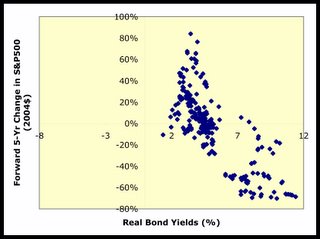
As we can see, this graph suggests that at present real bond yields, there is a lot of bullishness about bonds, meaning stocks may actually outperform bonds (delusion of crowds phenomenon). This woud be especially true if we believe concerns about inflation are overplayed.
Certainly there are many assumptions in this analysis, and this screw-up emphasizes why you should not take any one person's ideas too seriously!

First note that at high nominal yields, there is a direct correlation between those yields and ensuing performance. This would suggest the early phases of stock bull markets, where either inflation has investors fleeing bonds, or hype has them running to stocks (a la 1990s). But when we get to lower nominal bond yields, there appears little correlation between these yields and ensuing stock performance.
So what about my conclusions in the previous post on the need for capital preservation? Let's look at the data since 1981, when the era of hyperinflation ended.
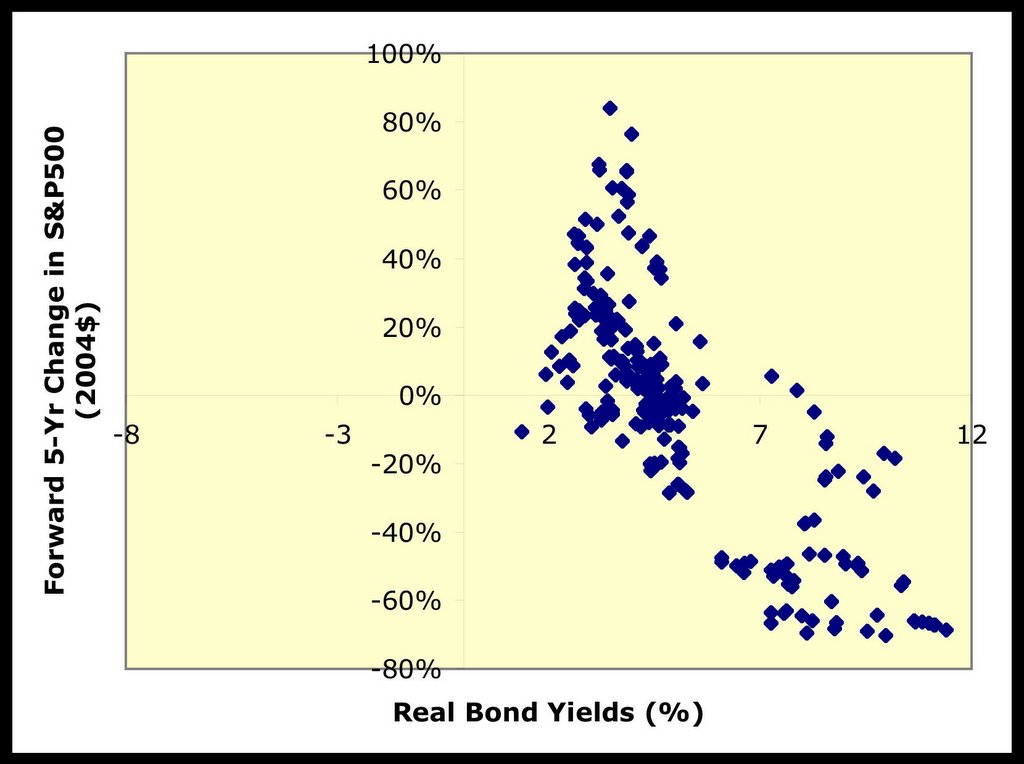
As we can see, this graph suggests that at present real bond yields, there is a lot of bullishness about bonds, meaning stocks may actually outperform bonds (delusion of crowds phenomenon). This woud be especially true if we believe concerns about inflation are overplayed.
Certainly there are many assumptions in this analysis, and this screw-up emphasizes why you should not take any one person's ideas too seriously!
Friday, November 25, 2005
The Case for Capital Preservation
Let me start by emphasizing that I am not an economist. No sir, my knowledge of economics is rather rudimentary. As an engineer, I try to predict (and hopefully understand) complex systems by a study of data. And in that spirit, I looked at returns that can be expected based on economic data from January 1963 to September 2005. (I talk about some assumptions and limitations further below)
My interest was to see what the historical record had to say about our historically low real bond yields, hovering just under 2% (real yields are yields minus inflation). If you look at the forward 5-year change in bond prices as a function of real bond yields, you notice at that present levels, bonds have been a good way to lose money.
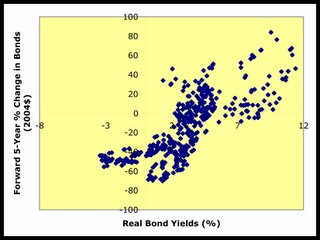
This is hardly surprising - low yields indicate high demand, and any value investor will tell you that when there is too much exuberance in the market, that asset will likely fall in price when investors realize the unsustainability in price.
So stocks are the way to go, right? After all, the fundamental principle of diversification is that stocks and bonds are inversely correlated. Well, not quite. If you look at the historical record, at present real bond yields, stocks have suffered quite badly in the ensuing years.
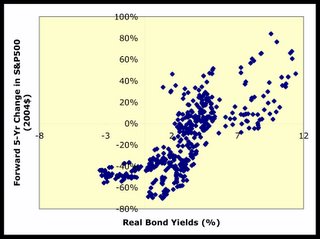
My first thought were that historical low real bond yields must have been associated with inflationary periods which killed businesses with high raw material costs. Unfortunately, this does not completely solve the puzzle, as plotting the data in terms of unadjusted (rather than real) prices shows similar trends.
Why this happens is a mystery to me, one I'd like to understand. If there's someone with an economics background or just a better understanding of these phenomena, please cue me in.
If this reasoning is correct, that makes the case for inflation-protected securities or CDs yielding above inflation. At last count, I-bonds were yielding (real) something like 1.6% (I think), while most CDs were closer to 0.75%. While an 4-8% real return over a 5-year period hardly seems appealing, the record suggests this may be better than rather significant losses in equities or fixed income assets.
OK, now for the less interesting (to many) details of assumptions and the weakness of my arguments.
(1) I assume that this limited (42 years) data set is sufficient.
(2) I assume that multiple factors are priced into real bond yields. While I did consider inflation above, the economy is a complex and nonlinear system, and it is questionable if real bond yields reflect the nonlinearities appropriately.
(3) I do not consider international investing. Correlations between international economies and the US are something to look at - I would argue that much of the Asia-Pacific economies are tied to the US, and a slowdown in the US economy would wreak havoc on these economies.
My interest was to see what the historical record had to say about our historically low real bond yields, hovering just under 2% (real yields are yields minus inflation). If you look at the forward 5-year change in bond prices as a function of real bond yields, you notice at that present levels, bonds have been a good way to lose money.
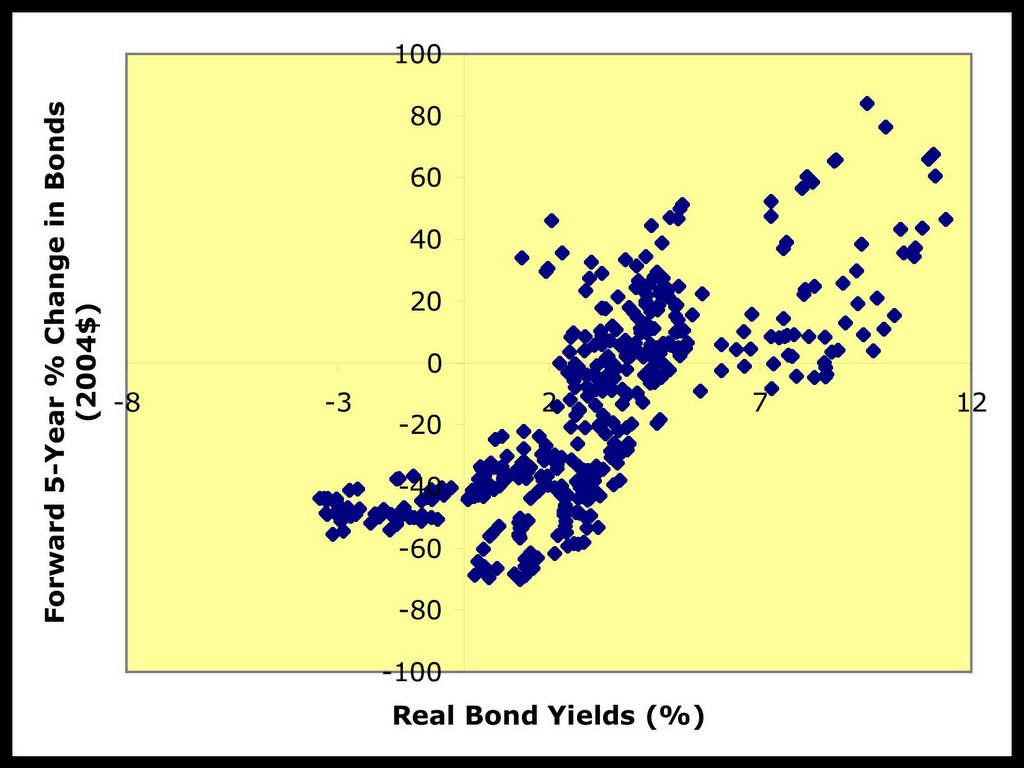
This is hardly surprising - low yields indicate high demand, and any value investor will tell you that when there is too much exuberance in the market, that asset will likely fall in price when investors realize the unsustainability in price.
So stocks are the way to go, right? After all, the fundamental principle of diversification is that stocks and bonds are inversely correlated. Well, not quite. If you look at the historical record, at present real bond yields, stocks have suffered quite badly in the ensuing years.
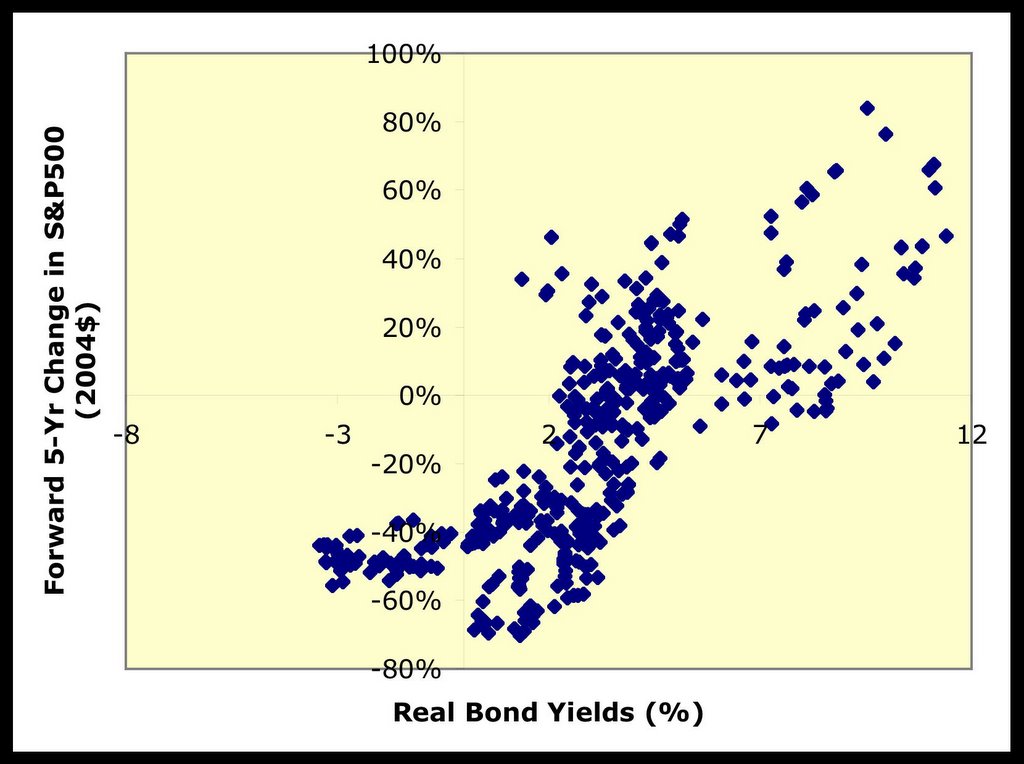
My first thought were that historical low real bond yields must have been associated with inflationary periods which killed businesses with high raw material costs. Unfortunately, this does not completely solve the puzzle, as plotting the data in terms of unadjusted (rather than real) prices shows similar trends.
Why this happens is a mystery to me, one I'd like to understand. If there's someone with an economics background or just a better understanding of these phenomena, please cue me in.
If this reasoning is correct, that makes the case for inflation-protected securities or CDs yielding above inflation. At last count, I-bonds were yielding (real) something like 1.6% (I think), while most CDs were closer to 0.75%. While an 4-8% real return over a 5-year period hardly seems appealing, the record suggests this may be better than rather significant losses in equities or fixed income assets.
OK, now for the less interesting (to many) details of assumptions and the weakness of my arguments.
(1) I assume that this limited (42 years) data set is sufficient.
(2) I assume that multiple factors are priced into real bond yields. While I did consider inflation above, the economy is a complex and nonlinear system, and it is questionable if real bond yields reflect the nonlinearities appropriately.
(3) I do not consider international investing. Correlations between international economies and the US are something to look at - I would argue that much of the Asia-Pacific economies are tied to the US, and a slowdown in the US economy would wreak havoc on these economies.
Wednesday, November 23, 2005
Stay Outa Faith Issues!
I think criticism of a Catholic school firing a pregnant unmarried teacher is really misguided. People send their kids to faith-based schools to help them inculcate the values of their faith, and teachers are supposed to be role models. To have a teacher obviously violate it and still be in the school confuses kids. As a Hindu Brahmin (a sect that abhors the consumption of animals), I would be outraged to find out a teacher in a school of my faith did not adhere to those same principles!
Secular schools just have to have different criteria than faith-based schools ... actually make that true for all types of institutions!!
Secular schools just have to have different criteria than faith-based schools ... actually make that true for all types of institutions!!
Tuesday, November 22, 2005
Save Your Identity
Some tips I just heard on the Clark Howard show:
* Never let your checkbook leave your house! If your check book is stolen, good luck saving your identity!
* If you have all the credit you need, opt out of pre-approved credit offers, by calling 1-800-5OPT-OUT
* Check your credit reports for suspicious activity. Added bonus: You can make sure your credit report is ok (Some 8 in 10 credit reports have errors!)
* Never let your checkbook leave your house! If your check book is stolen, good luck saving your identity!
* If you have all the credit you need, opt out of pre-approved credit offers, by calling 1-800-5OPT-OUT
* Check your credit reports for suspicious activity. Added bonus: You can make sure your credit report is ok (Some 8 in 10 credit reports have errors!)
Monday, November 21, 2005
Stupidity Award
OK, the latest person deserving on some kind of Nobel prize for Stupidity is this lady, who tried to open the door on a plane so that she could smoke. Shit, if you are scared of flying, that's one thing, but to actually try to open the jet door! And to think she got off with just a "good behavior bond"!!
Saturday, November 19, 2005
Quote of the Day
Rep. Mike Pence (R-IN), who wants Bush to show how the US is actually winning the war in Iraq:
This is football season. People want to know if we're winning or losing . . . what's the score ... just over 2,000 Americans dead, compared with 50,000 to 60,000 enemy combatants.
Thursday, November 10, 2005
Yuck! Say No to Fries!
The next time you feel inclined to shake your head at someone smoking or having a drink, disappointed at their choices in life, look at your own. I'm amazed at how many people who sneer at poor choices by others will not think twice before loading up on their favorite fried foods, be it french fries, or an ethnic delight like vadas (for my Indian audience!). Well, enjoy them if you must, but here's what it will do to you.
Wednesday, November 09, 2005
Blood Pressure? Sip this Java!!
Ok, just when I was trying to brainwash myself into accepting coffee is bad for you comes new research that coffee reduces blood pressure, at least in women. OK, so the difference isn't significant to justify drinking it, but it sure makes it seem a lot less evil, and hence a lot tougher to quit. (Whereas say, fried foods obviously clog your arteries and are easy to skip if you care enough about living a half-decent life!)
No, no, I still plan on gradually reducing my dependence and eventually quitting the need to have coffee, although I still hope to enjoy the nectar of the Gods ever so often.
No, no, I still plan on gradually reducing my dependence and eventually quitting the need to have coffee, although I still hope to enjoy the nectar of the Gods ever so often.
Sunday, November 06, 2005
Losing Weight
Men's Health Magazine had this piece on the new science of weight loss. Really quite interesting, and in some cases, counterintuitive. Here are some interesting facts:
* You could be increasing your body fat percentage by not eating! When your body needs energy, it burns muscle before fat, so if you don't get enough carbs, you burn muscle instead of fat!
* I have loved to bug my friends about this one - weight training is a MUCH BETTER method to lose weight than running or any other form of exercise. The difference is that weight training increases your resting metabolic rate (how many calories you burn while not exercising) and thus causes greater calorie burn.
There's a lot more, so I would read the story (even if you aren't a man!)
* You could be increasing your body fat percentage by not eating! When your body needs energy, it burns muscle before fat, so if you don't get enough carbs, you burn muscle instead of fat!
* I have loved to bug my friends about this one - weight training is a MUCH BETTER method to lose weight than running or any other form of exercise. The difference is that weight training increases your resting metabolic rate (how many calories you burn while not exercising) and thus causes greater calorie burn.
There's a lot more, so I would read the story (even if you aren't a man!)
Where's the Swagger?
Watching Bush the other day, I couldn't help thinking of how beleagured the President is. I mean, I had read of all his problems in the media, but it was nowhere more obvious than watching a press conference. Gone was the swagger and the charm, and instead was left a man who seemed excessively defensive. Bush needs to get back to what made him popular - besides conservatism, he got elected because he was a Washington outsider, not a seasoned politician with an eye fixated on the popularity scale. To redeem himself, Bush needs to come out strong on ethics issues, and fix his personal credibility, which has been tumbling. Don't play coy and refuse to comment - you are just adding yourself to the long list of politicians we hate. That's not how you became president, and certainly what people want.
As I complained in an earlier post, I was quite excited after the elections by a president who seemed ready to fix social security, healthcare, education, immigration. Instead we have gone nowhere. This second term is the most collosal waste of time we have experienced. Maybe he's waiting for elections to be done Nov 8? One can only hope so. Whether you are Republican or Democrat, you have to be frustrated at the lack of progress on so many issues.
As I complained in an earlier post, I was quite excited after the elections by a president who seemed ready to fix social security, healthcare, education, immigration. Instead we have gone nowhere. This second term is the most collosal waste of time we have experienced. Maybe he's waiting for elections to be done Nov 8? One can only hope so. Whether you are Republican or Democrat, you have to be frustrated at the lack of progress on so many issues.
Immigration Policy and Cheap Labor
It annoys me that a purpotedly business-friendly administration cannot fix our flawed immigration policy. Bush needs to look up from the problems with ethics and judges, and reevaluate his plans to fix a policy that encourages poor Mexicans to spend exhorbitant sums of money to get to the US, and then get scammed of their earnings, like these stories about Katrina cleanup workers not being paid. Capitalism is based on an understanding of supply and demand, and it's not rocket science to realize we have a real shortfall of cheap labor in this country.
Reading a biography on Greenspan, I found it interesting that economists (including those at the Fed) subscribed to a concept called NAIRU wherein unemployment rates below a threshold level trigger accelerating inflation expectations (for more on NAIRU, read this). I don't know if anyone has looked at how outsourcing and cheap labor may help reduce the NAIRU, but it certainly seems intuitively that the threshold should drop lower when there isn't supply constraints.
Reading a biography on Greenspan, I found it interesting that economists (including those at the Fed) subscribed to a concept called NAIRU wherein unemployment rates below a threshold level trigger accelerating inflation expectations (for more on NAIRU, read this). I don't know if anyone has looked at how outsourcing and cheap labor may help reduce the NAIRU, but it certainly seems intuitively that the threshold should drop lower when there isn't supply constraints.
Saturday, November 05, 2005
Damn Liberals and Iraq
Remember the pre-war days when liberals crooned that war was the wrong option, and that the US should follow the lead of Russia and France in pursuing diplomacy. Well, now that the Oil For Food program investigation is over, it turns out that, surprise surprise, companies in those countries, as well as many more, were getting fat violating UN sanctions and enriching Saddam's pockets.
On The McLaughlin Group on PBS yesterday, Eleanor Clift crooned about how the Bush administration lied about WMDs and implied we shouldn't have got rid of Saddam. This was a thug who tortured his people, invaded another country and then subverted a sanctions program, but don't count on leftist idiots to value all that. It was left to Mort Zuckerman to point out that every major intelligence agency in the world thought Iraq had WMDs, and indeed so did the Clinton administration.
Listen, it's tough stuff out there in Iraq, and there are innumerable risks, but in the end, I think it's the right signal that Bush gave that America will stand on the side of freedom. This is a sea change for a country that has often failed its role by supporting autocratic governments, and it is refreshing to see that the world's only superpower realize its responsibilites beyond its self-interest.
On The McLaughlin Group on PBS yesterday, Eleanor Clift crooned about how the Bush administration lied about WMDs and implied we shouldn't have got rid of Saddam. This was a thug who tortured his people, invaded another country and then subverted a sanctions program, but don't count on leftist idiots to value all that. It was left to Mort Zuckerman to point out that every major intelligence agency in the world thought Iraq had WMDs, and indeed so did the Clinton administration.
Listen, it's tough stuff out there in Iraq, and there are innumerable risks, but in the end, I think it's the right signal that Bush gave that America will stand on the side of freedom. This is a sea change for a country that has often failed its role by supporting autocratic governments, and it is refreshing to see that the world's only superpower realize its responsibilites beyond its self-interest.
The Source of Wage Losses
If you are wondering why there hasn't been a post in a while, it's because I spent the week in Cincinnati at a conference. Anyway, it's always good to be back home, although I come stressed out about just how much I need to do to get the elusive PhD.
On the theme of education, I liked this essay on the source of declining wages for low-skilled workers. Hint: it's not from outsourcing!
On the theme of education, I liked this essay on the source of declining wages for low-skilled workers. Hint: it's not from outsourcing!
Saturday, October 29, 2005
Greenspan's Legacy
As 'the Maestro' Alan Greenspan's tenure winds into its last leg and the excitement shifts to Bernanke, a introspection of Greenspan's achievements is in order. Very few news agencies have done so in a detailed and unbiased way. Most refer to Greenspan in mythical terms, the man who saved the US economy multiple times, the man who could do no wrong. So I thought a counterview was appropriate, and for that Forbes magazine is the place to be. To be fair to Alan, Forbes represents a group of supply-sides whose definition of a good Fed is no Fed.
James Grant's column is fairly critical of Greenspan's performance and record. Grant is a dollar-bear and gold-bull, in part because he thinks rising debts and poor fiscal policies do not bode well for any of the world's currencies (he does like Korean and South African currencies, but has in the past suggested dividend stocks in Korea instead - but this is not an investing post!)
James Grant's column is fairly critical of Greenspan's performance and record. Grant is a dollar-bear and gold-bull, in part because he thinks rising debts and poor fiscal policies do not bode well for any of the world's currencies (he does like Korean and South African currencies, but has in the past suggested dividend stocks in Korea instead - but this is not an investing post!)
Friday, October 28, 2005
Washington Stalling
I was truly excited at the start of Bush's new term as president. Here was a man who had a mandate, who talked about spending the "political capital" he had earned. Talked about reforming the fractured systems we endure, from a failing social security system to a obsolete education system.
Goals are great. But right now, Bush's second term's starting to look a lot like Clinton's. While the president's ethics have not been personally questioned, his aides and teammates are being battered. As I write this, Libby's joined the roster of injured players - soon after DeLay went down for questionable fund-raising. Karl Rove and Bill Frist look shakey. Harriet Miers withdraws her nomination. Bush's own approval ratings are sinking!
Is there hope for a new push forward? Don't count on it. Miers' fall is one of the worst things that could happen to our government, whether you are Republican or Democrat. Her qualifications may be questionable, but right now, Bush is in a quagmire. If he chooses a not-conservative-enough candidate, he can kiss his political future goodbye - his base will eat him alive. But a candidate who wins approval from them will face filibusters from the Democrats. In short, don't count on a new face on the bench anytime soon.
Why did Bush follow the brilliant nomination of John Roberts with such a disasterous choice? Did he not realize how charged an atmosphere he was stepping into?
Either way, let's look at momentum going forward on other issues. Will things improve in Iraq. Probably not. As countries which have dealt with insurgencies would tell you, you can't fix a place overnight, not even with the wonderous gift of democracy. It's a long and slow process, and I dare say that if the US is truly concerned about Iraqi stability, they should be prepared to hang out there for 10 years or more.
The legal woes for the Republicans are not likely to go away anytime soon. One of the problems with a party in power for too long is the arrogance that comes with it. The Democrats have been guilty of the same problem before.
And then add in candidates trying to distinguish themselves for elections in 2006 and the the Big One in 2008, and you have the death of unity in the ruling party. Add in an opposition that is confused and lost, struggling to come to new economic realities under the grips of powerful interest groups (yes, a union is a freaking interest group!) and you have chaos in Washington!
If anyone can find a way things might improve, and we see real change, positive change, do comment on it. Could even be far-fetched. After all, as I have been convincing some friends, the secret to happiness is delusion.
Goals are great. But right now, Bush's second term's starting to look a lot like Clinton's. While the president's ethics have not been personally questioned, his aides and teammates are being battered. As I write this, Libby's joined the roster of injured players - soon after DeLay went down for questionable fund-raising. Karl Rove and Bill Frist look shakey. Harriet Miers withdraws her nomination. Bush's own approval ratings are sinking!
Is there hope for a new push forward? Don't count on it. Miers' fall is one of the worst things that could happen to our government, whether you are Republican or Democrat. Her qualifications may be questionable, but right now, Bush is in a quagmire. If he chooses a not-conservative-enough candidate, he can kiss his political future goodbye - his base will eat him alive. But a candidate who wins approval from them will face filibusters from the Democrats. In short, don't count on a new face on the bench anytime soon.
Why did Bush follow the brilliant nomination of John Roberts with such a disasterous choice? Did he not realize how charged an atmosphere he was stepping into?
Either way, let's look at momentum going forward on other issues. Will things improve in Iraq. Probably not. As countries which have dealt with insurgencies would tell you, you can't fix a place overnight, not even with the wonderous gift of democracy. It's a long and slow process, and I dare say that if the US is truly concerned about Iraqi stability, they should be prepared to hang out there for 10 years or more.
The legal woes for the Republicans are not likely to go away anytime soon. One of the problems with a party in power for too long is the arrogance that comes with it. The Democrats have been guilty of the same problem before.
And then add in candidates trying to distinguish themselves for elections in 2006 and the the Big One in 2008, and you have the death of unity in the ruling party. Add in an opposition that is confused and lost, struggling to come to new economic realities under the grips of powerful interest groups (yes, a union is a freaking interest group!) and you have chaos in Washington!
If anyone can find a way things might improve, and we see real change, positive change, do comment on it. Could even be far-fetched. After all, as I have been convincing some friends, the secret to happiness is delusion.
Rosa Parks
I have been so busy I haven't had the time to mourn the passing of Rosa Parks. Here was an ordinary lady who made an extraordinary contribution to the history of this country by a simple act of resistance. She truly is a testament to the potential of one individual to change society, and is a breath of fresh air in the stench of cynicism that exists around us.
Monday, October 24, 2005
Sangkeertanam
This is for my Tamil audience interested in some incredible devotional songs. Sangkeertanam is a wonderful collection of songs produced (I think) by Bro. Jega from Malaysia and Rekha Ravindran (who I think is also from Malaysia), and is available online at the Sangkeertanam page at Tamilsongs.net. It features such accomplished singers as Unnikrishnan and SPB. The pick of the album, for me and my "karmic brother" Shiva, is Vazhavaipai Thayee, and especially the version by O.S.Arun, which practically gives me goose bumps every time I hear it. It's very much like a ghazal (or maybe is one?).
Incidentally, I'm not quite sure how if accomplished this, but when I checked it out from home, it had the words in Tamil, but at school, the song names were in English! Evidentally a script that checks for availability of a font or the like. But if you find gibberish, don't worry, the links still work.
Incidentally, I'm not quite sure how if accomplished this, but when I checked it out from home, it had the words in Tamil, but at school, the song names were in English! Evidentally a script that checks for availability of a font or the like. But if you find gibberish, don't worry, the links still work.
Friday, October 21, 2005
Bush in Rummy mode
Here's an excerpt of what Bush at his press conference with Palestinian leader Mahmud Abbas in the Rose Garden, in response to reporters' queries on Harriet Miers.
Sounds a bit like a certain Defense secretary? I don't know if he intended it, but towards the end, he certainly was grinning! Of course, he's got a long way to go before he can reproduce Rumsfeld's gems ... here's one of his classics, at a Pentagon briefing on February 12, 2002 (read it aloud, and only once to get the right effect!)
...the questionnaire that she filled out is an important
questionnaire, and obviously they will address the questions that the senators have in the questionnaire -- or as a result of the answers to the questions in the questionnaire.
Sounds a bit like a certain Defense secretary? I don't know if he intended it, but towards the end, he certainly was grinning! Of course, he's got a long way to go before he can reproduce Rumsfeld's gems ... here's one of his classics, at a Pentagon briefing on February 12, 2002 (read it aloud, and only once to get the right effect!)
Reports that say that something hasn't happened are always interesting to me, because as we know, there are known knowns; there are things we know we know. We also know there are known unknowns; that is to say we know there are some things we do not know. But there are also unknown unknowns - - the ones we don't know we don't know. And if one looks throughout the history of our country and other free countries, it is the latter category that tend to be the difficult ones.
Quotes of the Day: WARNING Politically Incorrect
Bill Maher's Rules in his latest book 'New Rules':
This one's less PI but still a good one.
Pasta la Vista
New Rule
If you're in Iraq and you even sort of think you might be kind of near a checkpoint . . . stop. Otherwise, don't be surprised if we shoot your car. Haven't you seen a single American movie, television show, or news story from the last 60 years? That's what we do: We shoot cars. Does the name Elvis ring a bell? Richard Pryor? Lee Harvey Oswald? I know it's hard for foreigners to understand, but in America we shoot first and ask questions rarely.
This one's less PI but still a good one.
Pay Ball!
New Rule
Stop saying that athletes do it for the love of the game. They do it for the love of their 32-room mansion with the live shark tank in the living room. Bass fishermen do it for the love of the game, which is why so few of them have agents. If pro sports paid minimum wage, Shaquille O'Neal would be a bouncer at Scores, and Anna Kournikova would be a mail-order bride from Minsk.
Thursday, October 20, 2005
Quote of the Day: Eddie George
Veteran running back, Eddie George, who is only the second NFL running back to run over 10,000 yards without missing a start:
That's for all you people who think yoga's for sissies! Incidentally, EG is on the cover of the book 'Real Men Do Yoga', and I can attest (although it's feeble compared to EG) that yoga has helped my weight training and stress management.
As a running back, you’re basically using your body as a battering ram. And I end up pinned in some really awkward positions. I thought if my muscles were more flexible and had experienced some of those stresses beforehand in yoga, I’d be less likely to get hurt.
That's for all you people who think yoga's for sissies! Incidentally, EG is on the cover of the book 'Real Men Do Yoga', and I can attest (although it's feeble compared to EG) that yoga has helped my weight training and stress management.
How Much for Retirement?
Choose to Save has this interactive calculator for determining how much you would need to save for retirement. It's only a ballpark estimate, and is sensitive to model inputs, but does exactly what it suggests - give you a ballpark estimate. If you are saving less than this for retirement, time to cut out of those fancy dinners and start ploughing more in. If you are single, I would say you need to exceed those estimates - remember, if and when you do have kids, you will have to put aside substantial amounts of money for their college education (currently, a decent 4-year program would set you back as much as $100,000 and it is likely that tuition inflation would be greater than overall monetary inflation)
Sunday, October 16, 2005
Hero Hoagland
My latest hero is Principal Hoagland, who put his foot down and cancelled the prom rather than allow it to become a vulgar display of affluence, and an excuse for a sex party. That a Catholic school, where presumably parents send their kids to escape the weak standards, academic and otherwise, of public schools, had degenerated to this was sad. But thankfully at least one educator seems to think we are headed in the wrong direction. Cheers to you! Now I would introduce into the curriculum a service component, where rather than the school going to Disneyland or some stupid trip, they go down to Mexico and solve the problems of their brethren. And if any parents don't seem keen about it, well, then let them take their kids to a school that does not have a mandate to impart values! All schools, but especially faith-based schools, whatever faith they represent, have a central covenant - mould the character of the pupils.
LIVE STRONG!
USNews had this story you have to read about being the husband of a breast cancer patient. Stop! Don't run away just because your wife is fine, or maybe you aren't married or whatever. This is a story worthy of reading, because it teaches us some important things about being in a relationship (whatever the relationship) with someone suffering from a terrible disease.
Live Strong, but also Live with Love and Compassion
Live Strong, but also Live with Love and Compassion
Saturday, October 15, 2005
Socialism In Action
This story speaks to the inefficiencies in socialist economies - an analysis of the Delhi Jal Board, the water utility of India's capital city Delhi. Even my non-Indian readers will want to read this, especially the comparison between the performance of the utility companies in "booming" India and the forgotten Ivory Coast. This is the reality that you need to keep in mind the next time you think the government should take over an industry (think Democratic calls to have the Feds run refineries to compete with those 'evil capitalists' profiting from Hurricane Katrina). The reality is efficiency is the product of a need to survive. Think if you were guaranteed an 'A' in a course without having to study, how much time would you invest in the course?
Some notes before you read the link: 1 crore = 10 million, Rs 50 is just over a dollar, although I find a conversion of 8X works better in adjusting for purchasing parity (so someone making Rs 800,000 a year truly makes about $16,000, but lives like someone who would make $100,000)
Some notes before you read the link: 1 crore = 10 million, Rs 50 is just over a dollar, although I find a conversion of 8X works better in adjusting for purchasing parity (so someone making Rs 800,000 a year truly makes about $16,000, but lives like someone who would make $100,000)
Friday, October 14, 2005
Prices Can Go Down
In recent times the popular press has been obsessed with the real estate bubble, which is why I have stopped writing that much about the issue. But this story (and accompanying table) reinforce what I have said in the past - real estate prices can go down!
Thursday, October 13, 2005
Quote of the Day
President John F. Kennedy welcoming 49 Nobel Prize winners to the White House in 1962:
Disclaimer: I go to the University of Virginia, founded by good ol' TJ, so anything associated with him has almost mystical status!
I think this is the most extraordinary collection of talent, of human knowledge, that has ever been gathered at the White House, with the possible exception of when Thomas Jefferson dined alone.
Disclaimer: I go to the University of Virginia, founded by good ol' TJ, so anything associated with him has almost mystical status!
We Want to Underpay!
I was watching an interview on PBS' Newshour with China's Vice Chairman Cheng Siwei yesterday, and in some ways I found it quite interesting. I could write several blog postings about the interview, but you'd be better off reading (or watching in streaming video or hearing on streaming audio) the whole interview at the Newshour page. The one thing that did strike me during the course of the interview (indirectly) was that essentially the US wants to underpay its debt to the Chinese! How? Well, we have built this huge surplus with China, all along paying for it with IOUs (Chinese buying Treasury bonds). Well, all the talk of revaluation has focused on our desire to reduce the trade deficit, which is probably true. However, one point that's missed out is that if China revalues the yuan, the debt in $ is now worth less yuan. You can then see why the Chinese have a good reason not to be thrilled about having to lose even the measly return they have been getting on Treasuries.
Tuesday, October 11, 2005
Brace Yourself for Rough Times!
Man, this is not the happiest time to be an investor. The specter of inflation and recession loom large. Two respected writers have argued for one or the other. Bill Gross of PIMCO, aka Bond King (more like Bond God!) argues that rising interest rates will cause the bursting of the housing bubble, triggering a US recession. If this is the case, stocks will be pummeled as corporate profits plunge.
David Dreman of Forbes, on the other hand, argues that inflation will be a killer, and that locking in interest rates would be murderous for your investments.
Hmm, funny how no one seems to talk of stagflation. If prices of crude, copper and other commodities continue to surge, fueled by growing demand, isn't it foreseeable that the Fed has its hands tied? Or if the US Treasury is forced to print money to pay its debts, then you have a situation where you have too much money and slow economic growth. I'm no economist, so if there's someone who understands this stuff better than I, clue us all in.
David Dreman of Forbes, on the other hand, argues that inflation will be a killer, and that locking in interest rates would be murderous for your investments.
Hmm, funny how no one seems to talk of stagflation. If prices of crude, copper and other commodities continue to surge, fueled by growing demand, isn't it foreseeable that the Fed has its hands tied? Or if the US Treasury is forced to print money to pay its debts, then you have a situation where you have too much money and slow economic growth. I'm no economist, so if there's someone who understands this stuff better than I, clue us all in.
Monday, October 10, 2005
Seventh Heaven
I really liked this story on Stephen Collins of Seventh Heaven fame, in part because I used to really like the show. I haven't watched it since moving to Charlottesville two years ago (where we don't have a WB station), but my recollection is the show, intended originally for a teen audience, represented the type of TV I'd like to see. It's not too surprising (but sad!) to read how WB and the entertainment shows never gave 7H its due, more keen to promote shows with generous amounts of sexuality and violence.
Quote of the Day
Sen. John McCain (R-AZ) when asked to comment if he would accept a slot for the Vice-Presidency in 2008:
I spent all those years in a North Vietnamese prison camp, kept in the dark, fed scraps, why the hell would I want to do that all over again?
Earthquake Victims
Our prayers and thoughts are with the victims of the terrible quake in Kashmir and the tragic loss of life. I hope the inept bureaucracies of India and Pakistan can get their acts together to prevent a further exxageration of their misfortune.
Saturday, October 08, 2005
Church and State
I was listening on the radio about how the Bush administration wants to reimburse faith groups for expenses incurred during Hurricane Katrina. While this may be good in the short term, I think the Faith-Based Initiative at the federal government with spell the deathknell of faith-based initiatives. No, I'm not just concerned about the influence of church on state. I am much more concerned about the influence of state on church.
Look at it. Right now, the top states for personal giving are the Red states (incidentally, why on earth are conservative states called Red, which is elsewhere synonymous with Communism?) Why? Because people in these states believe in a moral and religious obligation to help humanity. In the blue states, people think their obligation is to pay taxes so that the government can take care of the needy. (OK, these are simplifications, but you get the idea!) Knowing a church gets federal support means less individuals will contribute, churches will swell with "entitlement money" and soon churches will be indistinguishable from the inefficient bureacracies we are bestowed with!
Also, while the present government may not seek to have strings attached, what prevents a future government from dictating moral and social terms to future dependent faith groups? If a church believes, for example, that homosexuality is a sin, is it for government to dictate that they must hire gay priests? I think not. Heck, I say if a faith group believes white people are superior, I as a man of color would disagree with them, I would sue a company which tried to impose such views, but believe the religious groups are within their rights to pick only white people in their clergy, as long as they do not get federal money.
That's why I think Salvation Army is on a slippery slope. It cannot long-term depend on state money and yet chose to hire only those who conform with their article of faith. But rather than demand the Salvation Army hire non-Christians like me, I would suggest they get out of the government money handling business, and ask Him to assist in His mission.
Look at it. Right now, the top states for personal giving are the Red states (incidentally, why on earth are conservative states called Red, which is elsewhere synonymous with Communism?) Why? Because people in these states believe in a moral and religious obligation to help humanity. In the blue states, people think their obligation is to pay taxes so that the government can take care of the needy. (OK, these are simplifications, but you get the idea!) Knowing a church gets federal support means less individuals will contribute, churches will swell with "entitlement money" and soon churches will be indistinguishable from the inefficient bureacracies we are bestowed with!
Also, while the present government may not seek to have strings attached, what prevents a future government from dictating moral and social terms to future dependent faith groups? If a church believes, for example, that homosexuality is a sin, is it for government to dictate that they must hire gay priests? I think not. Heck, I say if a faith group believes white people are superior, I as a man of color would disagree with them, I would sue a company which tried to impose such views, but believe the religious groups are within their rights to pick only white people in their clergy, as long as they do not get federal money.
That's why I think Salvation Army is on a slippery slope. It cannot long-term depend on state money and yet chose to hire only those who conform with their article of faith. But rather than demand the Salvation Army hire non-Christians like me, I would suggest they get out of the government money handling business, and ask Him to assist in His mission.
Tuesday, October 04, 2005
OpenOffice Sucks!
Much is being made of Google's tieup with Sun which, as I understand it, will improve penetration of OpenOffice. Now, I'm no techie, but I have used OpenOffice, and there's no way it's going to be a serious challenge to Office in the near-term. Despite the hype about Office portability, OpenOffice fails to open highly formatted content appropriately, and lacks many of the features that Office has.
I understand a lot of people are anti-Microsoft (I use a Mac at work because my advisor is one of them!) But the reality is Microsoft makes a good product, and has the scale to automatically give it an edge on competitors. Yes, Google has those same attributes too, plus the "cool" buzz, but it's going to take a lot more to unseat Microsoft.
I understand a lot of people are anti-Microsoft (I use a Mac at work because my advisor is one of them!) But the reality is Microsoft makes a good product, and has the scale to automatically give it an edge on competitors. Yes, Google has those same attributes too, plus the "cool" buzz, but it's going to take a lot more to unseat Microsoft.
Sunday, October 02, 2005
Tree Climber
I thought about this story yesterday, and while I have posted it a while back, I decided I wanted to post it again, and not just a link to the old post. So here goes my rant again ...
While I am often bothered by the nature of disparity, I was particularly moved by something that happened this week. I went to bed reading the story of a panaiyeri nadar, a tree-climber in my home state of Tamil Nadu, a story typical for many in his profession. His job is to extract date palm jaggery from the trees, for which purpose he has to climb the tree, extract the juice with a knife, and on to the next tree. He has no safety harness or other protective gear, and a fall guarantees death, or worse serious injury that could spiral his family into serious debt. He often has to climb upto 150 trees, each at least 15 to 20 feet in height. That's about the same as climbing 250 floors up a staircase, except he has no staircase or even ladder - just his bare palms and legs. He starts working at 3 am in the morning, and gets done about 6 in the evening. The fruits of his labor? About Rs. 5-8 (under US 20 cents!) a day ... oh and muscle pains, asthma and a host of other ailments!!
I woke up the next morning, and turned on my TV to discover it was National Splurge Day - and we were being shown how we could splurge (if we had the money!) ranging from caviar to $200,000 diamond earrings to a Merc wheels that set you back close to 400 grand! Sure, spend, revel in luxury ...
This bothers me a whole deal, and I'm no commie or leftie! I don't believe the Government should necessarily be a constant presence in our lives. But I do believe that we are humans, and humanity is what distinguishes us from the beasts of the jungle. How can people not be bothered by the extreme poverty that besets so many in the world? And I don't mean just the rich. How far would the $2000 you spent on a home theater system gone in those parts? How many palaiyeri nadars would have had access to a more supportive system?
Yes, governments are supposed to do that, but it's obvious that for many in the Third World, governments have failed them. But ask yourself, if a loved one were in need of medical attention, and the state-sponsored medical system (Medicare in the US) refused to provide any assistance, would you turn a blind eye to their plight?
Religions love to talk about the great attributes of their leaders. And yet, how is it that so many who tout the virtues of Christ, Mohammed, Rama, Buddha fail to attempt to replicate their compassion?
How about envisioning a year, nay a day as a panaiyeri nadar?
You're fired!
I was reading this story on CNN about how great online banks are, when I came across this excerpt.
Whoa, never heard of that before. I'm not surprised or outraged - I mean, you can't kill the goose that lays the golden egg, but that's still radical, and the number is much higher than I would have imagined!
And if you're looking to have your hand held, online accounts are not for you. ING Direct, for instance, closes an average of 3 percent to 4 percent of accounts a month, when customers require too much personal service.
"We fire our customers is a colorful way of putting it," said ING Direct's Kuhlmann. "While the banking business says the customer is always right, we're online guys and you can only do business with us in a certain way."
He added that it just isn't cost effective to maintain high maintenance customers that need more personalized attention.
Whoa, never heard of that before. I'm not surprised or outraged - I mean, you can't kill the goose that lays the golden egg, but that's still radical, and the number is much higher than I would have imagined!
Subscribe to:
Posts (Atom)